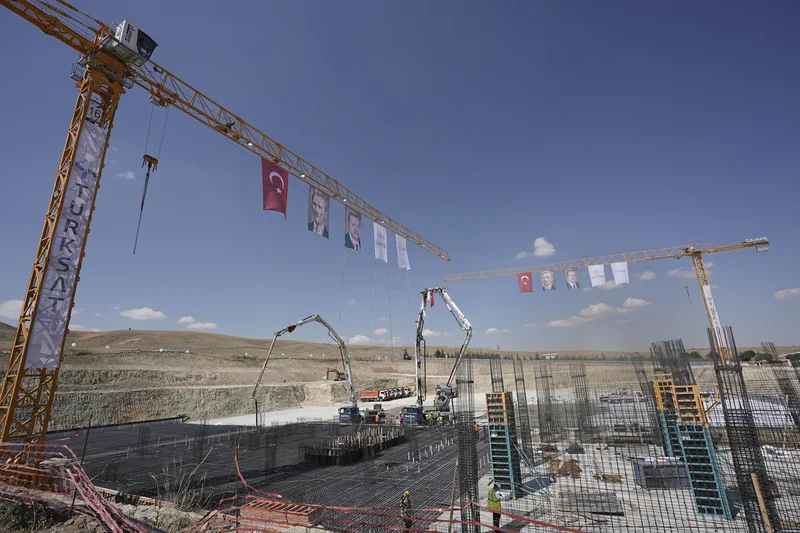
Türkiye on Wednesday laid the foundation for a new flagship data center that it says will strengthen the country's digital sovereignty, cybersecurity resilience and artificial intelligence infrastructure, as it seeks to expand domestic control over critical digital assets.
Speaking at the groundbreaking ceremony, Transport and Infrastructure Minister Abdulkadir Uraloğlu described the facility of the state-owned satellite communications firm Türksat in the capital Ankara as "Türkiye's new digital fortress."
Uraloğlu stressed the center would ensure that critical data remain within the country's borders. "We are establishing sovereignty over our data on our own soil," he said. "This is not just a concrete structure, but Türkiye's new digital fortress."
The project forms part of Ankara's strategy to expand domestic digital infrastructure and reduce reliance on foreign technology providers amid growing geopolitical competition over data, artificial intelligence and cyber capabilities.
Uraloğlu said the facility would include six system halls, two high-performance computing rooms with 20 cabinets each, 6,300 square meters (67,800 square feet) of white space and office space for 200 employees.
Infrastructure and Transport Minister Abdulkadir Uraloğlu (C) attends the groundbreaking ceremony for the Türksat Gölbaşı Data Center, Ankara, Türkiye, July 22, 2026. (DHA Photo)
Once completed, the campus will span 35,300 square meters, making it one of Türkiye's largest data centers. It will have an installed power capacity of 33 megavolt-amperes, while the physical capacity of Türksat's existing data center will increase threefold in the first phase and more than eightfold after the second phase, he said.
The center is being designed to meet LEED Gold energy-efficiency standards and will feature low-carbon construction.
Regional data hub
Uraloğlu said the facility would house dedicated infrastructure for AI applications, including machine learning, deep learning, data mining, model training and high-performance computing.
The data center will also provide cloud and data services for institutions handling critical information using domestically developed software, with particular emphasis on supporting Türkiye's e-Government platform and other public digital infrastructure, he added.
According to Uraloğlu, the center will be capable of maintaining uninterrupted operations during emergencies while helping reduce duplicated public-sector investments by consolidating cloud and data services under a single platform.
The minister said the facility could also position Türkiye as a regional data hub by offering secure hosting services to neighboring countries and Turkic states.
The illustration photo of the Türksat Gölbaşı Data Center. (DHA Photo)
Construction is expected to be completed within about 18 months, with operations scheduled to begin in early 2028.
Satellite expansion
Uraloğlu also outlined Türkiye's expanding satellite ambitions, noting that Türksat currently operates six active satellites at orbital positions of 31, 42 and 50 degrees east, providing coverage to an estimated 5.5 billion people, roughly two-thirds of the world's population.
He said the domestically developed Türksat 6A, produced with more than 80% local content, has enabled Türkiye to become one of only 11 countries capable of designing and manufacturing communications satellites.
The satellite's coverage has recently expanded across South Asia, providing broadcasting services in 10 countries including Pakistan, India, Bangladesh, Malaysia and Indonesia. Türksat now broadcasts a total of 550 television channels via its satellite fleet, including 69 channels through Türksat 6A's South Asia coverage.
Uraloğlu also said Türkiye plans to sign a contract for the Türksat 7A satellite project before the end of the year.
The satellite, scheduled to enter service by the end of 2029, will replace the aging Türksat 3A and offer higher data capacity, broader coverage and more flexible resource management.
Uraloğlu also recalled that Türksat had recently signed a strategic partnership with Qatar-based satellite operator Es'hailSat to jointly utilize capacity on the future Es'hail-3/Türksat-Biruni satellite at the 50-degree east orbital slot.
The Daily Sabah Newsletter
Keep up to date with what’s happening in Turkey,
it’s region and the world.
SIGN ME UP
You can unsubscribe at any time. By signing up you are agreeing to our Terms of Use and Privacy Policy.
This site is protected by reCAPTCHA and the Google Privacy Policy and Terms of Service apply.