- READ MORE: Expert-approved hacks for tackling jet-lag: From packing essentials to 45-minute naps
- See more Daily Mail on Google - save us as a Preferred Source
Millions of Brits heading abroad this summer could lose the first two days of their holiday to a 'holiday sleep hangover', a sleep expert has warned, with the effects of disrupted travel lingering long after they return home.
New research found that over three quarters of Brits (76 per cent) admitted travelling affects their sleep – while more than two in five admit tiredness affects at least the first day of their holiday.
Data analysed by sleep technology firm Simba shows nearly 18 per cent of Brits have already booked or are planning to book a trip abroad this summer, meaning more than 23 million adults could experience holiday-related fatigue.
Lisa Artis, Deputy CEO of Simba's charity partner, The Sleep Charity, says the so-called 'holiday sleep hangover' is caused by a combination of early airport starts, disrupted routines, poor sleep while travelling, unfamiliar hotel rooms and jet lag.
'The holiday sleep hangover has become the hidden physical and mental cost of modern travel. Sleep disruption usually starts much earlier and can continue long after you've unpacked your suitcase,' she said.
Lisa Artis, Deputy CEO of Simba's charity partner, The Sleep Charity, claims millions of Brits could lose at least two days of their holiday abroad due to a 'holiday sleep hangover'
Nearly 14 per cent of 1,000 surveyed UK adults lose at least the first two days of their trip to tiredness, while over 25 per cent need several days to recover after coming home.
Nearly one in four (24.3 per cent) even admitted they feel like they need another holiday to recover from the one they've just taken.
Lisa believes many travellers are already sleep deprived before they even leave home due to a range of factors, including travel anxiety, excitement and early alarms.
More than a quarter of respondents (26.1 per cent) said they sleep worse than usual the night before travelling, while one in five (22.1 per cent) manage just three hours of sleep or less.
Despite nearly one in five (17.6 per cent) reaching their destination feeling completely drained, 19.2 per cent still continue to book very early morning or late-night flights.
Lisa added: 'If you're up at 3am for an airport transfer after a restless night's sleep, you're already asking your body to function on less recovery than it normally would. That sleep debt can follow you into the first few days of your trip.'
'It can be tempting to over-optimise the night before you travel. But trying to force a really early night can make it harder to switch off. You end up clock-watching and feeling more alert.'
To combat this, the expert recommends sticking to a normal bedtime before travelling rather than trying to force an early night, which can make it harder to fall asleep.
The research also found nearly one in three Brits (29.9 per cent) struggle to sleep on a plane, especially in seats that offer little leg room.
Lisa suggests choosing a window seat near the middle of the aircraft, where there are fewer interruptions and turbulence tends to feel less noticeable. She also recommends avoiding seats close to toilets and galleys where possible.
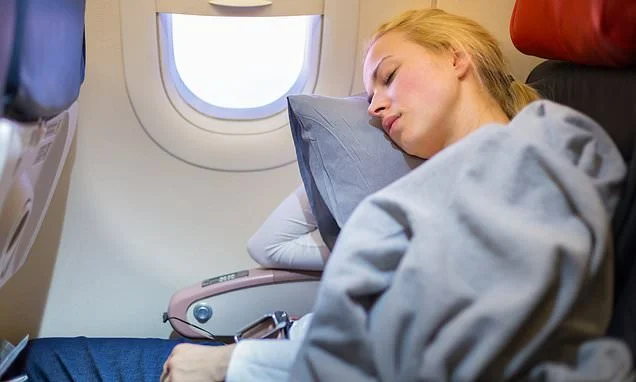
Where you sit on the plane can also impact your sleep schedule, with Lisa suggesting travellers sit in a window seat for the best chance of nodding off without interruptions
A window seat also provides an ideal space to rest one's head, while seats closer to the wings offer a more stable position for nervous flyers or those sensitive to turbulence.
The expert also suggests airport drinks could also be adding to the problem, with almost one in five travellers (19.4 per cent) revealing they usually enjoy an alcoholic drink before or during their journey.
She warned: 'The higher the alcohol content, the stronger the dehydrating effect tends to be.
'Spirits such as vodka, gin, rum and whisky contain a much higher concentration of alcohol than drinks like beer or wine, so they can contribute more significantly to dehydration if consumed in large amounts.'
While Lisa says there's no need to skip the holiday tradition altogether, she recommends alternating alcoholic drinks with water to reduce dehydration during the flight.
Even after arriving at a destination, getting a good night's sleep isn't always guaranteed.
More than one in five Brits said they rarely sleep well on their first night away, with unfamiliar surroundings making it harder to switch off.
Lisa suggests packing a pillowcase from home, avoiding long afternoon naps after arrival and getting outside in daylight as soon as possible to help the body adjust.
But the problem doesn't end when the holiday does, as nearly one in five respondents (18.3 per cent) said they feel more exhausted during their first week back at work than they did before going away.
In addition, more than a quarter (27.5 per cent) said travel-related tiredness affects them for at least two days after returning home.
According to the expert, recovery depends on how far holidaymakers have travelled and how many time zones they've crossed, with eastward journeys generally taking longer to recover from than westward ones.
Nonetheless, she suggests a good sleep setup – like supportive pillows and cooling sheets – can help the body get back to a normal sleep routine after a trip.
Lisa said: 'Your sleep environment can help speed up recovery. When you’re trying to get your routine back on track, comfort and temperature become important.
'If you’re waking because you’re too hot, too cold or uncomfortable, it can make recovery feel slower.
'The goal isn't perfection. It’s giving your body the best possible conditions to recover. A holiday should leave you feeling refreshed, not like you need another week to get over it.'