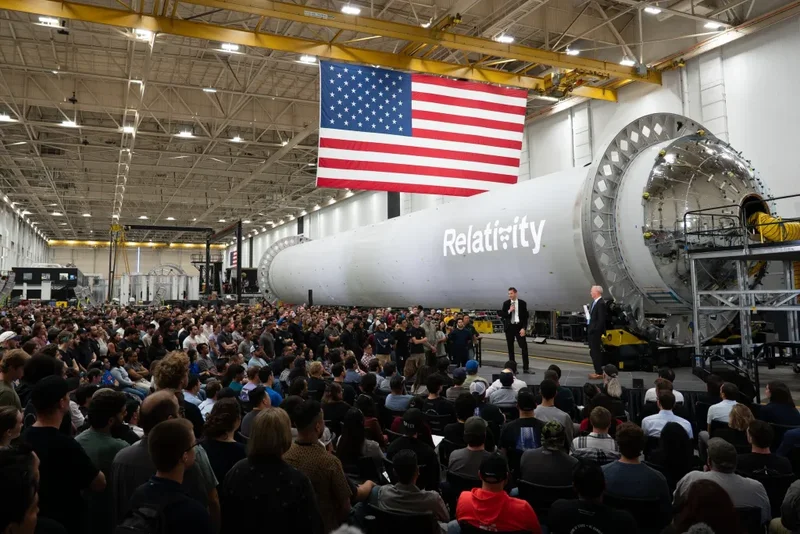
WASHINGTON — Relativity Space struck a deal with Space Florida to build manufacturing and test facilities for its Terran R rocket on Florida’s Space Coast.
Space Florida, the state’s space development and financing authority, announced July 21 that it signed an agreement to help finance construction of a new production facility for the company’s Terran R rocket near Cape Canaveral.
The agreement also includes a commitment by Relativity Space to expand test and launch infrastructure at Kennedy Space Center (KSC) and Cape Canaveral Space Force Station. The Florida Department of Transportation will provide up to $134 million in financing for those projects through its Spaceport Improvement Program.
“Expanding our capacity in Florida enables our ability to scale the Terran R program to support commercial, scientific and national security missions,” Eric Schmidt, chief executive of Relativity, said in a statement.
The new production facility, whose exact location was not announced by the company or Space Florida, would be in addition to Relativity’s existing factory in Long Beach, California. The company did not disclose a schedule for the factory, although Space Florida said the investments would create “thousands of high-paying new jobs” in the state by the end of 2034.
Relativity is developing Terran R, a medium-lift launch vehicle with a reusable first stage. The company will conduct launches from Cape Canaveral’s Launch Complex 16.
Relativity has issued a regular series of updates on development of Terran R and upgrades to the launch site, but has not recently stated when it expects the rocket to be ready for its first launch. The company, though, was recently added to the Space Force’s National Security Space Launch Phase 3 Lane 1 contract, making it eligible to compete for future launches by the service that do not require the highest levels of mission assurance reserved for Lane 2 missions.
A Florida production facility for Terran R, besides providing additional capacity, could improve the company’s logistics. In recent updates, Relativity noted it transported a Terran R second stage from its California factory to NASA’s Stennis Space Center in Mississippi for testing by ship through the Panama Canal, suggesting it will have to take the same approach to transport stages to its Florida launch site.
Launch capacity concerns
Florida officials hailed the deal. “Relativity is exactly the partner that helps advance our mission to solidify Florida as the world’s hub for aerospace commerce,” Rob Long, president and chief executive of Space Florida, said in a statement.
“This project is a win for Florida’s commercial space economy and is the direct result of how our infrastructure, strategy and talent ecosystem makes Florida the inevitable choice. We look forward to actively helping them grow in our state,” he added.
What has attracted many space companies to Florida is access to launch sites at Cape Canaveral. However, those sites have become increasingly congested as launch activity increases. A report in June by NASA’s Office of Inspector General warned that KSC could reach capacity by 2029 as growth in launch activity outstrips infrastructure there.
“The Cape was developed for a different space industry and program, and the infrastructure is challenged,” acknowledged Brian Hughes, director of KSC, during a July 21 panel discussion at Florida House here. “But the beauty of strategic planning is a lot of important legwork has been done at Kennedy to continue to stay ahead of the curve.”
He cited legislation recently introduced by Sen. Ashley Moody, R-Fla., and Rep. Mike Haridopolos, R-Fla., that would address some of those issues. The Space Ready 2.0 Act would establish a pilot program to allow NASA to accept voluntary contributions from industry to fund infrastructure upgrades at centers like Kennedy Space Center.
“Those needs, if they relied on the federal taxpayer alone, the pace could get off here in the near future,” Hughes said. “But the beauty is, we don’t have to have as much concern about that because of what’s emerging.”
“We want to go and talk about all those great things in space, but you got to get off the ground, right?” said Mike Miller, vice president of external affairs at Space Florida, on the panel. “So you have to have the roads, the bridges, the wastewater, the LNG, all those things, and those are challenges.”
He said Space Florida had a good relationship with both NASA and the Space Force to enable that increase in launch activity. “We are trying to support what is the greatest American endeavor of all.”