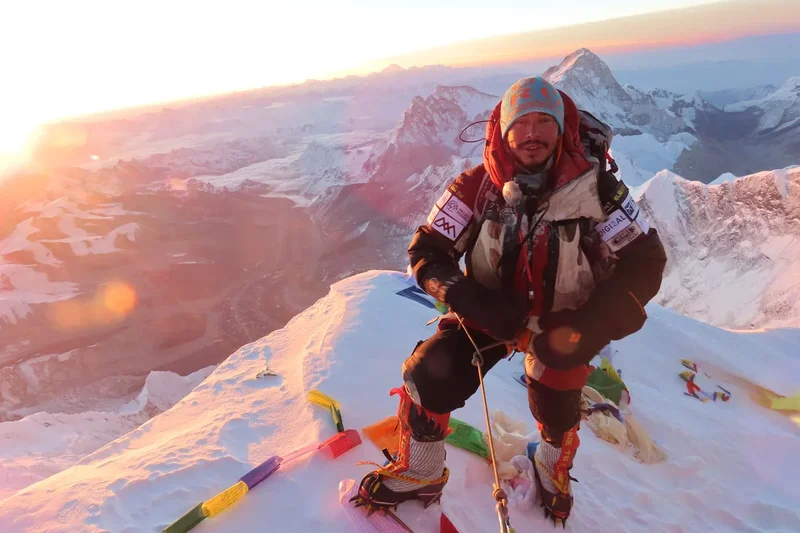
“Giving up is not in the blood, sir. It’s not in the blood.”
Nirmal Purja’s line, immortalised in a 2021 Netflix documentary, came to define the high-altitude mountaineering star’s relentless pursuit of seemingly unattainable goals.
Purja died, along with nine other climbers, after they were struck by an avalanche on Pakistan’s Broad Peak on 30 July.
A few days earlier, he had shared one final update with his followers. “This was never the plan,” he said.
“Initially the plan was to climb just G2. But just before setting off for Pakistan, I ran the numbers on my 8,000m summits. That’s when it hit me: if I tick off Broad Peak whilst I’m here, only one remains, ‘Cho Oyu’. Then I become the first person in history to climb all the 14 eight-thousanders, twice. Without oxygen.
“Broad Peak, I ask for nothing but safe passage up and back down.
“I take zero mountains for granted. Not one.”
The stakes were obviously high. Purja, or Nimsdai as the Nepali mountaineer was famously known, had travelled to Pakistan to climb Gasherbrum II before deciding to set another record by summiting Broad Peak in the Gilgit-Baltistan region.
But within days of publicly acknowledging that climbing Broad Peak, the world’s 12th-highest mountain at 8,051m, “wasn’t planned”, he perished in one of the deadliest climbing disasters in recent years.
The avalanche swept through the mountain’s upper slopes just as the climbers were making the summit push from Camp III.
Purja, 43, cemented his reputation as one of the most accomplished high-altitude mountaineers with “Project Possible”, which saw him summit all 14 of the world’s 8,000m peaks in just six months and six days in 2019.
The audacious quest, which he financed by mortgaging his house, transformed the former British special forces soldier into one of the world’s most recognisable mountaineers and the star of the documentary14 Peaks: Nothing Is Impossible.
The warning
Purja’s Broad Peak expedition unfolded after days of deteriorating weather had persuaded many climbers to abandon their summit plans.
Hungarian mountaineer David Klein and American Ian Overton had spent weeks attempting to scale Broad Peak without bottled oxygen. But by late July, heavy snowfall had made conditions dangerous.
“After lots of snowfall you do not only want good weather,” Klein says. “You want a few days of good weather in which there is no snowfall, but you aren’t moving because the snow has to do one of two things. It has to stick to the mountain or it has to slide down.”
Concerned by the fresh snowfall and growing avalanche risk, Klein and Overton left the base camp on 25 July. Most other expeditions had already packed up by then.
Purja’s Elite Exped team was one of the few that remained. How and why they decided to stay was not yet known.
The climbers who died on 30 July comprised clients and guides of four expedition operators – Elite Exped, Seven Summit Treks, Moving Mountains, and Imagine Nepal.
None of the operators has so far publicly explained what weather forecast they were relying on.
It was also unclear how the clients of four different operators came together on Broad Peak. Some reports have suggested that Purja was leading the expedition.
The Independent contacted the four expedition operators for comment, but didn’t hear back from any.
The avalanche
According to GPS data, Purja and his team left Camp II before dawn on 30 July and steadily gained altitude towards the summit. Shortly before 9am local time, tracking data showed Purja and Omani climber Nadhira Al-Harthy at a height of 6,660m. The next signals indicated that both had plunged more than 2,000 feet downslope.
Initially, there was hope that some climbers had survived. Elite Exped’s co-founder Mingma David Sherpa had said that Purja’s tracker seemed to continue transmitting after the accident. But a later analysis suggested the apparent movement was a GPS inaccuracy caused by devices getting buried under snow.
On 1 August, Purja’s company confirmed that he had died.
“Today, it is with profound sadness and immense heartbreak that we confirm that Nirmal ‘Nimsdai’ Purja tragically lost his life following the avalanche on Broad Peak” Elite Exped said. “We have also received confirmation that other members of the expedition sadly did not survive.”
“No words can ease the pain of this unimaginable loss,” the company added. “We mourn not only Nims, but every life lost in this tragedy.”
The climbers
Purja died alongside fellow Nepali climbers Kili Pemba Sherpa, Nima Sherpa, Nawang Thindu Sherpa, Gyaljen “Gyalu” Sherpa, and Pur Bahadur “Yukta” Gurung. The avalanche also killed Sohail Sakhi from Pakistan, Nadhira Al-Harthy from Oman, Wang Zhong from China, and Mallory Geis from the US.
Al-Harthy was the first Omani woman to summit Mount Everest.
The questions
The tragedy on Broad Peak has left the mountaineering community stunned.
As rescuers start to recover the bodies, social media and Reddit threads are filled with questions about what could have happened and what could have been done to avoid the tragedy.
Many people are asking the same question: if several climbers had already left the mountain due to bad weather, why did Purja’s group stay put?
“Conditions had changed significantly since we left base camp and since our summit attempt. It appears there was significant snowfall,” Overton, the American climber, noted on Reddit. “The amount of time slotted from the precipitation may have not been adequate enough for consolidation before the team went up.”
Overton, however, would not “speculate on the decision-making process of any of the other teams on the mountain”.
It was unclear whether Purja was leading the 10-member expedition or if the teams from different operators happened to be on the same route when the avalanche struck. It was also unclear what triggered the avalanche.
According to Windy, “new snowfall is one of the fastest ways to destabilise the snowpack. When 20 to 30 centimetres of fresh snow accumulates over a short period, the added weight can overload existing weak layers and significantly raise avalanche danger”.
“Under unfavourable conditions, especially when strong winds accompany colder temperatures,” the weather forecast website notes, “even 10 centimetres may be enough to form unstable slabs because the new snow bonds poorly and is quickly redistributed by the wind.”
“Investigators would still want to know whether it was a slab release or serac-triggered avalanche, what evidence supports that, what conditions existed, whether warning signs were observed, etc,” a Reddit user said.
Lhakpa Sherpa, a prominent Nepali climber, said mountains in the Himalayas had become more unstable compared to a couple of decades ago.
“They used to be very frozen and were quite solid. Now they melt a lot more, loosening the rock. You cannot take risks when it comes to weather,” she said in a now-deleted Instagram post.
The rescue
Mingma David Sherpa of Elite Exped is reportedly coordinating with Pakistani authorities to recover the bodies that are still on the mountain.
Recovery work has been hampered by bad weather and the difficult terrain. So far, the bodies of Kili Pemba Sherpa and Gyaljen Gyalu Sherpa have been brought to a flat area on the mountain and have been prepared for helicopter evacuation.
The corpses of Purja, Wang and Nima Sherpa remain stranded on a hazardous slope at an altitude of about 5,000m, where rescuers say that they can’t be safely carried down by ground teams. The only viable option is for a helicopter to retrieve them suspended from a cable. The three bodies were recovered from the avalanche site at around 5,700m and brought down by rescuers. Helicopter recoveries above 5,000m in the Karakoram range are extremely difficult because of the terrain.
Mingma, whose expedition is now reportedly the only one remaining on the mountain, said that he would attempt a ground recovery, despite the risks, after poor weather grounded planned helicopter operations.
“Weather is completely adverse for helicopter operations today,” he told The Tourism Times. “I know the risks and challenges in the mountains but I will try my best out of respect for my fellow legendary climbers.”
The body of Nawang Thindhu Sherpa remains above 6,000m in a dangerous location, making recovery impossible for now. Sohail Sakhi’s body is still to be located.
The remains of Al Harthy, Pur Bahadur Gurung and Mallory Geis have already been airlifted to Skardu, the regional capital.