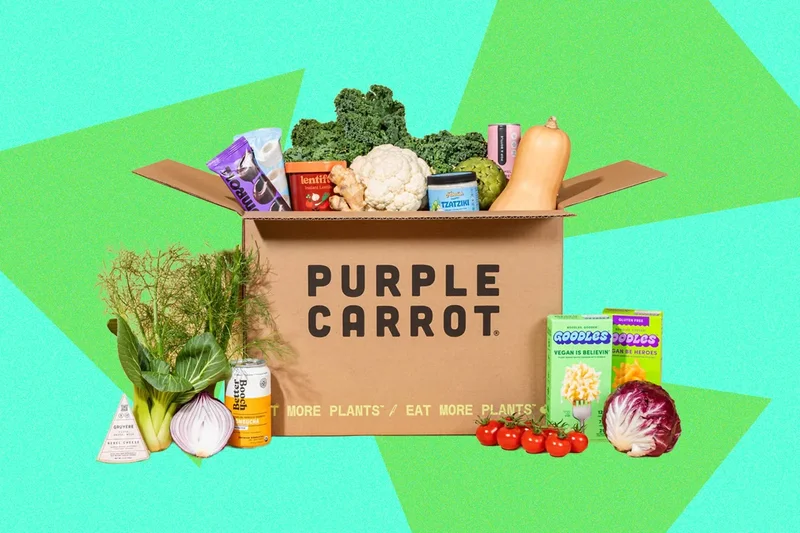
Adventurous, delicious recipes with excellent culinary technique. Offers both meal kits and ready-to-eat premade meals. Doesn’t over-rely on soy.
TIRED
Recipes can be involved and time-consuming. Prepared meals are less fun than meal prep options.
The meals I made with vegan meal kit Purple Carrot include some of the best-tasting food I've made with any meal delivery service. This is no small statement. I'm an omnivore and longtime food critic who’s tested pretty much every meal delivery service in existence over the past two years.
And so when I say Purple Carrot offers good cooking, I'm not grading on a curve. Purple Carrot's pecan-topped, five-spice butternut squash dumplings I prepped this July were among the most extravagant meals I made for myself during that entire month. The prep was extensive, more than I'd usually attempt on any but a weekend evening, but the results were both healthful and a rival to excellent bistro fare.
Purple Carrot achieves this on its meal kit recipes while avoiding the pitfalls endemic to vegan fare—namely, an over-reliance on soy or cashew substitutes. Purple Carrot, thank God, loves a vegetable. It loves a fruit. And it loves an herb. While Purple doesn't offer a huge menu each week, and I was less enthralled by microwave meal options that resorted more often to hunks of seitan, the meal kit choices are both broad and appetizing.
Purple Carrot manages to deliver the classic promise of a meal kit—sweet relief from the same staid recipes I bore myself with when I'm out of ideas. It does so better than most meal kits that cater to meat-eaters. It was my colleague Molly Higgins' favorite plant-based meal kit of the dozen or so she tested last year. After testing five meals and a number of market add-ons this year, I rank it among my favorites overall.
Here's the rundown.
The Nuts and Bolts
Specs
Cost per meal
$13 to $15 per serving, plus $12 shipping per box. (Shipping free for orders above $120.)
Meal plan options
Two or four people; three or four meals a week for the classic meal kit. One to 10 meals a week for the ready-to-eat meal plan. Mix & match plans also available.
More than a third of meals are gluten-free. (But not certified as such for celiac, and prepared in a shared facility with wheat-containing products.)
Plant-based meals?
Vegan, vegan, all-vegan
Other dietary plans or restrictions
Individual meals marked as high-protein, high-fiber, low-calorie (<600), and low-sodium. Allergens clearly marked on each recipe.
Prep time
20 minutes to an hour for recipes; quick-prep meals as fast as 5 minutes
Purple Carrot is among the older meal delivery services in the United States, founded in 2014 in Massachusetts but later acquired by Japanese sustainable-focused food delivery company Oisix. Purple Carrot is indeed packaged more sustainably than most kits: cardboard insulation, recyclable paper containers for microwavable meals. One could also argue that plant-based food is sustainable by its nature. But there's still the usual battery of plastic baggies housing the various ingredients.
Though it's a subscription service, Purple Carrot's subscription is unusually flexible. Meals are priced individually, from $13 to $15 a serving, and can be mixed and matched among solo ready-to-heat meals and meal prep recipes for two or four. (Introductory plans lop half off your first week's order up to $100.) While you can cancel a week, each week does have a $65 minimum order—amounting to five or six servings.
Note also that Purple Carrot does not add a lot of fats and sugar to its meals, nor load up lots of carbs. Servings tend to range between 550 and 750 calories. That's a large lunch, and filling enough for medium appetites—but unlikely to stuff you if you're used to more heaping portions at dinner. In a trashmonster mood, I could hoover two servings and save my guilt for later.
Recipe ingredients are organized nicely into individual bags, and the foldout recipe cards are charmingly well designed and easy to save if you plan to replicate them in the future with or without Purple Carrot. The kits offer a mix of fresh produce and prepackaged ingredients that might include tofu, instant rice, or spice pouches.
Although produce isn’t guaranteed organic, most of the ingredients were (and of course, they were all vegan). The only ingredients you need to provide are salt, pepper, and cooking oil. Though note that at least one recipe—those excellent butternut squash dumplings—required a food processor, a rarity among meal kits loath to make such assumptions about anyone's home kitchen.
Good Cooking, Real Cooking
Purple Carrot's strength lies with the recipes and the freshness of the ingredients. Some sourcing is local where possible, according to Purple Carrot. And the produce I received did seem a step above most of the bigger meal kits. In my box, the poblanos were crisp, and the herbs were fragrant. In July, my corn came seasonably still on its cob, waiting to be sliced off into kernels. Avocado, a real worry for a delivery meal kit, was unbruised and ripe but not overripe.
This kind of freshness adds confidence. But it also adds prep. The butternut squash dumplings I prepared required that I throw squash and soy cream cheese into a food processor with herbs and spices, then individually fold the filling into a dozen dumpling wrappers, before then frying up the dumplings and toasting a sesame-pecan topper. In the meantime, I'll be slicing up apples for a little citrus-y salad.
That recipe is advertised at just under an hour: It will take every bit of it. It's also worth it—a nice balance of crisp and soft, comforting and brightly acidic.
But most recipes sport advertised prep times closer to 30 minutes. Other recipes, like rajas avocado tacos with corn straight off the cob, aren't much harder to prep than merely slicing the vegetables. Beyond this, the recipe called for a short turn in the broiler and oven for both veggies and tortillas. I'll admit, I didn't want to heat the oven on a hot summer day, and so I instead griddled the ingredients on a broad All-Clad stainless steel pan, and it was both faster and delicious. The meal took maybe 20 minutes to prep, even less than advertised.
As a taco topper, the recipe also called for drizzling lime and salt onto sliced avocado—a bit like guacamole without the mush. This was kinda terrific. But the biggest factor in the recipe's deliciousness was probably the quality of the thick corn tortillas: They were every bit as masa-forward as the local packaged tortilla brand I favor in my own kitchen, which usually arrives within days of being made. For a meal kit, a tortilla like this is a rare offering.
A peanut-studded chili tofu dish, meanwhile, carried vague whiffs of Indonesia without making false claims: complex, savory, lightly spicy, lightly sweet. Textures were a nice little school in contrasts among the peanuts, the fried-hard exterior of the tofu, and the soft interior of each cube. It's the sort of recipe that feels easy to adapt into variations later.
The Caveats
As mentioned, Purple Carrot offers some of the best cooking I've seen from meal subscription services, and some of the more sophisticated flavors. But at times, this also requires a bit of experience in the kitchen. Directions are clear and easy to follow. But handholds are few.
If there's a consistent gripe, it's that the recipes are perhaps too concise: Preparation steps are often hidden in the ingredients list. When the recipe calls for “parsley, leaves and tender stems minced (divided),” what they actually mean is that you should separate and mince the parsley leaves and stems. Beginning chefs may have a hard time reading between the lines and thus doing appropriate prep in advance—leading to a scramble during later cooking steps.
I found the recipe cook times mostly honest, a rarity among meal kits. But in part, that's because I found myself compressing timeframes on recipes by reading ahead and doing a little planning, often performing multiple items simultaneously. For cooks less prone to multitasking, cook times might end up significantly longer than advertised. (This said, I actually came in under time on two recipes.)
But while I loved the recipes, I had less use for the microwavable meals I tried, whether a Korean-fried “chicken” with rice or a spaghetti with soy meatballs. In part, this is because I'm not much of a fan of soy as a substitute for meat to begin with. But it was also unclear that the microwave did its texture any favors.
The biggest sell for the meals I tried was that each was a substantial source of protein—more than 40 grams in each meal. For vegans, or those watching saturated fats, the convenient access to high-protein meals without the meat might be advertisement enough. Neither reheatable meal was better, nor worse, than B-minus.
But it's the prepped meals that I ended up loving, and that I'll both recommend and likely return to. Purple Carrot shows mastery across a broad palette of worldwide flavors and ingredients, without the compromises that too often come with wide-ranging recipes. Speaking as a man who loves a steak but needs to watch his cholesterol, I'd also happily find myself ordering Purple Carrot instead.