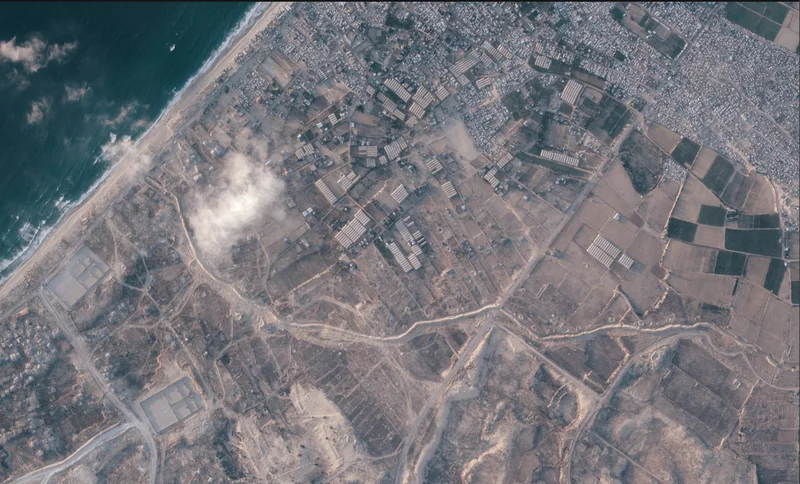
The Israeli military is rapidly constructing a massive earthen barrier to separate the area it controls from the rest of Gaza, satellite images show, deepening the enclave's division.
More than 23 kilometers (14 miles) have been constructed in recent months, running through Palestinian communities demolished by the military. That is equivalent to more than half the length of the coastal strip, which is some 40 kilometers long and 11 kilometers wide and home to over 2 million Palestinians.
When presented with the satellite images, Israel’s military confirmed to The Associated Press it has built a physical barrier in the area of the so-called yellow line, the boundary to which Israeli troops withdrew under the October cease-fire deal with Hamas.
The line was envisioned in the U.S.-backed agreement as a temporary division of the territory pending a fuller Israeli withdrawal.
But as the truce stagnates, it appears Israel is digging in, heightening Palestinian fears that the line is morphing into a border. Neither U.S. Central Command, which is tasked with monitoring the cease-fire, nor the Board of Peace, the body led by U.S. President Donald Trump meant to eventually oversee Gaza, would comment on the barrier.
Along with the barrier, the military told AP it has developed a "security zone" around the line, equipped with intelligence and technological assets. It declined to give details on the route of the barrier when asked how far it would be extended. It said the barrier aimed to prevent infiltration and protect Israeli troops and Israeli communities near Gaza.
Since the cease-fire deal took hold, Palestinians in Gaza have feared Israel would not return the area of Gaza it controls. But few appear to be aware of the berms now being built around them – because of the danger of even approaching that area.
A portion of the berm network in southern Gaza was extended by more than 2 kilometers in two weeks this month, according to the satellite images provided by Planet Labs PBC.
The berm was about 500 meters long on July 1. By July 15, it was about 2.4 kilometers, splicing the Israel-controlled ruins of the city of Rafah from Muwasi, site of some of the largest Palestinian tent camps.
If construction continues in its current direction, it will join up with the longest stretch of the barrier, which runs nearly unbroken for around 17 kilometers from the southern city of Khan Younis to near Gaza City, in the north.
Construction began on that stretch in February, and it appears work to extend it further south is continuing, according to the satellite images. More than a kilometer was added between June 21 and July 7, running close to an Israeli military base built on the ruins of the town of Bani Suheila, near Khan Younis.
In the far north of Gaza, several unconnected stretches of berms run just outside the largely leveled town of Beit Lahia.
The height of the berms in each place remains unclear. In some places, the barriers appear to run outside the yellow line.
Gaza’s population has been crowded into the coastal area west of the yellow line, most living in squalid tent camps and dependent on aid.
On the other side of the line, satellite imagery shows that Israeli forces have leveled the vast majority of buildings using bulldozers and explosives, virtually erasing several towns and Rafah, once home to more than a quarter million people.
They have carved new road networks and erected new bases on the ruins of Palestinian towns. Agricultural land has also been destroyed. The Israeli military says it is demolishing infrastructure used by Hamas.
The yellow line was never precisely defined, whether in the cease-fire deal or by Israeli or U.S. officials and it has been inconsistently marked on the ground. The military told AP it is working to clearly mark the route of the yellow line to "reduce friction and prevent harm to uninvolved individuals."
Israeli forces have killed Palestinians who came close to the line or crossed it. The Israeli military says it fires on those believed to be Palestinian resistance groups threatening its troops.
However, those killed have included children and other civilians seemingly unaware of the line. Some soldiers have said they don't always know who they are firing on and have orders to kill anyone crossing the boundary.
Israeli forces have killed more than 1,100 Palestinians since the cease-fire began, most in airstrikes and drone strikes around Gaza. Militant attacks have killed five Israeli soldiers in the same period.
Early Tuesday, an Israeli strike in Gaza City killed Firas al-Masri, his wife and their four children, ages 6 to 13, according to Shifa Hospital. Israel's military only said that they conducted a strike on Hamas members in the area at that time.
Firas' brother, Ahmad al-Masri, lives nearby and said he heard the children's voices at the moment of the blast.
"They were calling out to me, ‘Uncle! Uncle!’" he said. "But the fire was raging, and we couldn’t do anything."
Under the cease-fire deal, Israel is eventually supposed to withdraw its troops further to the very edges of Gaza, to be replaced by an international security force. But implementation of the deal has been stalled for months.
A former U.N. diplomat now in charge of coordinating the cease-fire has blamed Hamas’ failure to disarm. Sporadic talks to reach a formula for decommissioning its weapons appear to have made little progress and Hamas accuses Israel in turn of violating the cease-fire.
Israel's two-year genocidal war on Gaza has killed over 73,000 people, mostly women and children. The war was triggered by the 2023 Oct. 7 Hamas incursion, which caused 1,200 deaths in southern Israel.
The Daily Sabah Newsletter
Keep up to date with what’s happening in Turkey,
it’s region and the world.
SIGN ME UP
You can unsubscribe at any time. By signing up you are agreeing to our Terms of Use and Privacy Policy.
This site is protected by reCAPTCHA and the Google Privacy Policy and Terms of Service apply.