SOUTH AFRICA · ENERGY
What South Africa is offering Chinese investors
Ramokgopa addressed the South Africa–China Electricity and Energy Investment Conference, framing Integrated Resource Plan 2025 as an investment prospectus. The plan sets out what South Africa intends to build to 2039.
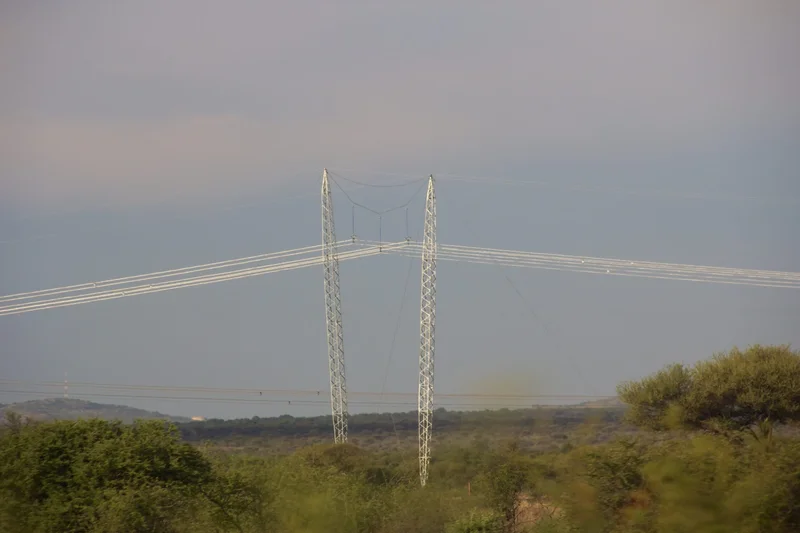
He put the investable opportunity at about R2.2 trillion to 2039, alongside a R440 billion transmission expansion programme. Together they are meant to enable roughly 105 GW of new mixed generation capacity and 14,500 km of new transmission line.
The transmission element is the part that has stalled hardest. Grid capacity, not generation, is now the binding constraint on the country’s energy transition.
The most recent renewable procurement round awarded no onshore wind at all against a 3.2 GW allocation, because there are no wires in the windiest provinces to carry the power. Whoever finances and builds those lines will shape the electricity system for a generation.
Why the delegation’s composition is the signal
This is not an energy ministry roadshow. Trade, Industry and Competition Minister Parks Tau and Deputy International Relations and Cooperation Minister Thandi Moraka travelled with it.
Development finance institutions and senior Eskom executives are also in the party, alongside provincial premiers. That combination means procurement, industrial policy and diplomacy are being presented as one package.
Ramokgopa’s framing has been consistent: the point is to rebuild an industrial base, not simply to add capacity. Localisation demands usually follow that language.
The American backdrop
This trip does not happen in a vacuum. Washington cut aid to South Africa by executive order in February 2025 and imposed tariffs on its exports that August, and relations have been strained over land policy and foreign alignment.
The headline tariff rate has since come down, but South African goods still face a US burden well above pre-2025 levels. A government with fewer Western options has more reason to court Chinese ones.
On the same day, South Africa’s second-largest governing party was in court alongside AfriForum and the Institute of Race Relations, challenging the Expropriation Act. That is the law Donald Trump cited when cutting aid.
Egypt made a comparable move in the same week, publicising a Chinese investment figure above US$10 billion. Two of Africa’s largest economies, one week, one source of capital.
What Chinese capital would actually change
Ramokgopa told the conference that China makes more than 60% of the world’s solar equipment and about three quarters of its lithium-ion batteries, with Engineering News reporting him putting the solar figure above 80%. On execution capacity, the pitch makes obvious sense.
The harder questions are about terms. Contractor-linked financing tends to import equipment and labour, which sits awkwardly beside a localisation objective.
There is also a debt question. Eskom is already by far the largest single call on the state’s guarantee book, accounting for roughly three-quarters of government guarantee exposure to state-owned companies.
Whether new money arrives as equity in independent projects or as debt against the utility is the difference between a solution and a deferral.
What to watch next
The first marker is whether anything is signed before the delegation leaves on 6 August. Conferences of this kind often end in memoranda rather than commitments.
The second is the transmission procurement model. South Africa has prequalified seven consortia for the first round of its independent transmission project programme, covering about 1,164 km of line, with the request for proposals due in the second half of 2026.
Whether Chinese firms appear in that round is the thing to watch. It is the first real test of the framework.
The third is the local-content condition. If Pretoria wants factories as well as pylons, it has to write that into the contracts, not the speeches.
Frequently asked questions
What is South Africa offering Chinese investors?
An energy investment programme drawn from Integrated Resource Plan 2025, put at roughly R2.2 trillion to 2039, alongside a R440 billion transmission expansion. Together they are meant to enable about 105 GW of new generation and 14,500 km of new transmission line.
Who is in the South African delegation?
Electricity and Energy Minister Kgosientsho Ramokgopa is joined by Trade, Industry and Competition Minister Parks Tau, Deputy International Relations and Cooperation Minister Thandi Moraka, development finance institutions and senior Eskom executives. The mission runs to 6 August 2026.
Why is South Africa courting Chinese capital now?
Washington cut aid to South Africa in February 2025 and imposed tariffs that August, narrowing the alternatives. Pretoria also needs transmission investment it has so far been unable to finance.
What is the main risk in the deal?
Contractor-linked financing tends to import equipment and labour, which conflicts with South Africa’s stated aim of rebuilding its industrial base. Whether the money arrives as project equity or as debt against Eskom also matters.
Is Egypt doing something similar?
Yes. In the same week Egypt’s prime minister announced that Chinese investment there had passed US$10 billion, alongside a broad new project pipeline.
This article was produced by The Rio Times’ automated newsroom system. How we use AI · Report an error