Another sign of underlying strength in the labor market.
By Wolf Richter for WOLF STREET.
The trends in the number of job openings, in the number of quits, and in the number of hires — trends of labor market “turnover” — bottomed out in late 2025 and then wobbled higher, and this is another sign of underlying strength in the labor market.
The Job Openings and Labor Turnover Survey (JOLTS) data today by the Labor Department tracks this “turnover” in the labor market in June. It doesn’t track employment growth, unemployment, etc.; the jobs report for June (released July 2) did that.
Labor market turnover is a function of slots left behind by people who quit their jobs; by people who were laid off or fired; and by people who retired or separated for other reasons, such as died while employed. Those left-behind slots become “job openings” when employers try to fill them. Growing job openings mean mostly growing turnover in the labor market.
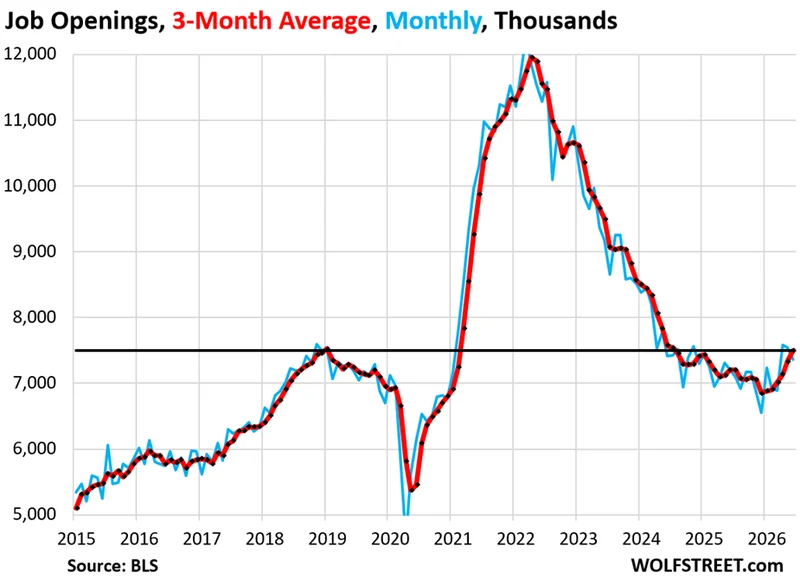
Job openings in June dipped a little from the spikes in April and May, to 7.36 million, still the third-highest since January 2024, behind only April and May (blue line in the chart).
The three-month average, which irons out the month-to-month squiggles and includes the revisions, rose by 157,000 in June to 7.49 million, the highest since July 2024, matching the prepandemic record in 2019, having now increased month-to-month every month this year – a meaningful improvement of the trend (red line in the chart).
Year-over-year, the three-month average is up by 4.0%.
The data is based on a survey of the HR departments of 21,000 business locations, not online job postings. A job is “open” only if it meets all three conditions:
- A specific position exists, and there is work available for that position.
- The job could start within 30 days.
- The employer is actively recruiting workers from outside the establishment to fill the position.
Excluded are positions open only to internal transfers, promotions, demotions, or recall from layoffs; positions for which employees have been hired but have not yet started; and positions to be filled by employees of temporary help agencies, employee leasing companies, outside contractors, or consultants.
Voluntary quits rose in June by 79,000 to 3.23 million, the highest in a year (blue in the chart below). These people quit their jobs voluntarily, such as to take a better job somewhere else, but do not include people who retired, died, etc., who are tracked separately.
The three-month average rose to 3.14 million, the highest since January, and both were the highest since July 2025 (red).
Higher quits indicate that workers are more confident they can find a better job, or that they already lined up a better job.
Quits are the biggest source of the labor market turnover and account for 60% of total separations.
More quits mean more job openings left behind, and therefore eventually more hires to fill those newly vacated jobs, and more turnover.
Layoffs & discharges remained roughly at 1.77 million in June, down year-over-year by 77,000. Getting fired for a variety of reasons, or for no reason, is a standard feature of the US labor market.
The three-month average declined by 39,000 from the prior month to 1.73 million. These levels are at the lower end of the range of the prepandemic years. Layoffs and discharges accounted for 34% of all separations.
Retirements and other separations (including deaths while employed, etc.) rose to 353,000 in June. The 12-month average, which irons out the huge month-to-month spikes and plunges, rose to 308,000 in June. It has been coming up from the 25-year low in 2025.
Retirements from federal government jobs play a role here. Since January 2025, the federal government has shed 324,000 workers, or nearly 11% of its workforce, and quite a few of them eventually switched to retirement. When people were still on severance pay, they did not count as retired, but as employed. When they come off severance and retired, that’s when they count as “retired.”
Retirements and other separations account for about 6% of total separations.
The number of hires rose by 96,000 in June to 5.35 million. The three-month average dipped a hair to 5.27 million.
But this is not a measure of an increase in payrolls, but mostly of “labor turnover,” and the number of hires is mostly a function of slots left behind by separations (quits, layoffs and discharges, and other separations). Nearly all of these 5.35 million hires filled slots left behind by separations.
Enjoy reading WOLF STREET and want to support it? You can donate. I appreciate it immensely. Click on the mug to find out how: