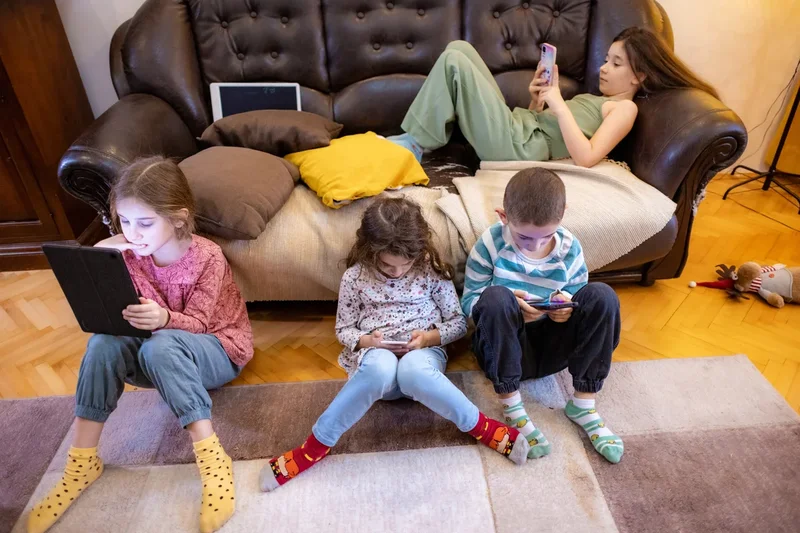
Building a den, exploring outdoors and making up new games are becoming things of the past, as children increasingly turn to phones, tablets, televisions and other screens to stave off boredom, research has found.
In a survey of 2,000 children aged four to nine, more than one in four – 28 per cent – said they would use or ask for an electronic device when they wanted something to do.
Just less than half that proportion – only 12 per cent – would invent a game.
The study found that only one in 10 children said they would go outside when bored.
It’s a contrast with pre-internet generations, who although they watched television, still used their imaginations to invent new worlds or different games at other times.
Toy cars and trains, puzzles, board games, arts and crafts and traditional role-playing games have been dropped in favour of screens. Most parents also said at least one of those things their child had previously enjoyed had been partly replaced by screens.
The findings also suggest children are growing up more quickly than ever, because 14 per cent of six-year-olds said they had already stopped using their imagination.
Before he left No 10, Sir Keir Starmer announced a ban on social media for under-16s after the results of a nationwide consultation showed support for the measures.
The survey revealed that nearly two-thirds of parents thought that they themselves had been more imaginative at the age their children are now, and most said today’s generation had less capacity to invent games.
None the less, many children are keen for their parents to be involved in their imagined worlds. Nearly four in ten wished their parents would play pretend games with them more often.
In the latest Toy Story film, the toys have to vie for a child’s attention with Lilypad, a frog-shaped tablet.
New UK government guidance recommends screen time limits for children under five.
Seven years ago, nursery workers warned that excessive screen time was damaging children’s imaginations.
Amanda Gummer, a research psychologist specialising in child development, said children had fewer opportunities to be creative. “When boredom first appears, a screen is often the quickest and most familiar option, so children may have fewer chances to practise getting a story started for themselves,” she told The Times.
“Imaginative play gives children room to experiment with ideas, language, roles and problems in a world they control.”
More than one in five parents said they ran out of ideas for imaginative games while nearly one in three blamed pressures of everyday life for leaving them too little time to join in with their children’s games.
The research, which was commissioned by Playmobil, suggests school holidays highlight the divide, because more than a quarter of parents said their children spent up to four hours a day using screens in the holidays while parents worked.
Most parents admitted relying on devices to keep their children occupied but also felt guilty about it and wanted their children to spend more time playing imaginatively.