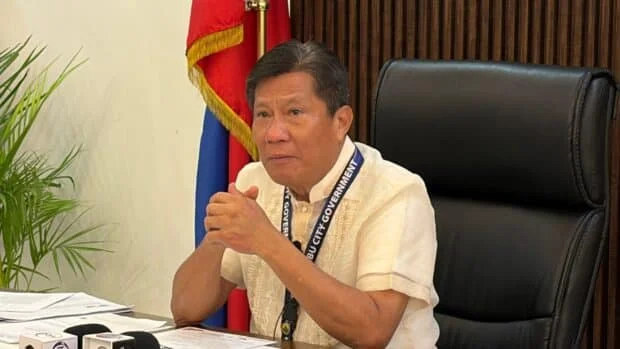
Archival eyes Cebu City as Pax Silica hub: ‘AI is the future’
CEBU CITY, Philippines — Mayor Nestor Archival has positioned Cebu City to compete for artificial intelligence (AI)-driven investments under the Philippines’ participation in the Pax Silica initiative, saying the city is preparing its workforce for an AI-driven future as the technology reshapes industries and transforms traditional jobs.
Archival said Cebu City is ready to seize opportunities from the country’s expanding semiconductor, artificial intelligence (AI), and advanced manufacturing industries, while emphasizing the need to equip government employees and the workforce with digital skills to stay competitive.
This came when he was asked whether Cebu City was ready to host AI-related investments as the national government pushes to expand the country’s role in semiconductor manufacturing, electronics, research and development, and artificial intelligence through the US-backed Pax Silica coalition.
READ: Pax Silica could bring 200,000 jobs to PH
“That’s why you noticed that we already have a Memorandum of Agreement with the Department of Science and Technology (DOST) regarding Smart and AI,” Archival said.
The mayor said the city had already begun training programs, including one for overseas Filipino workers (OFWs) who recently returned from Dubai.
“Nagsugod na ta sa programa nato, katong mga tawo nga gikan sa Dubai. I think there were about 30 of them nga atong gitagaan og financial assistance. Unya tanan gyud sila atong gipatrain sa usaka kompaniya nga accredited sa TESDA sa AI,” Archival said.
(We have already started our program for those who came from Dubai. I think there were about 30 of them whom we provided financial assistance. We also enrolled all of them in AI training through a TESDA-accredited company.)
Archival said the city also planned to expand AI training among Cebu City Hall employees through existing government scholarship and skills development programs.
“Akong gipaninguha nga katong mga tawo nga ganahan, ato ni silang i-enroll ani nga AI because naa man gud ta’y programa sa government nga ato silang paiskwelahon,” he said.
(I am encouraging those who are interested to enroll in AI because the government already has programs that can support their training.)
He said his office had also instructed employees to attend AI-related seminars to strengthen their capabilities.
“We understand that AI is the future,” Archival said.
‘AI changing the workplace’
Archival acknowledged that artificial intelligence had already begun transforming the labor market, particularly in the business process outsourcing (BPO) sector.
“Nag-estorya sad ta sa mga dako sa BPO. Naa’y ilang mga empleyado nga primary bitaw nga mga empleyado, ila nang gihulisan og AI. Mao na nagsige na sila’g upgrade and we want to be more proactive on this because in the future, kung dili ta makahibalo ani, mabiyaan ta,” he said.
(We have spoken with major BPO companies. Some of their primary positions have already been replaced by AI. That is why they continue upgrading their workforce, and we also want to become more proactive because if we do not learn these technologies, we will be left behind.)
Asked whether Cebu City would welcome an AI ecosystem should investments under the national initiative expand to Cebu, Archival answered in the affirmative.
“Yes. In fact, naglingkod na ta ana sa DOST… naa na ta’y Memorandum of Agreement that will also focus on that.,” he added
(Yes. In fact, we are already working with DOST. We already have a Memorandum of Agreement that will also focus on that.)
Cebu and the Pax Silica opportunity
The statement aligns with the national government’s efforts to attract high-value technology investments through the Pax Silica coalition, a US-led partnership that seeks to strengthen supply chains for critical minerals, semiconductors, artificial intelligence, advanced manufacturing, energy, and logistics.
The coalition has grown from 14 participating countries in April to more than 30 members, according to the Bases Conversion and Development Authority (BCDA).
BCDA President and Chief Executive Officer Joshua Bingcang earlier said the initiative could eventually generate between P68 billion and P75 billion in annual tax revenues for the national government and local government units, while creating 130,000 to 190,000 direct jobs, with about 90 percent expected to go to Filipino workers.
The proposed AI and advanced manufacturing hub will rise on a 1,620-hectare site in New Clark City, Capas, Tarlac, with an initial infrastructure investment estimated at $10 billion. Once fully developed, total investments could reach $40 billion to $70 billion, according to BCDA.
More than 50 companies, including several global technology firms, have already expressed interest in investing in the first Pax Silica site.
Although the planned hub will rise in Central Luzon, Archival said Cebu intends to prepare its workforce early so the city can capitalize on opportunities as AI-related industries expand nationwide.
“We want to be more proactive,” the mayor said, warning that workers who fail to acquire AI skills risk falling behind as technology continues to reshape the economy.
Disclaimer: The comments uploaded on this site do not necessarily represent or reflect the views of management and owner of Cebudailynews. We reserve the right to exclude comments that we deem to be inconsistent with our editorial standards.