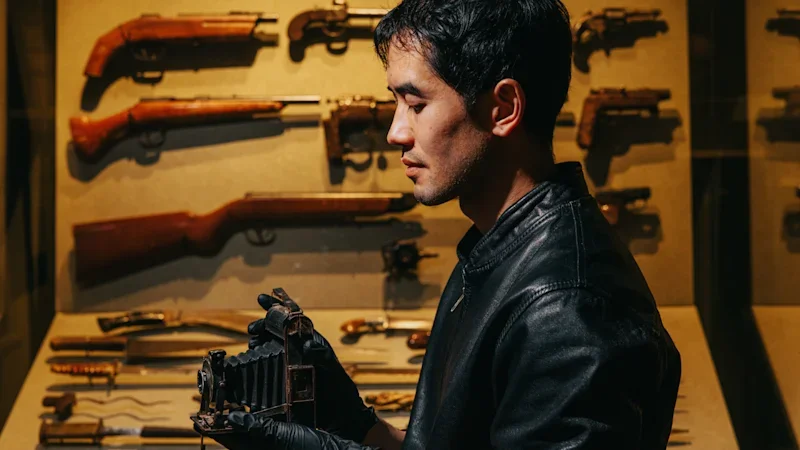
Deep in the bowels of the Justice and Police Museum – a rabbit warren of holding cells, criminal courts and a booking station right by the tourist vistas of Circular Quay – assistant curator Dr Tuan Nguyen, wearing appropriately macabre black gloves, shows me a vintage film camera.
It looks innocuous, the kind of thing you might find gathering dust at an antique shop or selling for “parts only” on eBay – nowhere near as frightening as the Peaky Blinders-esque backdrop of confiscated guns, switchblades and knuckledusters (the museum’s so-called “1910 collection”) that surrounds us – but the camera holds a gruesome history.
It belonged to Leonard Lawson, the artist renowned for creating The Lone Avenger, an Australian take on the Lone Ranger, a successful local comic series throughout the 1940s and ’50s. In 1954, Lawson used the camera to lure five young women aged between 15 and 22 into bushland in Terrey Hills under the impression he’d be photographing them for a swimsuit calendar. He bound and gagged the women and raped at least two of them at gunpoint. He was sentenced to 14 years in prison, but served seven.
In 1962, a year after his release, Lawson again used his profile as an artist to persuade a 16-year-old girl to let him paint her portrait. He raped and killed her, and the following day laid siege to SCEGGS Moss Vale – a former girls’ school in the Southern Highlands – where a 15-year-old girl was killed. He was sentenced to life imprisonment and died at Grafton Correctional Centre in 2003, aged 76.
For Nguyen, the camera’s morbid history teases out a number of contemporary debates. Is it possible to divorce art from the artist? What are the ethics around our fascination with true crime? Are there objects that are too controversial to display in a museum?
“I think it’s really interesting when you can take a seemingly mundane object, and then through learning its history, it’s added a different gravity. It actually makes you recoil looking at it, and I find that mental flip very interesting,” he says.
“The interesting thing for me as a curator is not the black and white questions, but the grey in between those things. This is why we have the collection, to bring out the moral ambiguity around some of these cases.”
Lawson’s camera is just one item Nguyen will unearth from the museum’s collection of over 10,000 artefacts for Holding Hatred, a tour being held as part of the Festival of Dangerous Ideas’ Dangerous Excursions program. The tours will offer a deeper peek inside our cultural institutions, including the State Library of NSW’s hidden storage stacks and the seed vaults at the Australian PlantBank in Mount Annan.
But there are limits to where dangerous tours can go. Nguyen cites a flag once brandished by the 1930s fascist group the New Guard in the Justice and Police Museum’s collection. “There’s not enough historical distance,” he says. “If we brought it up, it would be inflammatory. It would incite hate.”
Museums and cultural institutions around the world have increasingly grappled with the uncomfortable legacies around parts of their collections. In the US, the Smithsonian is sorting through more than 30,000 human remains collected by Ales Hrdlicka, its curator of physical anthropology from 1904 until 1941, in his attempts to “prove white biological superiority”.
The Chau Chak Wing Museum at the University of Sydney has been a frontrunner in addressing the ethical minefield of human remains in their antiquities collection through the Human Remains Research Project, a collaboration with Macquarie University and University College London.
In 2024, following surveys and focus group discussions with the Egyptian diaspora, the museum removed mummified body parts from display. “People were quite happy to have completely wrapped bodies on display, but they did not want to have severed body parts and unwrapped bodies on display,” says Dr Melanie Pitkin, the museum’s senior curator of antiquities and archaeology and co-lead of the Human Remains Research Project.
“For years, museums had normalised this. The first display of human remains from Egypt was in 1837 at the British Museum, and there are clips from the newspaper at the time of people queuing up… That set a precedent,” she says. “But now we have a more proactive approach around making better-informed decisions, because museums have been making decisions on behalf of others for a very long time.”
The Chau Chak Wing Museum’s Dangerous Excursions tour, titled Afterlives, Interrupted, leans into the complexity. The museum’s The Place of Truth room (formerly The Mummy Room) displays four mummified individuals – Meruah, Padiashaikhet, Mer-Neith-it-es, and the child Horus – acquired between 1856 and 1857 by Sir Charles Nicholson, a co-founder of the University of Sydney.
“As curators today, we deal with the legacies of past collecting practices,” says Pitkin. “We wouldn’t be acquiring mummified bodies or body parts today, but we have to make responsible decisions around what are the best ways of caring for the ones in our collection now. Who gives consent to display human remains? Should they be displayed, and how? What is a respectful way of displaying human remains and who is that respect being directed to, the living or the dead?”
An item to be shown on the tour – a fragment from the First Book of Breathing, ancient funerary literature which was found inside the wrappings of Horus – speaks to the challenge of their task. For 150 years, the museum had documented Horus as a little girl based on the British Museum’s mistranslation of the hieratic text in the book; CT scanning conducted in 2009 confirmed he was actually a boy. It’s ammunition for those who think the museum has skewed too sensitive in its handling of human remains.
“There are benefits to scientific research, but you don’t want to go too far,” says Pitkin. “We’ve had a lot of feedback both ways around being too reactive, but it’s still a process of getting people to unlearn a lot of entrenched ways of thinking and getting them to think about different narratives that museums have not communicated before. Black and white is not an option any more.”
The Festival of Dangerous Ideas, including its Dangerous Excursions, takes place from August 20-30.