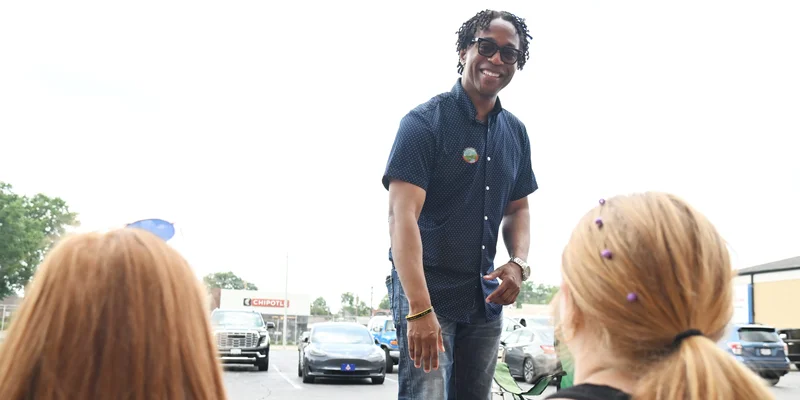
Fueled by pro-Israel funding, Rep. Wesley Bell, D-Mo., fended off a primary challenge from former Rep. Cori Bush, whom he ousted from Congress two years ago.
The race in Missouri’s 1st Congressional District was one of several contests on Tuesday pitting the left and democratic socialists against establishment Democrats in a midterm cycle defined by competing visions for the future of the party. Just over an hour after polls closed, The Associated Press called in Bell’s favor.
Before polls closed on Tuesday evening, Bell brushed off Bush’s criticism of his support from the pro-Israel lobby.
“What we’ve seen over and over is talking about an issue that is not impacting folks right here in St. Louis, and while we take those issues seriously, you know, the M in Missouri doesn’t stand for Middle East. It stands for Missouri,” Bell said.
The question going into Tuesday’s primaries, including the widely watched Michigan Democratic Senate race, was whether progressives could win in the Midwest. Despite a decent track record in the region, it was unclear if the energy that boosted progressives in other primaries from New York to Colorado would be enough to help Bush, a former member of Congress and another democratic socialist, come back from a bruising loss two years ago.
Outside groups opposing Bush poured money into the rematch, spending $4.6 million against her or backing Bell. In comparison, Bush drew just $200,000 in outside spending in her favor. Most of that money came from the super PAC for the American Israel Public Affairs Committee, the pro-Israel group that took credit for ousting Bush last cycle. The group’s super PAC, United Democracy Project, spent $3 million against Bush this year, far less than the $8 million it poured out against her in 2024 as part of a historic investment targeting elected lawmakers critical of Israel.
In response to that kind of spending, progressive groups put much more money into this year’s primaries, though they were still heavily outspent. But while groups like Justice Democrats and American Priorities, the new pro-Palestine super PAC, pumped record-setting sums in races in Michigan, Colorado, and New York, they did not spend in Bush’s race. Justice Democrats, which backed Bush in her 2020 election, gave Bush its endorsement this cycle but instead concentrated its resources on Tuesday in Michigan in support of state Rep. Donavan McKinney, another democratic socialist, in his bid against Rep. Shri Thanedar, D-Mich. Another new pro-Palestine PAC, the Institute for Middle East Understanding Policy Project, spent $20,000 in support of Bush.
With its funding, United Democracy Project recycled attacks that had helped topple Bush in 2024, hitting her for voting against former President Joe Biden’s infrastructure bill and claiming she had been an ineffective member of Congress. In line with that attack, a spokesperson for United Democracy Project, which ran the ads, recently described Bush as “a terrible member of Congress who didn’t do her job and didn’t deliver for St. Louis.”
Bush’s critics, including AIPAC and Bell, painted her as failed experiment by the left, pointing to past positions on defunding police and criticism of Biden and former Vice President Kamala Harris’s support for Israel’s genocide in Gaza. Bush went on to endorse Harris, and many Democrats have come to share her views on Israel. But her opponents cast her as an “extreme” in the party’s left flank who was out of step with voters.
Even some of Bush’s backers worried that the damage done last cycle would be enough to tank her attempt at a comeback.
Although Bush won reelection by a wide margin in 2022, the pro-Israel lobby started laying the groundwork to oust her shortly after Hamas’s October 7, 2023, attacks in Israel. Bush, a vocal critic of Israel, drew ire from AIPAC and other pro-Israel actors after she introduced a resolution for a ceasefire in Gaza less than 10 days later, alongside Rep. Rashida Tlaib, D-Mich. AIPAC’s super PAC and other groups spent close to $20 million to oust her that cycle, hitting her for her vote against Biden’s infrastructure bill. Bush said she took that vote, along with five other leading progressive Democrats, because the measure did not do enough to expand funding for social services.
One Bush supporter said they heard frequently from St. Louis residents about the vote — despite the fact that she easily won reelection shortly after taking it. They suggested that voters only started caring about the vote after AIPAC told them to.
Bush said voters were frustrated by attacks from AIPAC after having been saturated by similar ads in 2024.
“People have been coming up to me apologizing,” Bush told The Intercept in an interview ahead of the primary. “Saying, ‘Cori, I just didn’t understand. I didn’t understand the ads. I didn’t understand what was being said about you. I didn’t know who AIPAC was.’”
IT’S EVEN WORSE THAN WE THOUGHT.
What we’re seeing right now from Donald Trump is a full-on authoritarian takeover of the U.S. government.
This is not hyperbole.
Court orders are being ignored. MAGA loyalists have been put in charge of the military and federal law enforcement agencies. The Department of Government Efficiency has stripped Congress of its power of the purse. News outlets that challenge Trump have been banished or put under investigation.
Yet far too many are still covering Trump’s assault on democracy like politics as usual, with flattering headlines describing Trump as “unconventional,” “testing the boundaries,” and “aggressively flexing power.”
The Intercept has long covered authoritarian governments, billionaire oligarchs, and backsliding democracies around the world. We understand the challenge we face in Trump and the vital importance of press freedom in defending democracy.
We’re independent of corporate interests. Will you help us?
** IT’S BEEN A DEVASTATING** year for journalism — the worst in modern U.S. history.
We have a president with utter contempt for truth aggressively using the government’s full powers to dismantle the free press. Corporate news outlets have cowered, becoming accessories in Trump’s project to create a post-truth America. Right-wing billionaires have pounced, buying up media organizations and rebuilding the information environment to their liking.
In this most perilous moment for democracy, The Intercept is fighting back. But to do so effectively, we need to grow.
That’s where you come in. Will you help us expand our reporting capacity in time to hit the ground running in 2026?
We’re independent of corporate interests. Will you help us?
** I’M BEN MUESSIG,** The Intercept’s editor-in-chief. It’s been a devastating year for journalism — the worst in modern U.S. history.
We have a president with utter contempt for truth aggressively using the government’s full powers to dismantle the free press. Corporate news outlets have cowered, becoming accessories in Trump’s project to create a post-truth America. Right-wing billionaires have pounced, buying up media organizations and rebuilding the information environment to their liking.
In this most perilous moment for democracy, The Intercept is fighting back. But to do so effectively, we need to grow.
That’s where you come in. Will you help us expand our reporting capacity in time to hit the ground running in 2026?
We’re independent of corporate interests. Will you help us?
Latest Stories
Voices
Bari Weiss’s “60 Minutes” Hires Producer Who Downplayed Gaza Starvation, Justified Killing Journalists
The latest CBS News hire shows that the way to get ahead in journalism is to act as a tool for the powerful.
Chilling Dissent
BLM Protester Transferred Thousands of Miles Away After They Organized Against Their Solitary Confinement
A misconduct report before the transfer noted that Malik Muhammad, a Black Lives Matter protester, was critical of Israel in communications from prison.
Targeting Iran
The Pentagon Found a New Way to Undercount U.S. Casualties in Iran
U.S. troops killed or wounded since July 7 are now counted separately from casualties during the first months of the Iran war.