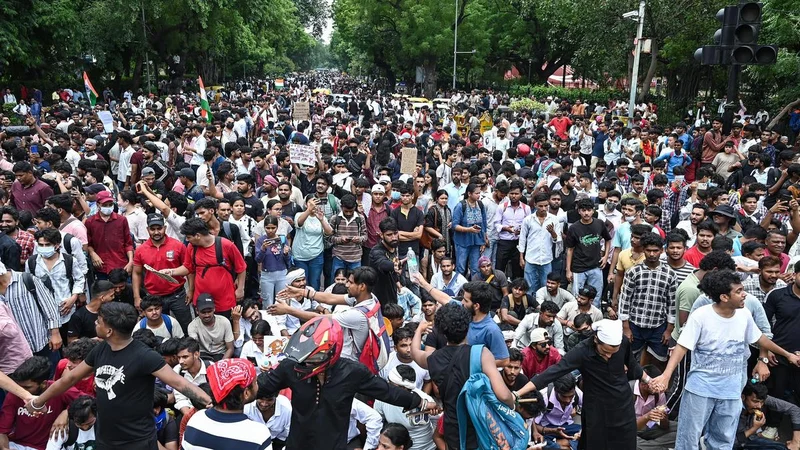
It won’t be an exaggeration to say that the Jantar Mantar protest led by the Cockroach Janta Party (CJP) is by far the most formidable challenge this government has faced in its 12 years of rule. While it was the issue of repeated paper leaks which pushed the people over the brink, the disillusionment runs far deeper among young Indians. And there is a material basis for this disillusionment. Unfortunately, neither the defiant resignation letter of the Minister nor the rousing welcome he got in the Parliament after the resignation gives the impression that the government has heard the voice of its own youth with any humility.
The question, then, is: why did the agitation catch the imagination of the youth?
A lost demographic advantage
Let us start with what is called a demographic dividend. India currently has the youngest population in the world. Chart 1 shows a rising share of people in the working age bracket (15-64 years) out of the total population — a potential demographic dividend. We are calling it potential because its mere existence does not guarantee its realisation. If the unemployment rates, especially among those entering the labour market, remain high, we are essentially frittering the youth dividend away.
Chart 2, which compares the unemployment rate among the youth (15-29 years) in contrast to the overall workers, shows that India is indeed turning its face away from its youth. Youth unemployment is three times higher than the overall rate. Among women, it is almost four times higher. Urban women are the worst affected. Nearly one in five women looking for work is unable to find a job. It is therefore no surprise that a significantly large section of those protesting were women students.
And the frustration runs deep because even education is not enough to find a job in the Indian markets. Chart 3 shows that unemployment rises with education. The more educated you are, the less likely you are to land yourself a job. So, lack of jobs for the youth is not a supply but a demand side problem. Youth in India are unemployed not because they are not educated but because the economy is not generating enough jobs for them.
The crisis in education
It is not just a lack of jobs; access to quality education is also becoming increasingly limited. This is due to both quantitative and qualitative reasons.
On the quantitative side, it is perhaps for the first time in India’s history that spending on education as a percentage of GDP has declined consistently for over a decade. While the government’s own National Education Policy (NEP) 2020 recommended a significant increase in spending on education, the reality is the opposite. Spending on education as a share of the total budget has been declining consistently under the current government (Chart 4). This is a significant point that cannot be stressed enough.
Strictly speaking, spending as a proportion of GDP could decline purely because other components (investments, exports, consumption) of GDP can potentially grow faster. In contrast, the share of its own budget that a government allocates to education is entirely at its discretion and reflects the importance it attaches to the sector. Chart 4 clearly shows that education has been slipping from the radar of this government over its tenure so far.
This was yet another case of a failed promise, to which the students responded with their feet on Jantar Mantar (and elsewhere in the country). The low priority accorded to education by this government becomes even clearer when one looks at what it did in the last Budget. They spent way below what they promised in their budget with a shortfall amounting to ₹6,701 crores (Chart 5).
Starving education of funds creates a serious supply bottleneck as far as access to education is concerned. While the number of applicants rises with the growing youth dividend, the number of seats does not. The odds of securing a seat even in an average institution, let alone a premier one, keeps declining every year. Added to this are the changing of goalposts by the government. One year, CBSE results are used for college admissions; the next, they are not. One year there is one entrance examination; the next, another.
Let us take the example of the Common University Entrance Test (CUET). If you want to join a college for an undergraduate (UG) degree, what you scored in your CBSE/ICSE/State board examinations no longer matters as much; what matters is how you perform in the Computer-Based Test (CBT) with multiple-choice questions (MCQs) under CUET (UG). If you want to do post-graduation (PG), what you did in your UG college for three or four years comes to naught, instead what matters again is what you did in the MCQ of CBT under CUET(PG). As a result, teaching and learning in schools and colleges have been affected. Students are being forced to prepare only for their CUET exams instead of focussing on a holistic teaching and learning process. It is therefore no surprise that, instead of quality educational institutions, coaching centres that help students crack these MCQs are mushrooming across the country.
As if this were not enough, the logistical nightmare that CUET brings to the table at the time of admissions is mind boggling. The National Testing Agency (NTA) conducts the CUET, and there have been glitches since its inception. Academic sessions do not begin on time in many of the institutions that depend on these examinations. National, centralised admission tests also result in considerable shifting of admissions, not just across institutions but across the country. As a result, you have students joining the programme almost half way through the first semester. CUET has disrupted the admissions process in higher education. One could understand if these were teething troubles but this is the fifth year of CUET, and there is still no respite from this chaos.
Another bizarre example was introducing the scanning of CBSE answer scripts for evaluation in the name of objectivity. Given the massive scale of the CBSE examinations in the country, expecting such a policy to work smoothly was unrealistic from the outset. Interestingly, there was nothing fundamentally wrong with the previous systems of either entrance examinations or CBSE evaluations. The government seems to have followed the maxim, “fix what isn’t broken.”
All this shows that not only is there an uncertainty of passing an exam, there is an uncertainty surrounding the exam itself. If the readers put themselves in the shoes of a student today, they would know what these students must be going through. One may argue that we are being a tad unfair to this government. After all, it has established new IITs and AIIMS. While this is true, merely increasing the number of institutions, with an overall fund squeeze, may not mean much. Buildings do not make institutions.
As for the quality of education, it is not infrastructure alone that matters, the quality of teaching does too. If the reports in the media were to be believed (and there is incontrovertible evidence to do so), there has been excessive political interference in the appointment of teachers at public universities. As a result, the quality of teaching has been sacrificed at the altar of politics under this regime. None of this is, or can be, hidden from students.
The Chief Justice of India gave an outlet to this simmering anger by calling those questioning the system ‘cockroaches’. Much like the cockroaches that possess incredible biological resilience, allowing them to survive for weeks without a head, the youth of this country braved the batons, tear gas, pellet guns and whatever the government threw at them.
(The authors are a part of DevMac (Development Macroeconomics) network, which seeks pluralism in Economics.)
Published - August 05, 2026 07:00 am IST