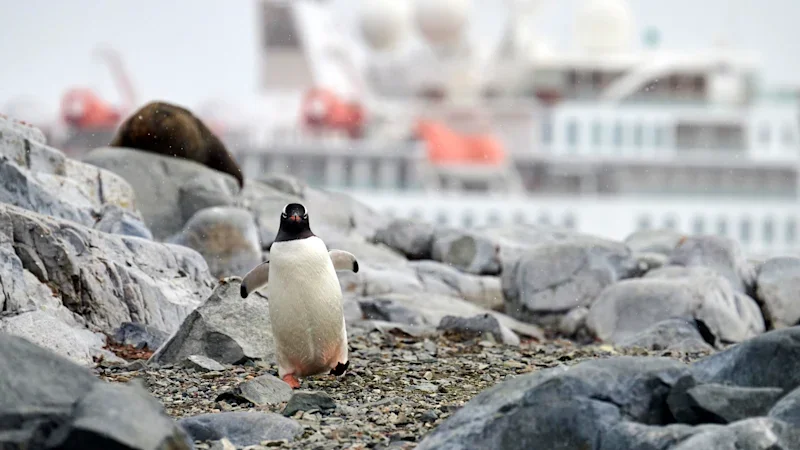
In the mid-1990s, about 8000 tourists annually went to Antarctica. That figure climbed beyond 120,000 last season, a figure the Journal for Sustainable Tourism suggests could reach more than 450,000 by 2033-34.
That kind of growth, of course, means more ships in the region and there are many parameters within which travellers will make their choice. For Australia’s Aurora Expeditions, one stands out.
Aurora’s Andrew Marshall says: “Expedition travel has often been viewed through the lens of destination first, but our own research tells a more nuanced story. In a survey of more than 700 expeditioners, 95.3 per cent rated the expertise of the expedition team as the most important factor when selecting an operator, ahead of considerations such as itinerary, ship size and landing opportunities.”
That means that in Antarctica, someone might be driving your Zodiac inflatable boat in the morning and enthralling you with a lecture about penguins in the evening. Polar Medal winners, expert scientists, award-winning photographers and esteemed historians might be onboard with you. As Aurora’s research proves, in a place as multi-layered as Antarctica, having access to experts who enrich your experience with their knowledge is key to a successful and memorable expedition.
The latest travel news, tips and inspiration delivered to your inbox. Sign up now.
Later this year, Aurora will have Dublin-based polar historian Liam Maloney joining its In Shackleton’s Footsteps voyage aboard the purpose-built expedition ship, Douglas Mawson. Alongside wildlife and remarkable landscapes, explorer Ernest Shackleton is an immense drawcard for Antarctic voyages.
Even for the most well-versed Shackleton fan, Maloney brings something different. He’s a historian whose focus is the lesser known human stories behind the Endurance expedition. For Maloney, who has spent more than a decade immersed in Shackleton’s world, the role extends well beyond delivering lectures between landings.
“My role is to augment what guests are already seeing and experiencing,” he says. “Not just where we go, but how they interpret it and how they experience it.”
It’s an approach that recognises not every passenger arrives with the same knowledge. Some have read every book ever written about Shackleton, others simply want to experience Antarctica for the first time.
“It’s about finding the balance,” Maloney says. “Those who know very little can follow along, but those who already know the story still get something extra.” For him, that often means shifting the spotlight away from the famous names.
Shackleton’s leadership remains endlessly fascinating, but Maloney is equally interested in the lesser-known members of the expedition: the young Welsh stowaway Perce Blackborow, who lost several toes to frostbite after hiding aboard Endurance; the men who remained on Elephant Island while Shackleton sailed for help; and the lives they all returned to once the headlines faded.
“These people were full people,” he says. “There are decades of the rest of their lives.”
Antarctica itself also changes the story.
“It’s hard to comprehend when you’re sitting at home reading about Endurance,” Maloney says. “Then all of a sudden you see it. That physically hits people.”
Some arrive knowing almost nothing of Shackleton’s story, only to discover that the history transforms the landscape before their eyes.
“Whether you have the pre-knowledge or not,” Maloney says, “it can change how you see the place.”
Marshall adds: “Liam Maloney’s depth of knowledge on Shackleton and the heroic age of exploration is exceptional, but what makes him so powerful on board is the way he connects that history to the very places guests are standing in, in real time. Travellers who join Liam don’t just visit these sites, they understand them more deeply.
“Antarctica is one of those rare places where interpretation matters as much as access. Australian travellers are becoming more discerning, and the quality of the expedition team is one of the things that turns a remarkable journey into a truly meaningful one.”
Departing Ushuaia, Argentina on November 8, the 20-day Aurora itinerary retraces Shackleton’s ill-fated Endurance expedition through the Weddell Sea, Elephant Island and South Georgia Island, where the explorer is buried at the hamlet of Grytviken.
Next year, Ponant Explorations will take Jonathan Shackleton, the cousin of Sir Ernest Shackleton, on a voyage to Antarctica and South Georgia, which departs Ushuaia in February. Jonathan Shackleton has spent more than 25 years working across Antarctica as a historian, guide, photographer and Zodiac driver.