In The Flaming Feet and Other Essays, the late cultural critic DR Nagaraj puts forth a broad overview of Dalit movements in India. He identifies two kinds of contemporary Dalit activists: one who seeks to create a better society by repressing caste domination with Dalit assertion, and the other expects the transformation of the caste-Hindu heart for a better society.
During one of my coursework discussions, my professor referred to Nagaraj as a “kind intellectual” and that word stayed with me. Nagaraj was capacious enough to understand how either of the two paths was partially successful and had limitations. He treated them with extreme sensitivity and a desire to intimately understand why people act the way they do, and he made space for both.
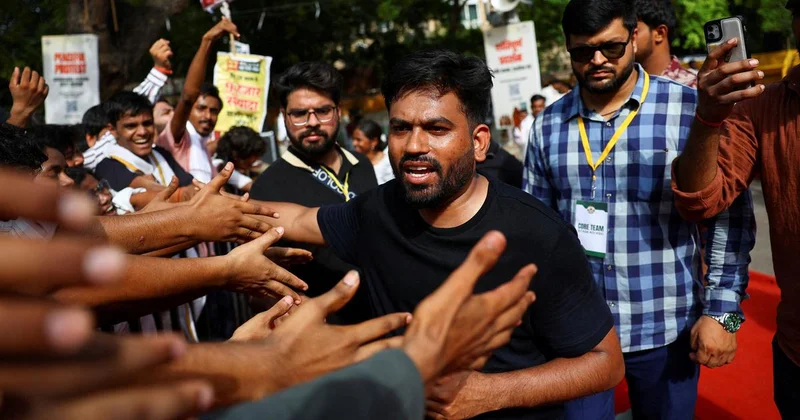
Abhijeet Dipke, who led the satirical Cockroach Janata Party through the recent protests, is a telling example of this capaciousness: he held space for multiplicity and contradictions and was eventually able to put the Bharatiya Janata Party on the back foot.
Unlike the Left activist circles in urban spaces that struggle to form meaningful connections with ordinary people due to their abstruse language and lack of organisational outreach, Dipke spoke in a language everyone understood. He also went against commonsensical, mainstream Ambedkarite politics by emphasising the need for demands that are not caste-based so that a wider range of people could be brought together.
Yet, he spoke of his Dalit background, proclaimed himself to be an Ambedkarite and asserted himself strongly against the ruling BJP government. At the same time, he did not want to be reduced to a Dalit leader.
Urban commentators in Delhi were casting aspersions on Dipke and the protest for not having an ideology nor radical demands for structural overhaul. But Dipke, by not being bogged down by the tiny, urban section of politically-defeated puritans, decided to imagine a broad politics that enabled a space and a moment for so many young Indians from small towns, slums in cities and rural areas from lower-income and lower-caste backgrounds.
With regular election losses, the disintegration of political parties, unstable alliances and the deletion of voters in the special intensive revision of the electoral rolls, ordinary people have lost hope that the Opposition parties can challenge the BJP.
There were sporadic, unconnected protests in various parts of India and simmering discontent among young Indians – Dipke became an anchor in highlighting the broad, shared character of these events. Rather than electoral politics, civil society discussions or legal activism, he emphasised agonistic politics, which has a natural potential to be expanded and broadened.
Transgressing categories
At several protest sites, many political groups and associations come forward to extend their solidarity. The month-long protest at Jantar Mantar, for instance, was visited by Opposition leaders, farmers’ associations and trade unions.
The unusual thing here was that people from across class, caste, religious and ideological backgrounds also responded to Dipke’s protest call against the leak of the National Eligibility-cum-Entrance Test paper and the demand for education minister Dharmendra Pradhan’s resignation. At the same time, the protest was explicitly anti-BJP and against its ideological parent, the Rashtriya Swayamsevak Sangh.
Usually, protests and padyatras that draw a cross-section of crowds comprise political party cadres and supporters who are managed from the top and are directed towards electoral objectives. These are usually symbolic, at best, without creating any upheaval in terms of demands. Politicians who usually shine on such occasions are normative, Indian upper-caste faces and names that draw people given their hegemonic claims to represent Indians.
Dipke, on the other hand, is a young, Dalit man who entered a hostile territory courageously and was able to strike a chord with his confidence, poise and kindness.
For most Dalits in India, venturing into any locality outside of their own or making claims on behalf of others can be as threatening as entering into enemy territory. Yet Dipke decided not only to stand amidst the vast, caste-Hindu crowds but also to make space for them to have their fragmented discourses in one place.
At the same time, he bound them with other social groups by reminding them of the shared discontentment and anger that young Indians are facing due to the failures of the education system and the concomitant lack of better employment.
What is remarkable about this feat is that Dipke transgressed the dual categories of Dalit activists that Nagaraj posited in his book. Dipke is neither the power-wielding, isolated Dalit activist who could be seen only as a leader of a particular caste among Dalits, nor he is the caste-Hindu, conscience-appealing Gandhian-mould Dalit activist.
He is neither the Bhim Army’s Chandrashekhar Azad, who emerged from assertion during caste conflict, nor is he Akash Anand of the Bahujan Samaj Party, who carries the legacy of the Dalit movement through his family. Dipke does not express himself in the language of regional Dalit social movements, urban civil society, and party politics, which have limited capacity to connect with people beyond specific constituencies.
This ability not to be bounded is precisely what makes him an effective, political communicator and relatable to multiple groups.
A space to be ‘Gen Z’
Dipke’s cockroach movement enabled a political infrastructure where youngsters could encounter several political claims being made in one place. For those brief moments, they could just be “Gen Z” and young, interact and chant slogans together, dance to songs and feel that they belonged to a broader collective.
The collective euphoria usually evoked by the Hindutva-endorsed Kanwar Yatra and religious processions found a counterpart in the protests, which were not built on hate. This was a space where the Constitution, transparency of institutions and Ambedkar’s importance were constantly emphasised.
What made the Jantar Mantar protest unique was also the emergence of a new political expression rooted in jokes, mockery, humor and memes already circulating among the Gen Z on Instagram. Once shared by independent YouTube channels and through Instagram short-form videos, this greatly delegitimised the BJP-supporting mainstream media and their vitriolic content.
This protest was not a collection of spontaneous participants. Many who came there had already been protesting and speaking against various forms of discrimination and exploitation in their respective spheres. For example, there was a group of Dalit youths who had come from Odisha right after protesting against an aganwadi teacher being subjected to untouchability.
There was agonism, euphoria, moral appraisals and political encounters that allowed for a broad politics without collapsing under the ideological bickering, isolationism, puritanism that are typical of many Left and Dalit political engagements.
In addition, a significant section of people from other northern and eastern states joined the call for protests in several small towns because of their grievances against the BJP and Hindutva. For them, the BJP represented an ideology – it could be of religious hostility, democratic backsliding, insecure employment, brute state power and withdrawal of welfare provisions.
A ‘Kind Hero’
Dipke was willing to listen to various sides of the protestors. Neha Bora, of the All India Students’ Association and another prominent voice at the Jantar Mantar protest, noted that Dipke was humble, willing to take suggestions, and that he made the protesters feel like he was just another student and comrade in the fight.
Rather than always speaking and making arguments like many activists, he listened to the many affected families and disappointed youths and comforted them regularly. In the backdrop of many limitations, scepticism and dismissals, Dipke led the protest with quiet fortitude till the end with others – despite being slapped, having ink thrown at him and receiving threats to join the BJP.
What could be a better way to describe him than with the epithet of the “Kind Hero” who exhibited fraternity in a society where caste keeps groups apart as warring camps.
This is why a significant section of “Gen Zs” from Dalit-Bahujan backgrounds who responded to Dipke’s call do not see themselves solely through a caste identity and the usual symbolic, reservation politics but also as aspirational youngsters, students giving exams, and urban migrant workers. They see themselves as sharing common difficulties and objectives with young Indians from various social groups.
Institutional failures, job creation and migration are concerns that affect this section equally – particularly for those belonging to North and Eastern states. These concerns do not form the core political agendas of the Dalit-Bahujan parties, which lack concrete programmes for education and youth unemployment.
The Cockroach Janata Party-led protests have set off similar demonstrations in states like Bihar and Jharkhand. These come at a time, when sub-categorisation politics has laid bare the conflicts among Dalits and castes from the Other Backward Classes category while groups like the Reservation Hatao Andolan have been vigorously trying to blame marginalised castes for institutional failures and unemployment.
The protests have opened up possibilities where livelihood, education and employment could become larger public demands that might not only push back against the dominant Hindutva narrative but also raise questions about the welfare politics of providing bare minimum entitlements.
For now, Dipke claims that the Cockroach Janata Party will remain a political pressure group and consult with various stakeholders in charting out its agendas. He has advocated for affordable education, capping fees in private schools, and improving facilities in government schools.
How effective and sustainable the Cockroach Janata Party can be in the long run, it is too early to predict. But Dipke has shown that broad politics is possible, of course, not without contradictions and conflicts but worth striving for.
Sumit Samos is a PhD student in South Asia Studies at the University of Pennsylvania. His research interests focus on political mobilisations, caste dynamics, and the formation of religious communities in Odisha.
We welcome your comments at letters@scroll.in.