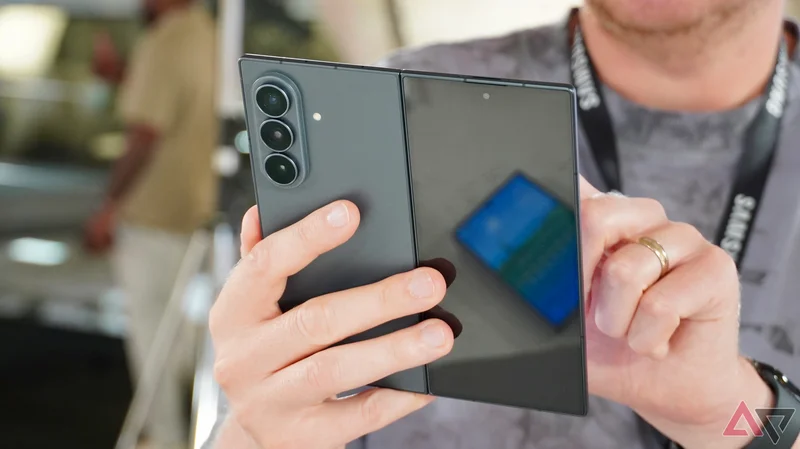
Samsung has been doing its big-screen folding phones a certain way since the start. They open like a book and have a tall, thin cover screen.
The Galaxy Z Fold 8 Ultra is the latest generation, and you may be thinking the addition of the Ultra name will make it a big upgrade over the Z Fold 7.
In reality, it’s mostly to distinguish it from the Galaxy Z Fold 8, the truly new model in Samsung’s latest foldable range. Samsung is pushing the Z Fold 8 Ultra as a productivity powerhouse, against the Z Fold 8’s more entertainment focus.
The question then becomes: is this differentiation clear enough, or has Samsung made its once clear Z Fold range more confusing than it has to be?
Related
The best foldable I've used is also the hardest to buy
Interesting screen tech upgrade
But only nerds will care
Samsung’s Flex Titanium screen technology is not only fascinating, but it’s also impressive, and it helps improve the overall foldable phone experience.
SoC
: Qualcomm Snapdragon 8 Elite Gen 5 for Galaxy
Display type
: Dynamic AMOLED 2x 120Hz
Display dimensions
: 8-inches open / 6.5-inches closed
RAM
: 12GB / 16GB
Storage
: 256GB / 512GB / 1TB
Battery
: 5,000mAh
Charge speed
: 45W Super Fast Charging 2.0 / wireless
Operating System
: Android 17 / One UI 9
Front camera
: 10MP main / 10MP cover
Rear camera
: 200MP main / 50MP wide / 10MP 3x telephoto
Wi-Fi connectivity
: Wi-Fi 7
Dimensions
: 158 x 143 x 4.1mm open / 158 x 73 x 8.9mm closed
Weight
: 215 grams
Colors
: Violet Shadow / Graphite / Cream / Green Shadow (online exclusive)
Material
: Armor Aluminum
It uses a titanium alloy film to support the OLED panel and an alloy plate to support the display structure itself. The clever system increases strength and resilience to damage, plus improves flexibility.
Looking at the Z Fold 8 Ultra, the crease has almost completely disappeared compared to other models, a by-product of Flex Titanium, and it has a flat, uniform look. The anti-reflective coating is obvious and useful.
The crease isn’t quite as minimal as on the Oppo Find N6, but it’s close. It’s also the most obvious visual benefit of Flex Titanium, and the part most normal people will notice.
The thing is, the Galaxy Z Fold 8 also uses Flex Titanium, and Samsung has engineered the hinge on its newest foldable in a way that makes it easier, smoother, and oddly more satisfying to open and close.
Trying the two phones back-to-back, it’s the Galaxy Z Fold 8 that is the more appealing folding phone to use, and I also think the entertainment focus is more relevant to more people than talking about productivity and multitasking.
The Z Fold 8’s friendlier size, hinge, and design may appeal more than the tall, thin Z Fold 8 Ultra, which has a sturdier hinge with more resistance.
What about the tech changes?
Upgraded camera and battery
If the design on the outside isn’t dramatically different, what about the rest? Both Z Fold 8 phones use a Qualcomm Snapdragon 8 Elite Gen 5 for Galaxy, and have the same software and features.
Samsung has answered criticisms about the Z Fold 7’s battery capacity, and increased it to 5,000mAh for the Galaxy Z Fold 8, something enabled by the Flex Titanium technology taking up less space inside the phone. It’s a silicon-carbon battery and has 45W wired and 20W wireless charging.
Camera improvements may be a little less satisfactory, with the 200-megapixel main camera and the 10MP 3x telephoto both making their return, and only the wide-angle camera getting an upgrade from 12MP to 50MP.
The Z Fold 8 Ultra’s camera uses Samsung’s ProVisual Engine and includes a Cine LUT video editing mode with four different presets. While it’s not going to compete with the Galaxy S26 Ultra, the Z Fold 8 Ultra’s camera is a step up from the two-camera system on the Z Fold 8.
New software features are a repeat of what’s on the Galaxy Z Fold 8. Now Nudge opens apps in a split window view from a contextual notification in apps like messages, and it looks like it’ll be useful. Gemini Notebooks is a take on other brand’s AI memory features, collecting photos and documents together and summarizing them.
A confusing line-up
It’s not an easy choice
The Galaxy Z Fold 8 Ultra is exactly what you think it is. It’s a modest upgrade over the Galaxy Z Fold 7, with some very clever internal engineering to make key spec updates possible.
Calling it the Ultra is an unusual marketing decision, when in reality just calling it the Z Fold 8 would have made its position in the range clearer for buyers, and adding something else to the other Z Fold 8 model would have highlighted its newness.
After all, it’s the new model here, and the Z Fold 8 Ultra is the annual update most people familiar with the range would expect. Calling it the Ultra doesn't excuse the $100 price increase over the Galaxy Z Fold 7 either.
What does the Ultra give you? A slightly larger capacity battery, a telephoto camera, and a different design and hinge feel compared to the Z Fold 8. If you didn’t “get” the Z Fold’s size and aspect ratio before, the Z Fold 8 Ultra won’t change your mind. It’s not shaping up to be much of an upgrade over the Z Fold 7.
- Samsung Galaxy Z Fold 8 Ultra (left), Samsung Galaxy Z Fold 8, and Samsung Galaxy Z Flip 8
- Samsung Galaxy Z Fold 8 Ultra, Samsung Galaxy Z Fold 8, and Samsung Galaxy Z Flip 8
Close
- Samsung Galaxy Z Fold 8 Ultra (left), Samsung Galaxy Z Fold 8, and Samsung Galaxy Z Flip 8
-
- Samsung Galaxy Z Fold 8 Ultra, Samsung Galaxy Z Fold 8, and Samsung Galaxy Z Flip 8
The Galaxy Z Fold 8, however, may change a few minds, and I love that Samsung has added a new shape and style to the range. It may not have hit the right methods to differentiate them with its marketing yet, but anyone who goes and tries them both out will instantly see and feel the differences between them.
What will be interesting is which model becomes the more popular one. The Z Fold 8 Ultra’s size and shape are played out in the world of foldables, while I think the Z Fold 8’s relative newness and extra versatility is likely to turn more heads.
Samsung Galaxy Z Fold 8 Ultra price and availability
The Samsung Galaxy Z Fold 8 Ultra is available to pre-order from July 22, ready for release on August 7. It starts at $2,100 or £1,899. This represents a $100/£100 price increase over the Galaxy Z Fold 7.