No system malfunction found, after 432 students report O-level English oral discrepancies
AI generated
Follow our live coverage here.
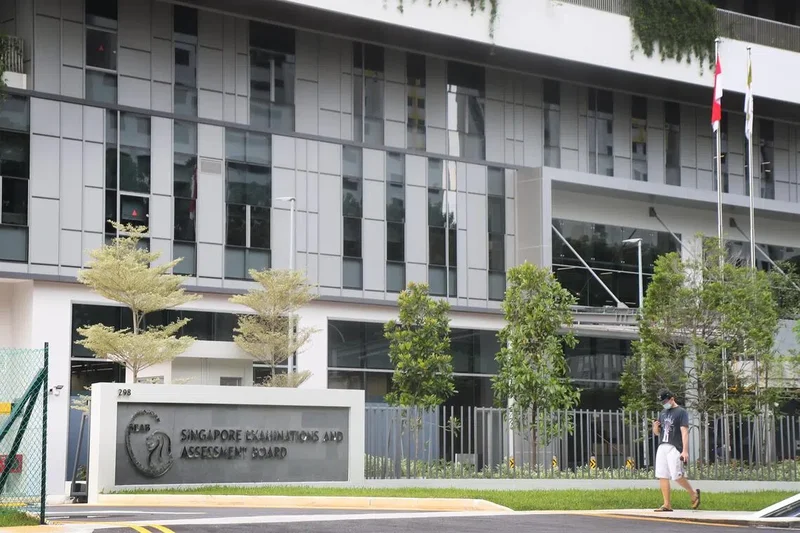
SINGAPORE – Oral examiners and students were shown the same question during the O-level English Language examination on July 15, and investigations found no evidence of a system malfunction, despite 432 candidates reporting discrepancies.
Senior Minister of State for Education Janil Puthucheary told Parliament on Aug 5 that the authorities had not observed any pattern across the reports of the candidates, who came from 200 different oral examiner teams. Recollections of the text prompts also varied significantly, he noted.
“There was only one source that all candidates’ and examiners’ accounts accessed,” Janil said, as he laid out the steps the Singapore Examinations and Assessment Board (SEAB) took, including verifying the examination material and reviewing all digital logs.
It was also not a cybersecurity incident, he added.
Janil was responding to eight questions from MPs after some candidates alleged that they were shown a different question during the 10-minute preparation period from the one read aloud by examiners during the assessment during their oral exam.
The issue first surfaced when students took to Reddit to report the discrepancy, with others saying that they had experienced something similar. In response to queries, SEAB had on July 18 said that no discrepancies were found.
MPs asked for details on whether SEAB had thoroughly investigated the alleged discrepancy, how many students and schools were affected, what support had been given to affected candidates, and whether the oral exam process would be reviewed going forward.
Janil said the actual prompt shown on July 15 was: “Who do you think would go to a place like this for a haircut? Why do you say so?”
A total of 173 candidates reported discrepancies on the day of the examination. That number rose to 432 over the next few days. Nearly 5,000 candidates took the English Language oral examination on July 15.
Investigations began the same day, Janil said, with SEAB conducting system-level checks and reviewing individual candidates’ accounts in the e-Examinations system, which logged the prompt and video each candidate had accessed.
SEAB also examined digital logs of how the exam material was authored and delivered, as well as what was displayed on individual screens during the silent preparation period, and ran cybersecurity checks to rule out a compromise of the system.
“The investigation showed that the prompt on candidates’ screens matched the prompt in the approved examination materials,” Janil said. “Investigations showed that in all examination centres, oral examiners and candidates accessed the same examination material during the oral examination on July 15.”
There was no discernible pattern – and no particular order – observed across the affected 432 candidates. For instance, the 2nd and 8th candidates from one oral team made reports, while for another, it was the 3rd and 10th candidates, Janil said.
The discrepancies reported were not about what the oral examiners asked, but about candidates’ recollection of the text prompt at the preparation station differing from what was read out, he noted.
He added that recollections themselves varied widely, even among students examined at the same centre by the same oral team.
Some recalled the prompt as “Would you go…”, others as “Would you visit…”, “Would you be interested…”, “Would you cut your hair (at the place shown)?” or “Why would I go…”, among other variations, Janil said.
“Putting together the technical details, the distribution pattern of the incidents across the stations, schools and time, as well as the variety of phrases reported by the students, SEAB has concluded that the cause for these incidents was not technical in nature nor the result of a deliberate or malicious act,” he said.
Candidates who reported discrepancies also had “comparable” mean scores with those of their peers who sat the oral examination on July 15, Janil said. The mean scores of those affected are also comparable with those of candidates who took the other four O-level English oral exam sessions.
For candidates who experienced “significant distress” from the incident, schools are working with them to apply for special consideration, Janil said.
Special consideration is an “evidence-based process” by SEAB to review the final grades for candidates whose “performance had been adversely affected by circumstances beyond their control during the examinations”.
Each case will be evaluated on its merit, Janil said, adding that some applications have been made, in response to Hany Soh (Marsiling-Yew Tee GRC), who had asked if students who have submitted appeals will be updated on the outcomes.
Janil said that SEAB will learn from this incident about how it can reduce the risk of prompts being misread and prepare students better. Non-Constituency MP Andre Low had asked whether the Ministry of Education would consider redesigning or user-testing oral exam questions in future to prevent similar confusion.
GovTech was also brought in to audit technical platforms and processes, and came to the same conclusion as SEAB, said Janil, in response to Kenneth Tiong (Aljunied GRC), who asked if SEAB would allow an external party to review its evidence.
Examiners take a “positive marking” approach; they do not look for exact compliance with a template answer, but assess students’ oral skills, said Janil, addressing David Hoe’s (Jurong East-Bukit Batok) question about what happens from the examiner’s perspective when incidents like these arise.
Examiners look at vocabulary, sentence structure, and how students organise and build on ideas, Janil said, adding that this is one reason the marks between students who reported discrepancies and those who did not are comparable.
“SEAB will review the oral examination processes for students to read the oral prompt more carefully during the 10-minute preparation time,” Janil said. “SEAB also remains committed to ensuring that all candidates, including those who might have misread the prompt, are assessed fairly.”