Welcome to The India Fix by Shoaib Daniyal. A newsletter on Indian politics.
As always, if you’ve been sent this newsletter and like it, to get it in your inbox every week, sign up here (click on “follow”).
India’s prime minister Narendra Modi has, in his 12 years in office, cultivated an image of being larger than life. He rarely addresses the country outside of election rallies.
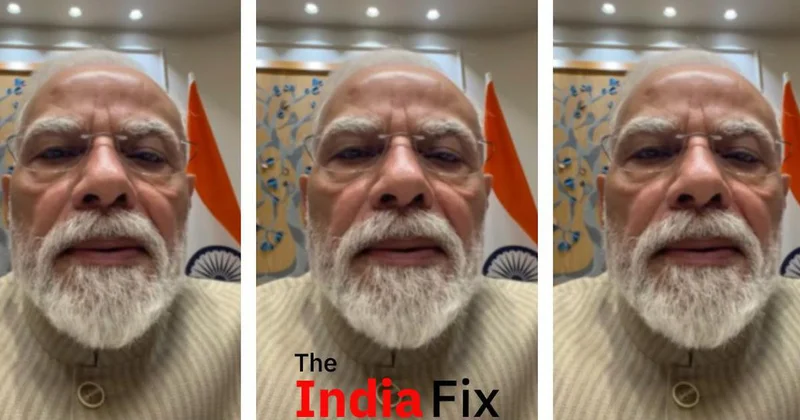
So late on Friday, when he took to Instagram to release a video in a vertical format, it was already an event. Even more remarkable was the fact that Modi was on the back foot. He seemed to adopt a conciliatory approach towards protesters in Delhi’s Jantar Mantar angry with his government for corruption in the education sector.
Specifically, Modi addressed the viral clips of young women protestors using profanity to poke fun at him. “I forgive misguided children who abused me,” he said. “Let’s show them the right path.”
For a muscular, right wing movement like Hindutva, this was an unusual position to take. Indeed, Modi’s video was released after his supporters had been hunting down young women and girls for making fun of the prime minister using purportedly obscene language.
“There is no limit to the death threats and rape threats that I’ve been receiving,” a distraught 23-year-old Shraddha Singh told my colleague Ayush Tiwari.
So terrifying was this online mob that a 15-year-old was forced to release a video apologising to Modi. “This is my first and last mistake,” she said in the video, clearly terrorised by what was happening. “I will never do anything like this.”
Her widowed mother had to flee her Noida home, reported the Indian Express, given that police and Hindutva groups were turning up at their doorstep.
Failed playbook
All of this comes in the wake of the Jantar Mantar protests when young protestors forced the Modi government to fire its education minister. It was a spectacular embarrassment for the Bharatiya Janata Party, given that the Hindutva party has practised a brawny politics of never bending to public pressure. Unlike in previous regimes, when ministers would resign in case of significant failures, the last 12 years have not seen a single instance of this. (MJ Akbar, the only Modi minister who’s resigned, left because of a personal criminal allegation.)
The BJP’s playbook was to simply brazen it out – helped by a largely pliant media that rarely asks hard questions. Demonstrations against the BJP have been met with violence. In one egregious case, the Adityanath government in Uttar Pradesh tried to head off protests by forcibly cremating the body of a teenager who had allegedly been raped and murdered.
The BJP today runs what is possibly India’s strongest Union government. It controls all key state institutions and, using them, ensures that Opposition parties are cut down by effecting defections. Since it also controls much of the media, that means it enjoys almost unchecked power.
So why is it so bothered by some young woman’s ribaldry on a street in Delhi?
Extremism kryptonite: ridicule
In 1946, an American activist called Stetson Kennedy did something incredibly brave by infiltrating the United States’ violent White nationalist group Ku Klux Klan. However, since so much of the state apparatus was controlled either by Klan members or people sympathetic to it, Kennedy was forced to turn to the entertainment sector. He collaborated with a popular children’s radio show called the Adventures of Superman to create a villain based on the Ku Klux Klan.
This, almost overnight, changed the image of the White nationalist group. From being held in awe, they became an object of ridicule. “Kennedy’s mission was to deflate that [Klan’s psychological] power by reporting on the Klan with ridicule, holding up their ritual as childish, and revealing the priesthood’s secrets to break their spirits,” his biographer wrote. The effect on the Klan was immediate. Attendance dropped at meetings. It turned out that poking fun at this extremist group was more effective than the legal action that had been taken until then.
An even more pertinent example of this is from the 2013 Gezi Park protest in Turkey. Like India, Turkey is ruled by a right-wing populist strongman, Tayyip Erdogan. To puncture his image, protestors not only used humour but also, like in Jantar Mantar, married it with profanity aimed at the prime minister. “We are continuously smooching Tayyip,” one graffiti read.
The protestors constantly poked fun at Erdogan’s hypermasculine image using “swear words that question his penis size, heterosexuality, and impenetrability”, one article noted. Like with Modi, the swearing was what most affected Erdogan and the ribald graffiti was most actively targeted for removal by his government.
Arguably, Indian protesters were quite mild compared to their Turkish counterparts. Swear words against Modi were only a very small part of the protest. But given how vulnerable right wing, masculine politics is to mockery, it is no wonder that the profanity seems to have made the most impact.
Also not surprising is the fact that ditties infantilising Modi have also gone viral, especially one that calls him a “56-inch monkey”, poking fun at the possibly exaggerated masculine claim that he has a 56-inch-wide chest.
They started it
Though Hindutva supporters are angry that their leader was abused during the protests, ironically they must bear quite a lot of the blame for it.
For one, the open use of expletives in Indian politics is very much a post-2014 phenomenon. Much of this includes abuse by BJP supporters and functionaries. Many of these abusive people are powerful and openly supported by the BJP’s top brass. On social media, many abusive handles are even followed by the prime minister himself.
In 2023, a BJP MP, Ramesh Bidhuri openly abused a Muslim Opposition MP in Parliament with shockingly communal slurs. He faced no serious action and is now a BJP MLA. Things have come full circle, in fact, and Bidhuri used communal slurs against the Jantar Mantar protestors too.
If the BJP now, of all parties, complains of bad language, that would hold little water given its own history.
Too much of a godi thing
Moreover, Modi’s extreme veneration by the godi media or pro-government media eventually made him a ripe target for ridicule. Given that Gen Z has come of age in the Modi era, all they have seen is the prime minister being near-worshipped on television. There were no standard pressure valves for anger against the government to be expressed.
When Indians eventually found a way to express anti-government narratives during the protests, the anger exploded after being pent up for so long – and some of this took the form of ribald ridicule of Prime Minister Modi.
With the godi media failing to protect Modi’s image, online mobs and the police took over, physically threatening and doxxing young women for ridiculing the prime minister. Unfortunately for the BJP, physical force is a poor instrument for narrative control, which meant Modi himself had to crack open his Instagram to “forgive” those who made fun of him.
The BJP owes a significant part of its power to the persona of Modi himself. However, as has been clear for a couple of years at least, Modi’s star is not ascendant anymore. The BJP was unable to win a simple majority in the last general election and its power now depends more on the control of state institutions rather than actual popularity.
And things have now reached a pass where Indians are taking to ribaldry to try and undercut Modi. This should worry the BJP and its supporters.
We welcome your comments at letters@scroll.in.