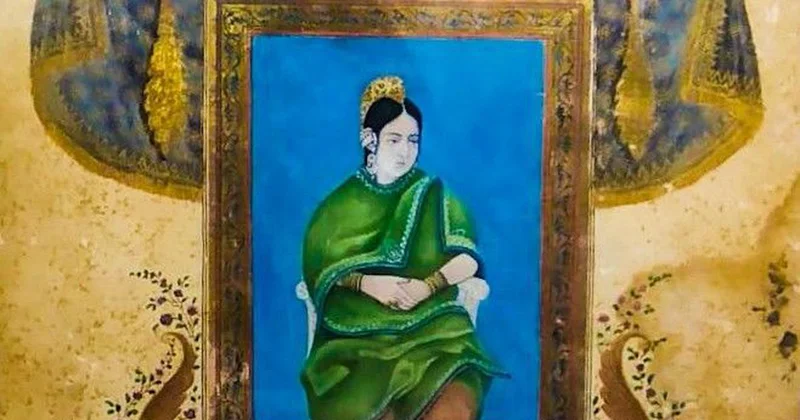
So little is clear about Hazrat Mahal’s early life that not only is her date of birth unknown but her birthplace too. Recent writers, including some online, have confidently claimed she came from Faizabad, the first nawabi capital to the east of Lucknow. Or perhaps Farrukhabad to the west. But frequent repetition doesn’t validate a statement. The honest response has to be that at present we don’t know where she was born nor exactly when. Her parents’ master, Ghulam Hussain Ali Khan, cannot be traced. She is first mentioned by King Wajid Ali Shah in his youthful autobiography Parikhana, when he notes briefly, “Through Amman and Imaman, a professional courtesan [Hazrat Mahal] who appealed to me, was included with the paris [fairies] after being given the title of Mahak Pari. Her training in music and dance commenced likewise.”
More is known about Amman and Imaman, who were sisters and singers in Farrukhabad, a city on the river Ganges about 130 miles distant from Lucknow. The sisters came from a musical family and had become well known through their singing performances in the household of a wealthy nobleman. “God knows why they chose to leave all that and approach my Court,” wrote the king with false modesty, though the reasons should have been clear.
Farrukhabad had been part of British India since 1801, when a British agent representing the governor-general was installed there. The adjacent cantonment of Fatehgarh housed the administrative centre and associated buildings with British staff. It was very different from Lucknow, particularly in its cultural activities, and musical patronage did not have the same status that it did in the Awadh capital. The famine of 1837–38 in the district surrounding Farrukhabad had been so severe that the Company had had to lower its demands for land revenue, indicating that landholders had been impacted both by the loss of produce and peasants to work the land. This would also have reduced the money available for luxuries like musical entertainment, so it is not surprising that Amman and Imaman travelled to Lucknow, where many more opportunities were to be found and even, if they were lucky, the patronage of the king. The sisters were joined by their father, Nathu Khan, two uncles and a cousin. But it was their brother, Ghulam Raza, who most impressed Wajid Ali Shah with his own musical talent and handsome appearance, and who probably smoothed the way for his family’s entry into the palace in 1843.
Within a short time, Amman and Imaman formed an intimate relationship with the king. They truly loved him; he wrote: “Together with the [female] daroga Najm un Nisa, they would take care of all my needs. I accepted Amman and Imaman as my sisters. These three women had a special place in my heart.’ When the king was suffering from an unrequited love affair, ‘these three of my close friends and confidants would soothe me by singing romantic songs.”
So did the family bring Hazrat Mahal with them from Farrukhabad or did they discover her in Lucknow? It is worth examining the term that the king used when he describes her for the first time in Parikhana. She is an aurat khanagi, which translates literally as a woman of the house – but the meaning is not that of a domestic servant but of a “kept woman” or select prostitute. Hazrat Mahal would not have been roaming the streets looking for customers, nor would she have been confined to a kotha or brothel where men could choose their partners. She is more likely to have been a mistress or temporary wife of a well-to-do man before she met Amman and Imaman, who recognised her potential and may have presented her to the king as a gift.
This is not such an outrageous idea as it may seem. Wajid Ali Shah had an insatiable appetite for young women and the financial means and legal justification to satisfy it. The extraordinary number of marriages he undertook (around 375) is explained by the Shi’a recognition of two kinds of union: the nikah or permanent marriage that lasted for life, and the mut’ah or temporary marriage which was contracted for a limited time, agreed upon by both parties (in theory) and for a certain sum of money, paid upon the ending of the arrangement. Wajid Ali Shah’s first nikah marriage had taken place in 1837 when he was 15, before he was named heir to the throne. This was to Khas Mahal, a woman of noble birth who was five years older than her husband. Over the next three years, she produced three sons, whose fates are recorded later in this book.
Becoming a father while still a teenager himself did not inhibit Wajid Ali Shah from embarking on numerous affairs, which he described in his autobiography. At first, Khas Mahal remained silent. There was in fact nothing she could do and when she did tackle her husband verbally, he told her it was his fate to behave like this and asked Khas Mahal to choose another mut’ah wife for him. Khas Mahal, he added, “was an extremely intelligent woman, well aware of the prevailing situation”. Without wasting time, she began procuring young women for him under the pretext of employing them first as maids. Her revenge was to come years later. Many of Wajid Ali Shah’s mut’ah wives had been procured for him, often by other women who were anxious to please and hopeful of a financial reward. Amman and Imaman, who introduced Hazrat Mahal, came up next with Sardar Pari, “the daughter of a courtesan and barely 11 years old”. Another 11-year-old, Haidri, was presented “as a tribute” by her elder sister, Dilbar.
Hazrat Mahal’s first name – the name she was given as a child – is unknown. Again, there has been speculation but no firm information. It was usual for girls and women accepted into Wajid Ali Shah’s household to be renamed, and Mahak Pari or “fragrant fairy” was the name given to her. Her training in music and dance is not spelt out but she would have been enrolled on the Pari Khana, a dance school in the new part of Lucknow, which was embellished with marble flooring to provide a smooth surface for the barefoot dancers. The building was called Rashk-e-Iram (Envy of Paradise) and its exact location has not been identified. There was also a hostel on the premises with bedrooms for the paris which were guarded by female soldiers, both to prevent them from being molested by intruders and to stop them escaping, as some tried to do. Musicians, including Ghulam Raza, worked daily in the Pari Khana, tutoring the fairies under the watchful eye of Wajid Ali Shah.
A small online painting whose provenance and owner have not been identified shows the king fingering a cane while four elaborately dressed and bejewelled women are lined up in front of the male musicians. Ghulam Raza, who was described as short in stature, may be the man holding a sarangi. The scene takes place at night, and two servants are holding flaming torches. Everyone, including the king, is barefoot. The women’s complexions are noticeably different in colour. Two are pale brown, with the favoured “wheaten” complexion still popular in India today; one is darker, though not black; and the fourth is a white woman who has somehow ended up as an Indian fairy. The painting shows not only Wajid Ali Shah’s very hands-on approach to musical training but also the variety of women who were being trained. The king is depicted with a halo, the signifier of royalty. Recently, another version of this painting has emerged. It is similar, though not identical, in that the king does not have a halo, so his dark, curly hair merges into the black background.
Both these paintings have been identified by art historians as copies by Indian painters of a lost original by a European artist. It had become the custom among the nawabs to employ a European court artist, something that had begun informally during the reign of Nawab Asaf-ud-daula, who had attracted a large number of artists from the West. George Duncan Beechey, the likely painter of the original version, was the last court artist and had served several generations of rulers before Wajid Ali Shah. Towards the end of his life he sent most of his paintings home to England by ship which unfortunately sank en route, and with it a lifetime’s work.6 It was not unusual for Indian artists to copy European paintings and in some cases, such as these Pari Khana pictures, they are all we have left. What is interesting about the original painting is the importance that Wajid Ali Shah attached to the Pari Khana. No small, private dance school, it was important enough to have Beechey commissioned to depict it; to show the king actively, almost intimately, involved with the dancers, of whom Hazrat Mahal may be one.
Even if she had shown promise as a singer or dancer, Hazrat Mahal’s training in the Pari Khana would have been brief. She was introduced to Wajid Ali Shah in 1843 by the musical family from Farrukhabad and by the beginning of the following year she was pregnant. Pregnancy for mut’ah wives meant purdah, that is, seclusion for nine months in designated areas of the palace. If they had to go out – to visit a shrine, for example, or an ailing relative – they were heavily veiled in black and carried in a palanquin with its curtains drawn. Hazrat Mahal’s son was born in September or October 1844, during the month of Ramzan in the hijri year 1260. Accordingly, he was named Mirza Muhammad Ramzan Ali. Wajid Ali Shah was delighted. “The angel of day and night conveyed the good news of an infant flower’s arrival,” as he put it, and “my darling exalted son was born.” The baby’s grandfather, King Amjad Ali Shah, was equally pleased. He gave the baby the title of Mirza Birjis Qadr and ordered an eleven-gun salute. The baby’s mother, previously known as Mahak Pari, was given the new name of Iftikhar-un-nisa or “pride among women”. The “infant flower” was the fourth son to be born to the 21-one-year-old Wajid Ali Shah and the birth gave him additional status in his family and in his own eyes, too.
Excerpted with permission from Hazrat Mahal: The Rebel Begam of Awadh, Rosie Llewellyn-Jones, Macmillan.
We welcome your comments at letters@scroll.in.