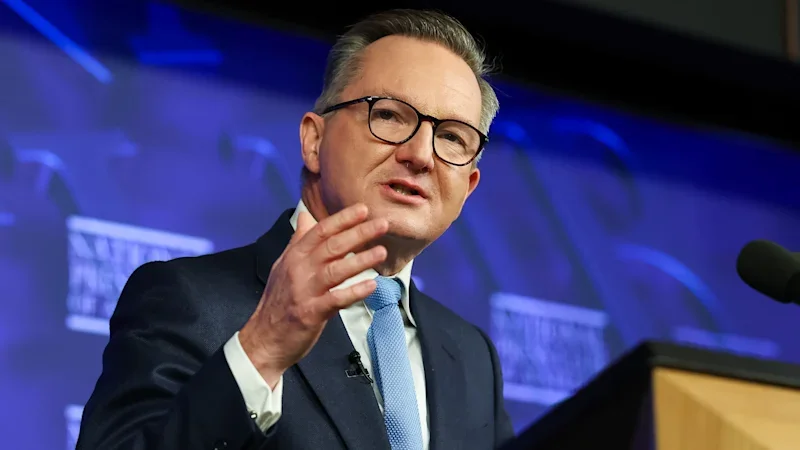
Climate and Energy Minister Chris Bowen has said he will use federal power to force the Queensland and Northern Territory governments to fall into line with his plan to require data centres to fully offset their electricity use with investments in renewable energy.
Describing the surging use of artificial intelligence and climate change as the “defining issues of our age”, Bowen said he would not allow states to ignore the impact on the climate or grid stability in their race to attract data centre construction.
“While I always prefer to work with my state and territory colleagues, the Commonwealth will not be standing by and letting a race to the bottom of states falling over themselves to attract data centres, at the cost to household bills, reliability or emissions”, he said during an address to the National Press Club.
“We will use all the powers available to the Commonwealth, including Commonwealth legislation, to ensure that Australian households and Australian energy reliability is put first: even if some states have different ideas.”
Bowen outlined new regulations he had already flagged, based on what he called a “causer pays” principle.
“If you cause the cost, you will pay the cost. It means that if data centres, and other large energy users, need new or accelerated transmission, they have to foot the bill.”
He said the government would use the existing “guarantee of origin scheme”, which tracks and verifies the origin of renewable electricity through digital certificates, to ensure that data centres prove they are fully offsetting their power use with renewable energy that may not otherwise have been built.
“For example, data centres could sign power purchase agreements or invest in renewable generation directly,” Bowen said.
“An agreement from a proposed wind farm, for example, that may have received support under the capacity investment scheme or a state scheme and environmental approvals, but has not yet reached final investment decision stage, could qualify as new additional renewable energy.”
He said that data centres must also prove that they have enough firmed power to back them up, strengthening the stability of the energy grid.
The government on Wednesday formally requested the Australian Energy Market Commission to make a rule change forcing large data centres to make “appropriate contributions” to fund new power poles and wires to ease the strain they will add to the grid.
Belinda Dennett, chief executive of Data Centres Australia, the industry’s peak body, said the organisation welcomed the principle that the industry invest in renewables and pay its own way. But she said other users should help pay for shared assets.
“Where data centres pay for shared assets that others use, that contribution has to be properly recognised. That is core to a user pays system,” she said.
Dennett argued a national framework should be designed to help speed up renewable supply and connections to the grid.
At an energy ministers meeting last week, Queensland and the Northern Territory, states that back the use of fossil fuels, split with Bowen and ministers from other states over these plans.
Queensland Energy Minister David Janetzki said after the meeting that his state supported “reliable and sustainable” power, a reference to fossil fuels, not “underdeveloped ideas that hand increased power to Canberra”.
Queensland premier David Crisafulli last month made a bid for more data centre investment, declaring that “only one state believes that the energy source for [data centres] should come from wherever it is best placed, not exclusively from one source of energy.
“On the back of that, I’m very confident that we’re going to get a level of investment in data centres in this great state of Queensland,” he said.
Asked at the press club how he would secure the cooperation of Queensland and NT, Bowen said the federal government would use all of its powers.
“The clearest one is obviously Commonwealth legislation. We said we’re going down that road. The Constitution is pretty clear about any conflict between Commonwealth legislation and state legislation,” he said.
“The only thing that would require unanimity from the states [and] territories is a national energy law change. That’d be great if we had it. We don’t, so we will do it other ways.”
In his speech, Bowen described data centres as energy consumption “whales” that would be using 10 per cent of the national grid’s electricity by 2050, but said they were welcome as long as they abided by the new rules.