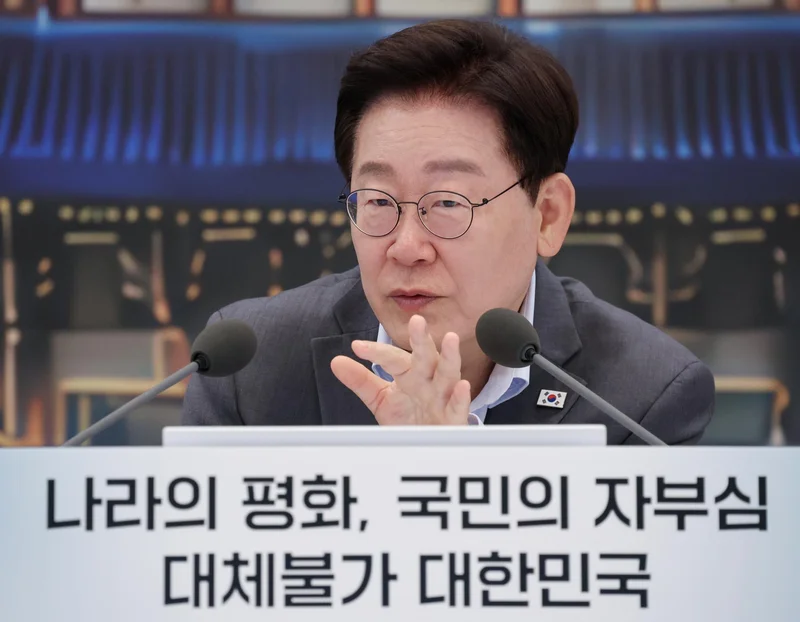
President Lee Jae Myung criticized the prolonged delay in the return of lands formerly used by U.S. Forces Korea (USFK) to the Korean side, Wednesday, saying it "defies common sense" and urging officials to speed up negotiations with Washington.
Lee argued that Korea has already fulfilled its obligations under the bilateral agreement for the relocation of USFK headquarters out of U.S. Army Garrison (USAG) Yongsan in central Seoul, but many of the former military sites that were supposed to be returned remain unavailable for public use.
In support of his claim, Lee noted that Korea spent more than 10 trillion won ($7.02 billion) to expand USAG Humphreys in Pyeongtaek, Gyeonggi Province, which became the main hub for American troops on the Korean Peninsula after the relocation was largely completed in 2018.
"Negotiations over the return of former U.S. military sites are taking far too long. It simply defies common sense,” the president said during a joint policy briefing from the foreign, unification, defense and veterans ministries at Cheong Wa Dae.
“We spent an enormous amount of money to build Camp Humphreys so U.S. forces could relocate there. Yet many of the sites that were initially supposed to be vacated still have not been returned," Lee said.
He added that some sites had technically been returned but remained unavailable for public use because post-return procedures had not been completed.
He even argued many of the reasons cited for the delay were "little more than excuses."
Defense Minister Ahn Gyu-back replied that the U.S. side had been "somewhat passive" in the negotiations and that Seoul had continued urging it to speed up the process.
The president asked Foreign Minister Cho Hyun whether the Ministry of Foreign Affairs was also involved in the negotiations.
Cho replied that the ministry has been playing an active part and would step up its efforts.
Lee also questioned the sequencing of the relocation agreement, saying Korea should not have financed expansion and construction at USAG Humphreys before receiving the former military sites in return.
He went on to say that the delayed return underscored the need to avoid providing assistance upfront in future negotiations, stressing that Korea's support should be linked to the other party's fulfillment of its commitments.
"You should never pay in advance," Lee said. "We trusted that relocation and the return of the lands would proceed simultaneously because that's how relations between countries should work. But that principle has not really been honored."
While most of the troop relocation to Pyeongtaek was completed by 2018, negotiations over returning former U.S. military sites have dragged on because of disputes over environmental investigations, cleanup responsibilities and administrative procedures.
The delays have complicated redevelopment efforts, particularly in northern Gyeonggi Province, where many former U.S. bases are located.
About 180 square kilometers of land formerly housing USFK facilities has been returned to Korea's ownership nationwide, including 72.4 square kilometers near the Demilitarized Zone available for redevelopment.
However, only about 17 square kilometers of that land has so far been developed because of funding shortages, regulatory restrictions and other obstacles.