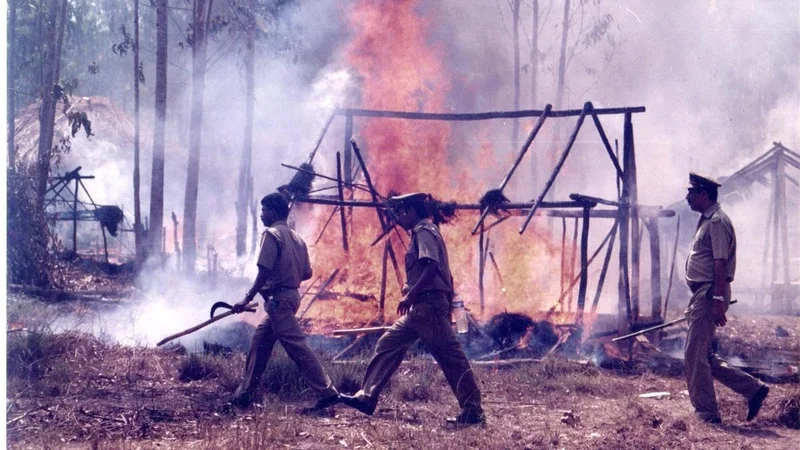
Sivan Yogi was just 14 when he accompanied his father, Yogi (Jogi), to the Muthanga Wildlife Sanctuary in Wayanad, Kerala, where hundreds of landless Adivasi families occupied forest land in January 2003, to assert their right to land. More than a month later, the agitation ended in a violent confrontation between Adivasi protesters and the Kerala Police on February 19, 2003, leaving Jogi and K.V. Vinod, a police constable, dead.
The Muthanga land agitation has returned to the limelight after the Kalpetta Principal Sessions Court, on July 31, acquitted all the accused who stood trial, including social activist M. Geethanandan, in the case relating to the murder of Vinod. However, it convicted Geethanandan and three others on related charges, including attempting to murder a senior police constable, abducting a Forest Range Officer and criminal conspiracy, sentencing each of them to five years of rigorous imprisonment.
While the death of Vinod was investigated by the Central Bureau of Investigation (CBI), Adivasi organisations say Jogi’s death was never properly investigated, reviving long-standing demands for justice and scrutiny of the police operation and the alleged human rights violations during the agitation.
For Sivan, the verdict has reopened wounds that have remained unhealed for more than two decades.
“I lost my mother, Kali, at a young age. For my five siblings and me, our father was everything. He was killed in the police firing that sought to suppress the agitation and evict us from the land that was rightfully ours,” recalls Sivan.
Jogi, belonging to the Adiyan tribe, died of a head injury after he was struck, reportedly by a rubber or plastic bullet. Following his death, Sivan’s sister, Sita, was offered a government job, and the family was allotted 1 acre of land at Thettamala along with several other landless Adivasi families. However, the land remains uninhabitable and unsuitable for cultivation.
“Twenty-three years later, our family is still waiting for justice. No proper investigation has been conducted into our father’s death. We want the government to carry out a thorough investigation. It should also fulfil its promise of providing cultivable and habitable land to our family and the other Adivasi families,” says Sivan, who now earns a living through odd jobs.
Following Jogi’s death, the police registered an FIR, but the investigation made little progress. The CBI later concluded that the police had resorted to non-lethal firing in self-defence and to protect the reserve forest and that Jogi’s death, allegedly caused by a rubber bullet, was unintentional. It found that no criminality could be attributed to the police firing, observing that it had been ordered by the Executive Magistrate present at the scene.
The allegations that justice has eluded the indigenous people who took part in the protest are echoed by many others who participated in the agitation.
“I was 25 when the police beat me, fractured my arm and hit me on the head,” says Kavitha, who was part of the agitation. “I lost consciousness and was later shifted to Sulthan Bathery Taluk Hospital, where I underwent treatment for 53 days. A case was also registered against me, but the Kalpetta court acquitted me last week.”
Now living with her family on a 5-cent plot near the forest fringes at Kattikkulam, Kavitha says the government allotted them 1 acre of land at Valad, but it was washed away in the 2018 floods. “We were promised alternative land, but we are still waiting.” Her husband, Anilkumar, was among those convicted by the Kalpetta court.
Charges of excessive force by police
According to the protesters, many of whom belonged to some of the most marginalised tribal communities, including the Paniya, Adiyan and Kattunaikar, the police operation was marked by indiscriminate violence, cruelty and brutality. They alleged that women and children were among those caught up in the operation, with several sustaining severe injuries. They also accused the police of using excessive force against women and children and alleged that some children were taken into custody without justification, detained and lodged in prison along with adult accused.
The Adivasi Gothra Maha Sabha (AGMS), which spearheaded the agitation, says the police firing and the criminal cases that followed disproportionately targeted the Adivasi community.
“Many who took part in the agitation continue to live with serious injuries, disabilities and psychological trauma, while some women were allegedly subjected to sexual violence. Even a direction issued by the then National Human Rights Commission to conduct a comprehensive probe into the alleged human rights violations was not implemented. While the death of constable Vinod was thoroughly investigated, Jogi’s death was registered only as an unnatural death and never properly probed,” says Janardhanan P.G., general secretary of the AGMS.
Though The Hindu contacted Kerala Home Minister Ramesh Chennithala seeking a response to the demand for a fresh investigation into Jogi’s death, no response had been received at the time of publication.
AGMS is planning a series of protests from August 9, the International Day of the World’s Indigenous Peoples.
Published - August 05, 2026 12:34 pm IST