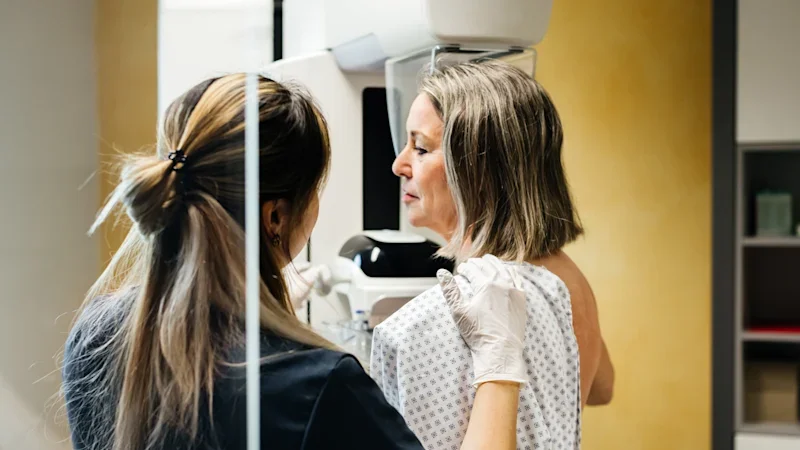
A radical overhaul of Australia’s breast cancer screening will implement a risk-based approach to detect cancers earlier with new technologies beyond mammograms, replacing the current one-size-fits-all, age-based model.
Australia’s federal, state and territory governments on Wednesday endorsed a new national strategic framework for BreastScreen Australia, based on the latest evidence of risk assessment and new technologies.
A high-priority action is establishing nationally consistent two-tiered risk-based screening pathways based on women’s risk factors for developing breast cancer – including breast density – that deploys a range of screening techniques, including contrast-based imaging and AI prediction models.
Breast cancer is the most common cancer diagnosed in females in Australia. More than 20,000 people are diagnosed, and about 3000 women die of breast cancer every year.
Breast screening prevents up to half of breast cancer deaths among Australian women aged 50 to 74, but take-up remains low at 52 per cent, well below the 70 per cent target.
Associate Professor Carolyn Nickson at the University of Sydney’s Cancer Elimination Collaboration group said the best available evidence showed a risk-stratified approach for women aged 50 to 74 could lead to some breast cancers being detected earlier, save lives and reduce the intensity of treatment.
“We know that we can identify groups of women who may benefit from having some more intensive screening protocol than what’s standard for this screen,” said Nickson, who was part of an expert group tasked by the federal government to explore risk-adjusted breast screening program options.
One such group was women with higher breast density, who have a higher risk of breast cancer, and whose tumours can be harder to see on mammograms.
Risk-stratified screening could also help determine which women in their 40s may benefit from starting screening sooner and with screening technologies better suited to younger women.
“That could be contrast-based imaging or a change to their time between screenings,” Nickson said.
A revamped BreastScreen Australia could also include a risk assessment questionnaire that considers family history and lifestyle factors, as well as AI mammogram image processing.
“If we can combine all of that information, we know that we can identify groups of women who may benefit from having some more intensive screening protocol than what is standard,” she said.
Australian research published in the prestigious Lancet medical journal in March showed an AI tool known as BRAIx could help predict which women were at high risk of developing breast cancer after receiving a mammogram all clear.
One in 10 women with the highest BRAIx risk scores developed cancer within four years – even after receiving an “all-clear” breast screen.
The AI tool searched for patterns in mammograms to pick up signals for risk invisible to the human eye, making it easier to detect signs of cancer in dense breasts.
Associate Professor Davis McCarthy, whose team at St Vincent’s Institute of Medical Research led the development of BRAIx, said the Australian government’s new risk-based strategy would do a much better job at identifying women at higher risk of developing breast cancer than the current protocol.
“It’s a very successful program, but it’s a one-size-fits-all program, and what we have in the population are many people at many, many different levels of risk for breast cancer individually,” he said of the existing BreastScreen Australia program.
“If we can get it right in terms of allocating the right people to each pathway, then we have a huge opportunity here to do a much better job of keeping high-risk women safe while keeping lower-risk women equally safe.”
The overhaul may also encourage more women to take part in screening, McCarthy said.
“Hopefully, when people see these efforts to make positive changes with good evidence behind them, they see that this is a service that’s not stuck in the past, but is looking to the future.”
The federal government will invest $1.3 million to implement the plan and help BreastScreen Australia keep pace with new technologies.
The road to Australia’s risk-based breast screening program:
- Develop a national annual screening eligibility policy
- Pilot approaches for women aged 45 to 49
- Develop a risk assessment tool
- Research alternative screening pathways for women with high breast density.
BreastScreen Australia would operate as normal while the reforms are implemented in phases over the next 10 years.
Federal Assistant Health Minister Rebecca White said regular breast screening remains one of the most effective ways to detect cancer early, preventing more challenging treatment and poorer outcomes for women.
“Early detection saves lives, and these reforms will help ensure even more women can access the care and support they need for years to come,” White said.
Since 1991, BreastScreen Australia has detected more than 140,000 invasive breast cancers in women who had no symptoms.
Breast Cancer Network Australia welcomed the announcement and urged the Federal government to publish a fully costed, 10-year implementation plan, which government modelling suggested could be $2 billion.