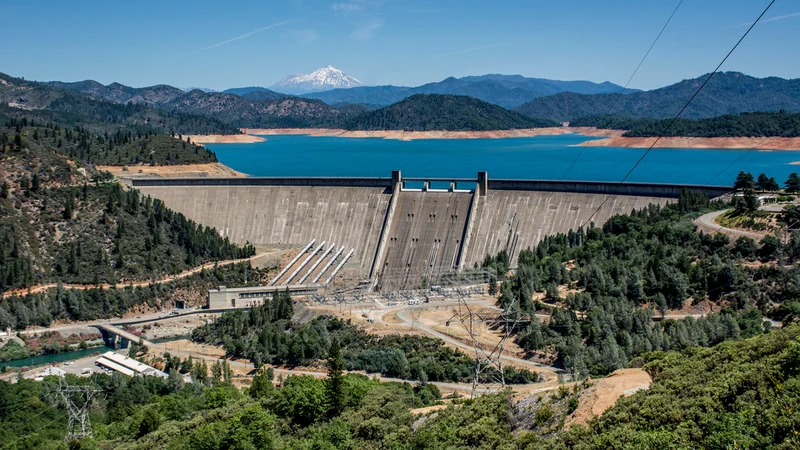
Each year, tons of soil, silt and rocks flow into reservoirs in the U.S. and get stuck there, creating a "ticking time bomb" that threatens lives and livelihoods. According to a new study, around a fifth of the world's reservoirs are currently at high risk of filling with sediment, and by 2060, half could be inoperable as a result.
The sediment takes up space meant for water, putting additional pressure on structures that were not built to contain large quantities of sand and sludge. As the reservoir fills with the material instead of water, sediment-filled reservoirs pose a serious threat to water security and the safety of people living near or downstream of them — and as the climate changes, scientists expect the problem to worsen.
"We are losing storage space in our reservoirs faster from sediment accumulation than we gain space from new dam construction," Amy East, a geologist at the U.S. Geological Survey, told Live Science.
What is dam sedimentation?
Dam sedimentation is not a uniquely U.S. problem. Rain pulls sediment down slopes into waterways. Normally, this sediment would travel through the river system, shaping the water flow, creating habitats, and fortifying coastal wetlands and estuaries against erosion. In many parts of the world, this sediment is also a vital natural fertilizer for crops. But after a river is dammed, this sediment can collect in the reservoir.
A 2023 study published in the journal Science found that sediment buildup was the greatest threat to global water storage in existing reservoirs — even more than drought.
New research, which includes smaller reservoirs, has offered a more nuanced and concerning picture. In the study, published June 5 in the journal Nature Sustainability, researchers assessed the state of reservoir sedimentation globally. They looked at more than 550,000 reservoirs, most of which spanned less than 0.4 square miles (1 square kilometre). They found that almost 1 in 5 of reservoirs globally are at high risk of filling up with sediment.
The researchers found that sedimentation is eating into global reservoir storage capacity at about 7.3% every decade. There are 16 global hotspots that are at high risk of reservoir sedimentation, threatening water supplies to more than 2 billion people and impacting more than a quarter of global irrigated land. One of these hotspots includes the western U.S.
Get the world’s most fascinating discoveries delivered straight to your inbox.
The authors found that sedimentation risk was especially pronounced in regions with dense small-reservoir networks supporting key crop systems.
"Without intervention, we project that, by 2060, more than half of all reservoirs could become functionally inoperable," the authors wrote. This includes more than half of all small reservoirs and more than a third of large reservoirs globally.
Where is it a problem in the U.S.?
North America has the second largest number of reservoirs, after Asia, according to the global survey. And at 7.8%, its sedimentation rate is higher than the global average, ranking it third after Oceania (9.9%) and South America (8.1%),
The U.S. is home to many small dams, said Matthias Kondolf, a geomorphologist at the University of California, Berkeley who wasn't involved in the study. "All the focus tends to be on the big dams, and these many, many small ones have been neglected," he told Live Science.
From the 1940s to 1970s, there was a big push by the U.S. government to build "farm ponds," he said. In western Oklahoma, for example, "all these dams are now filling up with sediment, and there's nothing in place to assess the safety of these features, which have now become threats."
Some of these dams have already failed, following large storms as the ageing dams were not able to cope with the volume of water. A 2018 study found that since 1980, there have been on average 24 dam failures a year in the U.S.
Reservoirs in some regions are more at risk than others. The western U.S. is a natural hotspot because it has a steeper topography, meaning more sediment naturally ends up in watersheds, East, who wasn't involved in the new research, said.
And in areas where human activities like farming or logging disrupt the landscape, rainfall is likely to drag even more sediment into reservoirs, East said. "Those types of land use can create sediment-producing hotspots almost anywhere."
In California, for example, more than half of small reservoirs in maize-growing areas are filling up with sediment at a rate of more than 10% a year, which threatens local maize production.
The threat to water security will be particularly acute in places struggling with wildfires, such as the western U.S. After fires, rain washes the debris and sediment into watersheds. A 2024 study in California found that most of this post-fire sediment erosion occurred upstream of reservoirs, rather than in places where sediment would move downstream directly to the ocean.
The dam-sedimentation situation is likely to get worse as the climate changes, researchers said. As the climate changes, there will be more extreme weather events, such as droughts and wildfires, adding more sediment to watersheds. Dams are designed to cope with the pressure of water, not sediment which exerts more force on dam walls. Moreover, in seismically active areas, the sediment vibrates at a different frequency than the concrete of the dam, which creates further impact against the structure. Additionally, the dams are just getting older.
"What do we do 50 or 100 years from now when we have all these reservoirs across the landscape filled with sediment, sitting there as ticking time bombs?" Kondolf said.
What can be done about it?
For a reservoir to be sustainable long-term, the amount of sediment entering it and leaving it should be the same.
"A big part of preventing reservoir sedimentation problems is upstream soil conservation in the watershed," East said. Interventions include ensuring that land use, such as agriculture or timber harvesting, follow best practice to reduce the amount of sediment washing off the landscapes.
If sediment is already in the dam, it can be difficult to manage and expensive to remediate, Kondolf said. Some dams, such as Fall Creek Dam in Oregon, have mechanisms that enable engineers to release sediment. But in the past, reservoirs were not designed to manage sediment and little thought was given to how to decommission them.
"This is one of those issues that falls in the cracks between different agencies and responsibilities," Kondolf said. Some larger facilities fall under the remit of the federal government. Other dams fall under state governments. California, for example, recently launched a state-sponsored program to future-proof the state's dams.
But smaller dams often get overlooked, Kondolf said.
One option is to remove the dams entirely. For example, sediment-related concerns contributed to the decision to remove the Elwha and Glines Canyon dams in Washington. The Elwha River later carried most of the sediment to its river mouth.
For smaller dams with a relatively small amount of sediment, "you just blow up the dam and let the sediment work its way downstream", Kondolf said.
There are other technological solutions, but they are expensive, such as retrofitting dams to enable them to pass sediment; creating a bypass to route sediment-heavy water around the dam; and mechanical dredging.
Related stories
- Thousands of dams in the US are old, damaged and unable to cope with extreme weather. How bad is it?
- 'They are trying to tame nature': China is building the world's biggest dam in an earthquake-prone region of Tibet
- Dams around the world hold so much water they've shifted Earth's poles, new research shows
Another option is to empty the reservoir of water and let the river cut a channel through the sediment, Kondolf said.
However, released dam sediment brings its own risks. If not managed carefully, sediment can flood the river system and disrupt downstream ecosystems.
"The economics of managing reservoir sediment long-term were not generally incorporated into dam design and planning in the last century when many western-U.S. water projects began," East said. This has "pushed the cost burden on future generations."
But the reality is that reservoirs around the country are filling with sediment. It is reducing their ability to store water and potentially endangering the communities living downstream of them — and unless addressed, the problem will only get worse.
Sarah Wild is a British-South African freelance science journalist. She has written about particle physics, cosmology and everything in between. She studied physics, electronics and English literature at Rhodes University, South Africa, and later read for an MSc Medicine in bioethics.
Since she started perpetrating journalism for a living, she's written books, won awards, and run national science desks. Her work has appeared in Nature, Science, Scientific American, and The Observer, among others. In 2017 she won a gold AAAS Kavli for her reporting on forensics in South Africa.