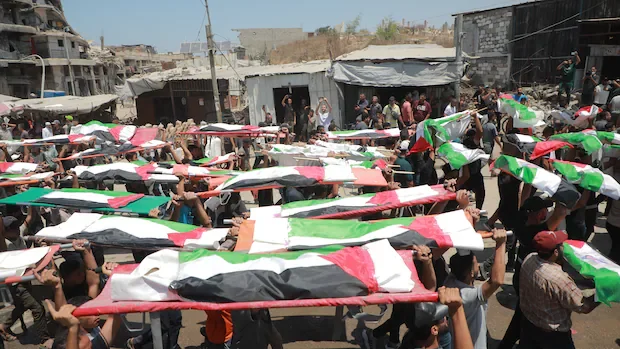
In Gaza City, a funeral for 112 family members takes place 3 years after their deaths
Famiy members say they dug through rubble with their hands when excavators weren't available
Between mounds of rubble and shells of buildings in Gaza City, more than 100 orange stretchers were draped in Palestinian flags Tuesday morning — it was the site of an Israeli airstrike that took place at the start of the war.
Some flags were smaller, indicating the remains belonged to children. Photos rested atop some of the makeshift shrouds, while others were strewn with flower petals. It took almost three years to retrieve these remains, now reduced to bones, teeth and bits of clothing.
They belong to 112 members of the Abu Sharia and Hasayna families, members of the same clan, who were killed in the Nov. 23, 2023, Israeli airstrike on the neighbourhood where they lived.
WATCH | Mourners bury 112 family members in Gaza funeral 3 years after deaths:Hundreds of people, including surviving family members, gathered on Tuesday morning to pray for the dead as they were laid to rest at the nearby Baptist cemetery.
Members of the families say they've been looking for their loved ones for years alongside Gaza's Civil Defence, first responders who attend strike sites to look for survivors and later retrieve remains. But the process has been slow due to a lack of heavy machinery in the strip.
Mahmoud Hasayneh, who was there to bury his brothers, says it opened old wounds for the family.
"Now we will start a new broken heart with this mission and all our family is crying," he said.
Heavy machinery needed
Last month, Youssef Abu Sharia, 23, was at the strike site waiting with baited breath as an excavator worked slowly, digging through piles of dirt and metal to try to retrieve any human remains that might be buried beneath the rubble.
Some of the heavy machinery in the strip has been damaged in Israeli strikes, and the United Nations said last month that Israeli restrictions on the entry of heavy equipment into the enclave has hampered efforts to locate remains.
Abu Sharia lost his mother, father, brother and cousins in the November strike. He's been looking for their remains for years, but the process has been slow due to this lack of equipment.
He and his family decided to split up sometime in October 2023 when the war began to avoid the possibility of the entire family dying in one strike.
Abu Sharia and some of his cousins moved to a different part of the strip, while his parents and brother remained together with other relatives in Gaza City. Soon after, they were killed in the strike.
At Tuesday's funeral, he said he felt relief that they could finally bury their loved ones following "three years of waiting day after day and moment after moment." He said there was also frustration and sadness over "a wound that has opened again."
His relative, Tayseer Abu Sharia, who was also at the funeral, says the last few years have been difficult as they waited for the Civil Defence to help find their loved ones.
Eventually, he says, they took matters into their own hands — literally digging through dirt and rubble "using our nails and hands."
The Civil Defence and human rights groups have called on Israel to allow heavy equipment into Gaza to help excavate bodies from the rubble.
Thousands still missing in Gaza
At least 7,400 people remain under the rubble in Gaza, Zaher al-Waheidi, head of the health ministry’s records department told The Associated Press.
The true number is likely thousands higher, he said, because in some cases entire families were killed in a single attack, leaving no one to report the missing.
Mahmoud Basal, the Civil Defence spokesperson, was at Tuesday's funeral where he urged the international community to act to get machinery into the strip.
"The difficulties we face are very big, there are no resources, no tools, no equipment," he said.
Basal said Tuesday's funeral was the first time in the history of the Palestinian cause that people have had to attend a funeral for 112 people.
A long-awaited burial
Tuesday's ceremony began with a prayer over the flag-covered remains at the strike site.
Then, members of the crowd picked up the shrouds and carried them in a procession to the cemetery as onlookers tossed flower petals.
Chants and prayers filled the air as the Abu Sharia and Hasayneh families finally brought their loved ones to their final resting place.
- Israeli strikes kill two in Gaza and destroy warehouses storing medicine
- Family of Gaza hospital chief detained by Israel 'shocked' over his deteriorating health condition
As Youssef Abu Sharia and his surviving family members watched the burial, they could not help but think of those who are still missing.
"We cannot find any trace of them, we don’t see their bodies, we don’t see bones," he said. "Where did they go?"
With files from Mohamed El Saife, The Associated Press