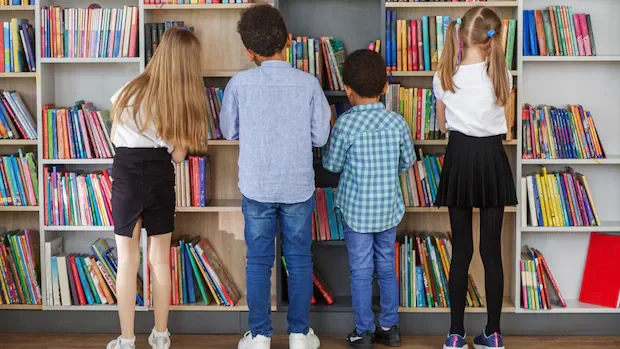
Struggling to get your kids to read a book? Here are some tips
New data suggests kids and teens aren’t reading for fun the way older generations did
LISTEN | What do we lose if we’re not reading?:Canadian author Mireille Silcoff says her eldest daughter was raised with everything you’re supposed to have to help you fall in love with reading for pleasure.
“She had a mom who reads, both parents who read to her, she enjoyed being read to, she loves narrative, she does pretty well in school,” Silcoff told The Current.
“And yet picking up a book — rather than picking up a device or whatever — really didn't seem to come naturally to her.”
Two years ago, as an experiment, Silcoff offered her daughter $100 to read a novel.
It worked. Her daughter read the book, then read another for free. But when it came to a third, she switched to an audiobook — and now listens to about one novel a week.
For Silcoff, that’s a win.
“Books are good, stories are good, narrative is good, and she's still getting it. But boy, is it different than how I grew up reading,” she said.
New data suggests Silcoff is not alone: kids and teens today aren’t reading for fun the way older generations did. In June, the U.S. Education Department published survey results showing that 37 per cent of nine-year-olds reported reading for fun in 2025, down from 53 per cent in 2012. In an older cohort, 14 per cent of 13-year-olds reported reading for fun almost every day, compared to 27 per cent in 2012, and 35 per cent in 1984.
Sachin Maharaj, an assistant professor in the faculty of education at the University of Ottawa, said there is a similar trend in Canada — but it’s also the type of reading that matters.
“People are reading all sorts of things, emails, texts. They might read things on Twitter, social media,” Maharaj told CBC Radio’s __ Just Asking__.
“But it's really this deep engagement over sustained periods of time with things like books, novels, long articles, things of that nature, where we're seeing that real decline.”
Author Daniel Willingham said that distinction gets at why we want kids to read in the first place.
“In the case of a novel, you really live with these characters for a while,” said Willingham, a professor of psychology at the University of Virginia and author of Raising Kids Who Read.
“That's much different than the sort of seconds of pleasure, quick hit that you get from reading social media posts,” he told __ The Current__.
WATCH | Asking kids about their favourite books:## Reading helps kids build empathy
That long-form reading gives kids a chance to learn about other people, and in turn learn about themselves, says Michelle Kearney, a lecturer in literacy at the University of Maine.
“Every time they open a book, they have an opportunity to think, 'What is this character thinking? Why did they make that choice? How would I feel if that happened to me?'” she told The Current.
That process helps them to develop empathy, she said, while it also lets them “learn about who they are and their identity as not only readers, but as humans.”
For Kearney, that chance came when she read Anne of Green Gables as a child.
“Anne Shirley was that for me … I felt that she was giving me a way to see myself and think about myself — and that made me excited and curious to learn more,” Kearney said.
Reading doesn't have to be about making you a better person; pleasure and escapism and fun are perfectly valid- Ira Wells
Willingham says he thinks that increased screen time is playing a role in declining reading rates, across all age groups. In recent years, screen time among kids has been linked to decreased physical activity, mental health issues and lower test scores in schools.
But Willingham said that teenagers have always been very socially active, and perhaps less inclined to pursue the solitary act of reading a book.
“I think that dramatic decline we're seeing in some of these surveys is more about kids being more willing to admit that they don't read,” he said.
Willingham added that doesn’t mean there isn’t a problem. He thinks “kids aren't reading very much and they should be reading more.”
LISTEN | Do Canadians have less time for books these days?
:## Frame reading as fun, not work
Parents who want their kids to read more should lead by example, Kearney said, by having books around the house and reading for fun themselves.
It helps “having children see parents reading — not because they have to, but because they want to — and … really fostering that curiosity through conversation,” she suggested.
Willingham said it might also help to restrict certain distractions, such as screen time, without framing reading as some kind of punitive alternative.
“Let the child still feel like they're making a free choice, but … reading has to be the most attractive thing that's available to them at any one time,” he said.
Kearney agreed it’s important to present reading as a fun activity, while Maharaj thinks that starting with pop culture connections or subjects that a child is already interested in can help to build reading habits.
He used the example of the movie The Odyssey, currently in theatres. Older kids or teens might see the movie and become interested in the literature it’s based on. Younger kids could be interested in books that touch on Greek mythology, like the Percy Jackson and the Olympians series.
“I think it's about finding things kids might gravitate toward, or are interested in and then using that as a starting point, but recognizing that it's going to be difficult at first,” he said.
- 6 Canadian picture books for kids to read this summer
- 14 Canadian books for tweens and teens to read this summer
Ira Wells, president of PEN Canada, said parents and educators should be wary of taking an “eat-your-vegetables-approach to reading.”
“I think that risks turning some kids off,” Wells told Just Asking.
“Reading doesn't have to be about making you a better person; pleasure and escapism and fun are perfectly valid reasons to read — as is the experience of beauty.”
Audio for The Current produced by Amanda Grant.