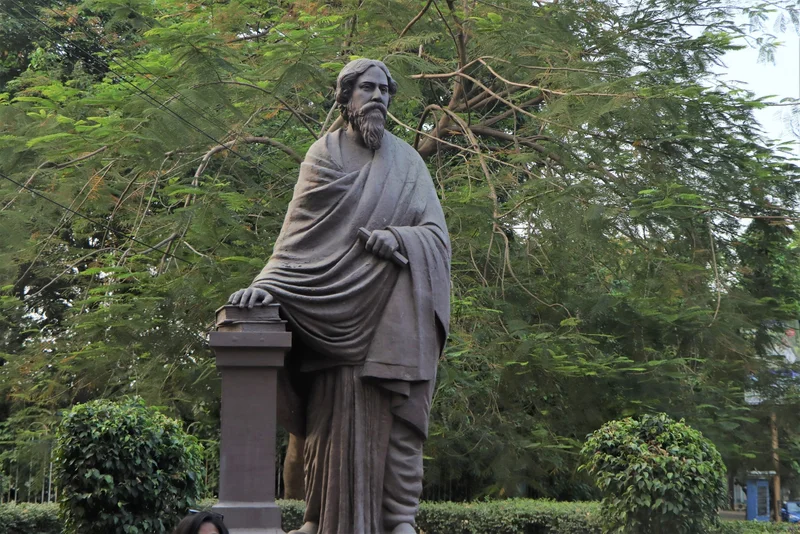
“Although I have not studied Türkiye in depth, I hold the Turkish Revolution in high regard. I believe it will help shape a promising future not only for Türkiye, but for the broader Eastern world. As someone from the East, I am encouraged to see Türkiye making such progress.”
These are not the views of an ordinary observer, but those of Rabindranath Tagore (May 7, 1861-Aug. 7, 1941), the renowned Nobel Prize-winning poet, thinker and writer from the Indian subcontinent. Tagore shared these reflections during a conversation in Istanbul on Nov. 22, 1926, while responding to a question from a reporter of the well-known Urdu newspaper Rozana Hamdard. The reporter had asked for his views on the Turkish Revolution. Notably, Rozana Hamdard was edited by Maulana Muhammad Ali Jauhar, a prominent figure who became the first journalist in British India to be imprisoned by the British authorities for expressing support for Türkiye.
After touring Italy, Germany, Hungary, Czechoslovakia, Bulgaria and Romania, Tagore finally arrived in Istanbul on Nov. 21, 1926, aboard the Romanian ship Imparatul Traian. He was accompanied by his son, daughter-in-law, secretary and wife.
According to a report published in the Victoria Daily Times (Victoria, British Columbia) on Nov. 23, 1926, Tagore had earlier met King Ferdinand of Romania in Bucharest, where the king invited him to lunch before his departure for Istanbul. The meeting received notable attention in Romania, as it helped reassure the public amid uncertainty about the king’s health. At the time, conflicting reports about the monarch’s condition were circulating, and the meeting had a calming effect on the public. King Ferdinand passed away on July 20, 1927, approximately eight months after this meeting.
Meanwhile, many people in Istanbul had expected Tagore to arrive by train, and preparations were made to welcome him at the railway station. However, he arrived unexpectedly by sea, so only representatives of newspapers were able to greet him on board the ship upon arrival.
His photographs were published in newspapers across Türkiye, with much respect and admiration. Contemporary reports, including those in the Ottoman Turkish newspaper Vakit, confirm this coverage. (The writer of this article has also seen these photographs and news reports in Vakit, written in Ottoman Turkish.)
It should be noted that the ship remained in port for one night and two days, but Tagore did not disembark due to ill health.
A correspondent of Rozana Hamdard wrote in a special report: “When Turkish journalists informed him (Tagore) that his books were widely read in Türkiye, a distinct sparkle appeared in his eyes. When asked about the themes of his speeches delivered on various occasions in Europe, he said: ‘The materialism of the West is leading it toward disaster. Modern life is making people increasingly materialistic and hard-hearted. The purpose of my speeches was to remind my listeners that the aim of life is far higher than mere material pursuits.’” According to these correspondents, Tagore was also pleased that the people of Europe, despite differences in mentality and customs, had welcomed him with such enthusiasm.
According to a report published in the Dec. 24, 1926, issue of Rozana Hamdard, Tagore was asked about the future of humanity. He replied: “When people abandon the idea of ruling over one another and begin to treat each other as equals, there will be no danger to humanity.”
A correspondent of Rozana Hamdard wrote in a special report: “On the 22nd, two professors along with several students from Istanbul University, as well as an official from the Istanbul Municipality, conveyed a message of welcome to Rabindranath Tagore. They also expressed regret that he had arrived in their city by sea under circumstances that prevented the formal public reception usually accorded to distinguished guests.”
The Turkish newspaper Vakit reported on Nov. 23 as: “Yesterday morning, a delegation of about ten people from Istanbul’s Darülfünun (now Istanbul University), consisting of students from various disciplines and led by instructors Ferid Bey and Avram Alati Effendi, went to meet Rabindranath Tagore and welcomed him. However, as the poet was unwell, he received the delegation in his room.”
The report also noted that Saad Bey, an official of the city administration, visited Tagore to convey greetings on behalf of Muhiddin Bey, the head of the Istanbul Municipality. According to the same newspaper, on Nov. 22, Tagore departed from the city for Egypt via Greece around 2 p.m.
In a book edited by Smita Tewari Jassal and Halil Turan, economics professor Eyüp Özveren describes Tagore’s visit as follows: “Symbolically, when the boat set anchor in the harbor, his cabin faced the Asian rather than the European side of Bosporus. He was in poor health, he said, because of the successive conferences he had been giving, and this was why he abstained from yet another one in Istanbul. Nevertheless, he agreed to talk to the press in his cabin.”
According to Özveren, Tagore’s views on Türkiye were also sought during this exchange. He reportedly stated, “The President of Türkiye showed us the way to civilization instead, which Western nations had also followed.”
Özveren bases this account on a report published in the Cumhuriyet newspaper on Nov. 23, 1926. He also notes that, after returning from his trip, Tagore wrote to Atatürk requesting books on Türkiye and Turkish literature for the library he set up at Viswa Bharati University. Atatürk subsequently sent 41 books, which later came to be regarded as “treasures of the university,” a phrase later referenced by Indian Prime Minister Atal Bihari Vajpayee during his official visit to Türkiye nearly eight decades later.
In the same chapter, professor Eyüp Özveren, quoting the Turkish sociologist Niyazi Berkes, notes: “Thanks to Berkes, we know that Tagore had a poetry reading in the then prestigious Majik (Magic) Cinema Hall in the cosmopolitan Pera district of Istanbul.”
After reading this reference, I consulted Berkes’ work "Asya Mektupları" (1976). In it, Berkes recounts that he was in Aligarh, India, in January 1958, where he attended two weddings. Reflecting on what he saw at a Jain wedding, Berkes describes a priest in unusual detail, and then turns to an earlier memory of Tagore.
He writes: “There is also an astrologer-like priest who is moving around in circles like a bullock at a mill. But when I say priest, do not imagine a frightening figure with long hair and a beard, dressed in white. Perhaps you remember that during our student days, the Indian poet Rabindranath Tagore visited, and he recited his poems in Bengali at the ‘Magic Cinema’ in Taksim, which to me sounded like ‘Kabara makara.’ Yet he had a dignified and imposing presence. He was dressed in white, and his magnificent white beard reached down to his stomach.”
However, apart from Berkes’ memoir, there appears to be no independent historical evidence confirming that Tagore gave a Bengali poetry reading at the “Magic Cinema” in the Taksim area of Istanbul.
Türkiye has always remembered Tagore with enduring dignity and affection, not merely as a formal tribute, but a living tradition. Many of his works that have been translated into Turkish continue to be read with enthusiasm even today. Similarly, the naming of a street in Ankara after him in 2003 stands as a beautiful expression of recognition for the Indian poet and thinker. It is a sign that Türkiye not only maintains the intellectual ties of its past but also continues to embrace knowledge, literature and shared human values.