AMD has had its best quarter yet, as the chipmaker reported record revenue of $11.5bn for the second quarter, up 50% on a year earlier, as demand for AI hardware kept climbing.
The engine was the data centre which brought in $6.7bn, more than double last year’s figure and now 58% of the company, the clearest sign yet that AMD has a real foothold in the market Nvidia defined.
The profits followed the revenue as AMD posted adjusted earnings of $1.66 a share and a non-GAAP gross margin of 56%, and it guided to around $13bn in the current quarter, which would be another 41% jump.
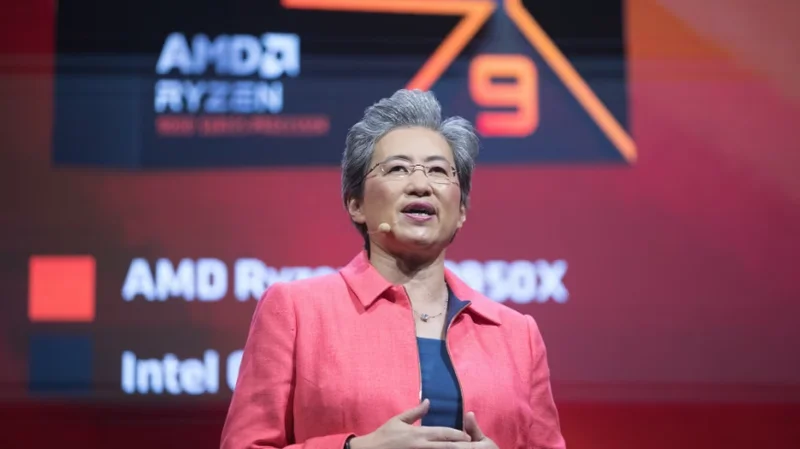
Chief executive Lisa Su called it an excellent quarter and said AI was driving compute demand across every market. The rest of the business was mixed, with client chips up 23% and embedded up 19%, while gaming slid 31%.
The guidance was the loudest signal. AMD expects around $13bn in the third quarter, a 13% step up in a single quarter, which is the sort of sequential jump that only happens when data-centre orders are stacking up faster than the company can book them.
Even so, the comparison with Nvidia is sobering. Nvidia’s data-centre business remains several times larger, and it still captures the overwhelming share of AI accelerator spending, which is why a doubling at AMD reads as catching up rather than pulling ahead.
Yet the hardware is only half the contest. Nvidia’s dominance has never rested on silicon alone, and its real moat is CUDA, the software layer that a generation of AI developers learned first and rarely leaves.
That is the wall AMD is trying to lower. Its answer is ROCm, an open-source software stack pitched as the alternative to CUDA’s walled garden, and the pitch is aimed squarely at buyers wary of being locked to a single vendor.
The argument is strategic, not sentimental. If AI infrastructure standardises on open tooling, the advantage of CUDA’s head start shrinks, and a customer can move workloads between chips without rewriting everything.
The counter-argument is inertia. A decade of tutorials, libraries and trained engineers all assume CUDA, and matching that ecosystem takes years of unglamorous work, which is why AMD frames the effort as one step after another rather than a single leap.
There are signs the pitch is landing. Researchers have begun running serious models on AMD hardware, including a planet-scale AI model out of Cambridge built on AMD rather than Nvidia, the kind of reference win the company needs.
The next test is the hardware roadmap as AMD is pushing its MI400 accelerators and Helios rack-scale systems as the answer to Nvidia’s densest configurations, and the pitch only works if the open software keeps pace with the silicon.
Moreover, AMD has struck a deal to supply Anthropic with two gigawatts of its Helios systems, a marquee customer that anchors its next-generation MI450 accelerators against Nvidia’s flagship racks.
Deals like that cut both ways, though. AMD’s data-centre surge leans on a small number of very large AI buyers, and revenue that concentrated is exposed if any one of them trims its spending.
Nvidia, for its part, is not conceding the software ground. It has spent years deepening CUDA and locking partners into its ecosystem, the same playbook rivals such as Google are now copying as they build their own alternatives.
AMD has proven it can sell the chips, and the open question, quite literally, is whether openness can pry loose the customers who still reach for CUDA by habit.
For now, the momentum is real and the gap is still wide. AMD is closing distance on the hardware while betting the war is won in software, and that bet will take more than one blockbuster quarter to settle.
Get the TNW newsletter
Get the most important tech news in your inbox each week.