Back on July 23-24 US struck targets in Iran’s Gilan Province on the Caspian Sea. Reportedly damaged was the port in Bandar Anzali, Iran’s biggest on the Caspian coast that links up to the country’s national railway grid. Ukraine followed up with an attack on an Iranian commercial vessel in the Caspian Sea on July 25.
We’ve been warning for a long time about the potential for the Middle East conflicts to spill over into the Caucasus and Caspian-Central Asia regions, yet it is the other war in Ukraine now helping both to boil over.
Meanwhile, the US, Turkiye, and Israel (with the Europeans on board) press eastwards. On the agenda are energy, logistics, and CIA Islam corridors from Türkiye to Kyrgyzstan. This has long been US strategy as such a corridor would exclude Russia and Iran and carving out such a chunk would deal a death blow to the idea of a united, peaceful and prosperous Asian heartland.
The US, Israel, Türkiye and EU have already made significant progress. Armenia and Azerbaijan are onside; now for the push across the Caspian where Central Asian states are already more aligned than ever with NATO/Israel. What to do with the world’s largest —albeit shrinking rapidly— inland body of water?
Caspian Connections
Following the destruction of Nordstream, the EU’s successful walling itself off of most other Russian pipeline gas, and the pressure for some southeastern European nations to refuse Russian gas via Turk Stream, and Ukraine/NATO attacks in the Black Sea there is now a renewed push for energy flows from Central Asia.
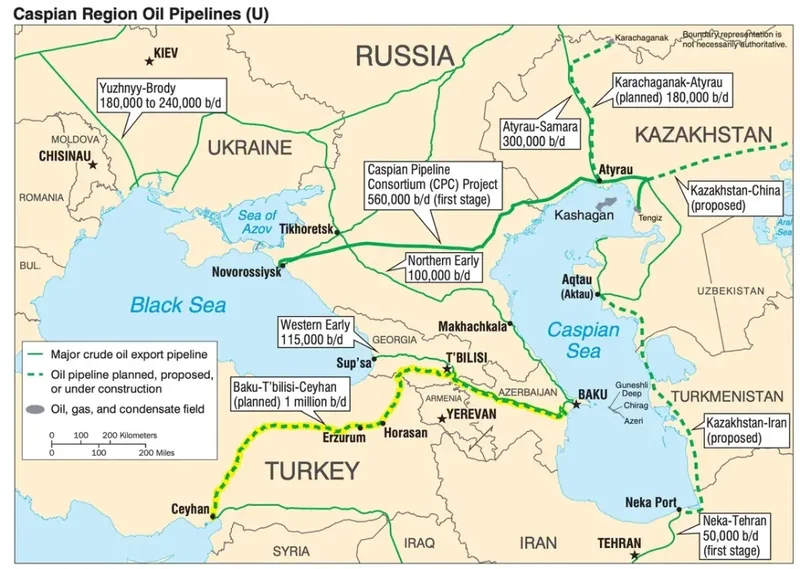
The EU has already tapped Azerbaijan for all it can afford to send and so the plan —if one can call it that— appears to be to call on Kazakhstan and Turkmenistan. A quick check of the map, however, shows how difficult that is to do while keeping with the goal of excluding Russia and Iran.
There are/were, of course, energy flows to Europe from Central Asia in place or in the works, but those have been or are being successfully torpedoed.
Kazakh oil flows through the Caspian Pipeline Consortium (CPC) are being slowed to a trickle by Ukraine/NATO strikes on ships in the Black Sea. Kazakhstan recently denied a complete shutdown, but that day might be far off. While Kazakhstan has gotten increasingly cozy with Washington, the problem for the 1,510-km CPC is that it involves Russia. It connects Kazakhstan’s Caspian Sea oil fields with Russia’s Black Sea port of Novorossiysk, and it brings roughly 80% of Kazakhstan’s oil exports to the world market. Its operations have been disrupted at various points during the war by Ukrainian attacks on pumping stations in Russia and by drone strikes on the CPC loading terminal.
Similar to the way the US told Türkiye it could become a regional energy hub but not by going all in on Russian oil and gas, the message to Kazakhstan appears clear: find another delivery route.
It’s a similar story to the south. A natural partner for gas deliveries to Europe is Iran via its own supplies or transiting Turkmen gas through Türkiye. Ankara actually had a small gas swap deal with Turkmenistan and Iran last year in which Iranian gas was pipelined to Türkiye in exchange for Turkmenistan sending gas to Iran. Expanding on such arrangements would be the most logical route to get more gas to Europe, but if we’re doing logical we might as well turn Nord Stream back on or stick with TurkStream.
There is, of course, no way that the US-Israel and Zionists in Europe are going to allow any Iranian involvement. And notably, Türkiye and Turkmenistan halted gas exports via Iran following the reverberations from the decision by Washington to block Iraq from importing gas from Turkmenistan via a similar swap deal with Iran.
So, doublechecking the map, that leaves one possibility, and this looks to be what years of moves by the US and friends are angling towards:
- Send fossil fuels and other resources from Central Asia and the Caspian westwards across the sea.
- Then through Azerbaijan, the Trump Route for International Peace and Prosperity (TRIPP) in Armenia, and Türkiye.
- Cut out Russia and Iran from these trade routes.
- Increase its footprint in Caucasus and Central Asian countries, effectively carving out a chunk of the Eurasian “heartland.”
Nevermind that Russia and Iran will only be pushed so far and that ultimately the widening of the war will damage European energy prospects and result in the torpedoing of the Middle Corridor. One can be forgiven for believing that Washington favors such outcomes as it would mean Europeans paying higher prices for American LNG and a Eurasian heartland on fire.
Sure enough, the much-ballyhooed corridors between China and Europe have fallen one-by-one in recent years. The Northern Route through Russia was killed by Project Ukraine and all the sanctions. The Southern Routes are blocked by the ongoing conflagration in the Middle East. Middle land routes, despite their economic deficiencies, are consistently set back by other US-sponsored road blocks, and a Caspian conflict would bury it for a good long while. How long can Washington and friends keep this up, and is there any chance they might try to build something of their own? Or is destruction the name of the game?
Renewed Push for Trans-Caspian Route
The Trans-Caspian pipeline and adjoining logistics routes across the shrinking sea have long been discussed but they are now getting another day in the sun. Supporters of the Trans-Caspian route envision it linking up with a new pipeline through Armenia from Azerbaijan to Türkiye or the existing Baku–Tbilisi–Ceyhan (BTC) pipeline that runs from Azerbaijan to Türkiye via Georgia and then onto Europe.
Nurul Rakhimbekov, the Founder and President of the DC-based think tank Center for Global Civic and Political Strategies, writes:
The BTC route offers a secure, Russia-free pathway from the Caspian to the Mediterranean, connecting Kazakhstan’s oil to markets in Europe and Israel via Türkiye’s port of Ceyhan. It also dovetails neatly with Western efforts to reduce dependence on Russian energy corridors.
Unlike the congested Black Sea route, BTC provides stable access to global markets and reduces insurance and logistics costs that have been driven up by regional instability. Technically, a trans-Caspian connection— whether through a growing tanker fleet or a future subsea pipeline — could handle 50 to 60 million tons per year, matching the CPC’s capacity and giving Kazakhstan more control over its own export future.
The diplomatic groundwork for this shift is already in place. Washington and its allies have expressed broad support for Kazakhstan’s diversification strategy. The next step is execution.
Here’s Energy Intelligence with more:
Turkmenistan also appears to have indicated that it is eager to participate in the Middle Corridor and not be isolated from the growing sense of rapprochement between Caspian and Central Asian nations. Serdar Berdimuhammedov, the president of Turkmenistan, made a landmark trip to Baku in June, sparking fresh speculation that Turkmenistan will one day export gas to Türkiye and Europe via a pipeline across the Caspian Sea to Azerbaijan.
A similar theme was evident during a tour of Azerbaijan, Kazakhstan and Turkmenistan in July by Montana Republican Senator Steve Daines to underscore Washington’s support for closer collaboration. US President Donald Trump has personally backed a side-shoot of the Middle Corridor, namely the Trump Route for International Prosperity and Peace, which until recently was known as the Zangezur Corridor, a 40 kilometer (25 mile) stretch through Armenia that would connect Azerbaijan to its Nakhchivan exclave and then on to Türkiye.
Naturally, energy cooperation was always part of the discussions in Baku and Ashgabat, sparking fresh speculation that a trans-Caspian gas pipeline could play a role in the Middle Corridor. Türkiye would welcome an opportunity to get its hands on a cheaper source of gas, and there would be support from Western capitals. Some analysts believe that the conditions are right for a smaller trans-Caspian, with a capacity for, say, 10 Bcm/yr, around one-third of the original plan, that could fly under the radar.
As ever, however, the ultimate issue is whether Turkmenistan would be bold enough to back a subsea pipeline in the face of opposition from fellow Caspian states Russia and Iran.
Notably, the heads of state at the C5+1 (the Central Asian states and the US) summit endorsed the development of the Trans-Caspian Trade Route and pledged to integrate it with TRIPP.
Iranian and Russian Resistance
Naturally, Moscow and Tehran are opposed and have issued subtle and not-so-subtle threats and used economic leverage to try to slow the advance of the US-NATO encroachment across the Caucasus and into Central Asia.
For whatever reason, Iran seems more alarmed than Russia at the developing situation, although that could be more the result of differences in their ways of doing business. Some Russian officials, for example, have downplayed TRIPP while those in Tehran do the opposite, presenting it more as a key piece in a dreaded Turan Corridor. As Security & Defence Quarterly notes:
The Strategic Council of Foreign Relations in Tehran, whose director is Iran’s former minister of foreign affairs Kamal Kharazi, condemned the construction of the Zangezur corridor, indicating that the corridor has been introduced as NATO’s “Turan corridor,” a project ostensibly supported by Israel and NATO, which aims to foment ethnic unrest in the areas of Iran inhabited by Turks. As per the aforementioned Council, NATO’s Turan corridor is supposed to directly bring NATO onto the northern border of Iran, the southern border of Russia, and western China and lay the groundwork for their disintegration.
It’s interesting that Iran is now considering ratification of the 2018 Convention on the Legal Status of the Caspian Sea, and it’s reportedly at the behest of Moscow. The convention was signed by Iran, Russia, Azerbaijan, Kazakhstan, and Turkmenistan at the Fifth Caspian Summit in Aktau in August 2018, but it met stiff opposition back in Iran and parliament never ratified it.
The administration of Iranian President Masoud Pezeshkian just recently reintroduced it despite the risk it could exacerbate internal divisions in Iran. Dr. Ehsan Movahedian, an international relations specialist at ATU University in Tehran, argues that’s exactly what will happen and is critical of the Pezeshkian faction in the government in a recent piece for The Cradle:
The convention does not itself allocate a fixed percentage of the Caspian to each country. That politically explosive question remains subject to separate agreements on baselines and the delimitation of the seabed and subsoil. Yet critics fear that accepting the new framework will weaken Iran’s position in those negotiations.
Ahmad Bakhshayesh Ardestani, a member of parliament’s National Security and Foreign Policy Committee, told Tabnak that parliament should require the government to settle Iran’s share before approving the bill.
“The government should seek to secure Iran’s 20 percent share under the Caspian legal regime, after which the matter should be submitted to parliament for approval,” he said. According to estimates cited by the lawmaker, Iran’s current share stands at around nine to 13 percent…
Eurasia specialist Dr Shoaib Bahman questions both the timing and the procedure:
“The Pezeshkian administration has ratified this convention at a time when Iran is engaged in a decisive hybrid war. In such an atmosphere, where maintaining national unity is a vital necessity, raising such a divisive issue is questionable. What is even more peculiar is that the government has announced that the clause concerning negotiations on the delimitation of the seabed and subsoil (which contain vast oil and gas reserves) has been temporarily removed from the agenda. However, such an important international treaty must be accepted or rejected in its entirety; splitting its various parts has no legal validity and indicates a kind of non‑transparent decision‑making.”
There also seem to be quite a few bots pushing criticism of Pezeshkian online, e.g.:
The Caspian Convention: A Silent Strategic Shift Against Iran?
The 2018 Convention on the Legal Status of the Caspian Sea is often presented as a diplomatic success. Yet from a geopolitical perspective, it also reflects a major transformation in the regional balance of power—one… pic.twitter.com/I0yXoOXlCi
— InsightAxis (@MrEngineerInfo) August 4, 2026
🚨 The Islamic Republic has dramatically reduced Iran’s share of the Caspian Sea, surrendering one of the world’s richest strategic and energy basins.
Under the 2018 Caspian Sea Convention signed by Hassan Rouhani’s government, the regime accepted a share of the Caspian widely… pic.twitter.com/u8dhY37VV1
— The Iran Watcher 🇮🇷 (@TheIranWatcher) August 4, 2026
Meanwhile, Russia wants ratification because it believes that it will help keep outside actors away from states on the sea. Here’s Russian Foreign Affairs Minister Sergey Lavrov earlier this year:
“Now it is up to Iran. Amid the turbulent developments in the world and around this part of Eurasia, it is important to ultimately fix the principle of non-interference into the affairs of this region by non-Caspian states. That is why we hope that Tehran will ratify this convention…
The Convention on the Legal Status of the Caspian Sea was signed during the previous summit of the Caspian littoral states in 2018. It says that all issues related to the use of the Caspian region’s resources, environmental protection, the use of structures guaranteeing security are to be addressed solely by the five littoral states. This is the pivotal principle.”
Moscow’s ongoing faith in such agreements despite being on the receiving end of repeated violations is a bit odd. On the one hand, it is laudable; without diplomacy and treaties that are adhered to, we’re left with chaos. On the other hand, chaos rules the day, and Moscow is repeatedly burned by such deals. There are the well-known agreements with the West. There are also others in its backyard.
For example, the 2020 peace agreement Moscow brokered between Armenia and Azerbaijan called for Russia’s involvement in a corridor through southern Armenia between Azerbaijan and its exclave. Instead, Washington swooped in, Baku and Yerevan disregarded the agreement with Moscow, and the route now bears Trump’s name.
Yet here Moscow is again pressuring Iran to ink an agreement that the other states are likely to ignore (with plausible deniability, of course) the first chance they get.
Israel intelligence already has a sizable presence in Azerbaijan, with which it enjoys very close ties. Kazakhstan just joined the Abraham Accords at the end of last year. And Israel and Turkmenistan enjoy warming ties, as do all three states with the US.
Would Iran ratification of the treaty allow for the much-discussed pipelines between Kazakhstan and Turkmenistan and Azerbaijan?
The recent report in The Cradle argues it would. I’m not so sure. First, here’s The Cradle:
According to Dr Mohammad Mehdi Hajian, a faculty member at Allameh Tabatabai University, “Previously, no littoral state could construct pipelines on the Caspian seabed due to legal disputes, and this obstacle served as a powerful lever for Iran and Russia to benefit from energy transit routes. But with the ratification of this convention, Turkmenistan and Kazakhstan will be permitted, without Iran’s or Russia’s involvement, to build pipelines on the Caspian bed and deliver their gas directly to Azerbaijan, and from there to Europe and Israel.”
As one can see from the following map, there is a fear that the Convention will permit the -stans and the -jan to move ahead with Western-backed pipelines in there territorial waters should Iran ratify the Convention.
Yet here’s Article 14 of the Convention:
-
The Parties may lay submarine cables and pipelines on the bed of the Caspian Sea.
-
The Parties may lay trunk submarine pipelines on the bed of the Caspian Sea, on the condition that their projects comply with environmental standards and requirements embodied in the international agreements to which they are parties, including the Framework Convention for the Protection of the Marine Environment of the Caspian Sea and its relevant protocols.
-
Submarine cables and pipelines routes shall be determined by agreement with the Party the seabed sector of which is to be crossed by the cable or pipeline.
-
The geographical coordinates of areas along routes of submarine cables and pipelines where anchoring, fishing with near-bottom gear, submarine and dredging operations, and navigation with dredging anchor are not allowed, shall be communicated by the coastal State whose sector they cross to all the Parties.
The key segment: “on the condition that their projects comply with environmental standards and requirements embodied in the international agreements to which they are parties, including the Framework Convention for the Protection of the Marine Environment of the Caspian Sea and its relevant protocols.”
The 2003 Framework Convention stipulates environmental standards for the Caspian, and Moscow and Tehran repeatedly invoke it to effectively block the construction of pipelines between Azerbaijan and Kazakhstan and Turkmenistan. As far as I can tell, they can still do so should Tehran ratify the 2018 Convention.
A tanker fleet like the one mentioned above by Blob creature Rakhimbekov could be a different story (although it could face challenges posed by climate change shrinking the sea, including already 50 kilometers off the coast of Kazakhstan).
Sure, it wouldn’t make economic sense, but then again that means it would mirror Europe’s energy strategy for the past four years. And it would cut out Russia and Iran and serve as a ”Western connection” into Central Asia.
Pipeline or not, a conflict is brewing as the West pushes into the region and works to exclude Russia and Iran from the movement of energy, goods, and data.
As these nations align more closely with the US, NATO, and Israel who are working to Balkanize Russia and Iran, it increases the chances the order in the Caucasus and Caspian regions will be settled the same way it is being decided in the Middle East and Ukraine: by force.