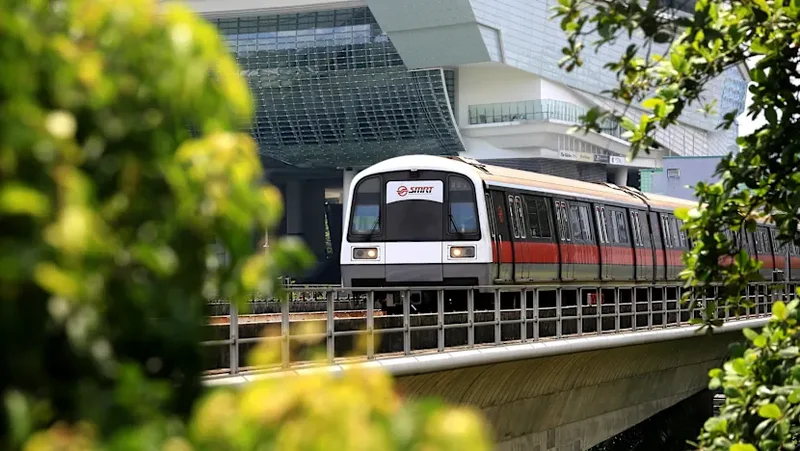
SINGAPORE: SMRT Trains' profit after tax nearly doubled to S$12.8 million (US$10 million) in the latest financial year, as revenue grew 5.6 per cent on higher ridership and fare income, the transport operator said on Wednesday (Aug 5).
Profit after tax rose from S$6.9 million a year earlier, while earnings before interest and tax climbed to S$16.2 million from S$4.9 million. Revenue increased by S$51.5 million.
The increase in earnings and revenue was “partially offset by higher repair and maintenance expenditure, as SMRT continued to invest in its rail assets and strengthen its engineering capabilities”, the company said in a release.
SMRT Trains' profit margin rose to 1.3 per cent from 0.75 per cent, which the company attributed to disciplined cost management and energy contracts secured before recent geopolitical developments.
The previous year, its margin had been dented by S$10 million in one-off costs from the September 2024 East-West Line disruption.
Speaking to reporters, SMRT Corporation chairman Seah Moon Ming said total train maintenance cost stood at S$245 million and total energy cost at S$125 million.
He noted that SMRT’s train network achieved an average of about 2 million mean kilometres between failure (MKBF) for the first time earlier this year.
“That is double the 1 million MKBF benchmark associated with some of the best-performing metros in the world,” said Mr Seah.
MKBF is a measure of rail reliability that tracks the average distance a train travels before encountering a service delay of more than five minutes.
The Land Transport Authority (LTA) publishes MKBF figures for Singapore's train lines monthly. It excludes the SMRT-operated Thomson-East Coast Line (TEL), which is still undergoing phased openings and has not fully stabilised.
That level of reliability “does not happen by chance”, Mr Seah said. “It is not the result of a single breakthrough or the effort of one exceptional individual. It comes from discipline, teamwork, and a commitment to keep improving, every single day,” he said.
RAIL LICENCE RENEWAL
Mr Seah also addressed the renewal of SMRT Trains' rail licences, saying such discussions typically take more than three years to complete.
The TEL licence expires in 2029, while licences for the North-South Line, East-West Line, Circle Line and Bukit Panjang LRT expire in 2031.
“It is timely for us to begin discussions with the relevant authorities on the renewal of our rail licences,” he said.
The issue came to the fore after SMRT said it had difficulty attracting new tenants for the Tanjong Pagar station retail area, citing the rail licence for that station expiring in 2031.
Longer licence periods would have “clear merits”, Mr Seah said. “They provide greater certainty for long-term investments, strengthen workforce stability, reduce transition costs and allow operators to focus on improving service for commuters.
“A rail system is built over decades, from the infrastructure, engineering capabilities to the skills of the people. Long-term outcomes are best supported by long-term planning.”
He added that licence renewals are part of the normal regulatory framework, and that it is SMRT Trains' responsibility to work closely with the Ministry of Transport and LTA on the process.
GUANGZHOU METRO PARTNERSHIP
SMRT has also collaborated with Guangzhou Metro to develop innovations such as predictive crowd control and maintenance for trains and stations.
One system being developed could use real-time data at fare gates to predict crowd density at stations and on trains, allowing SMRT to deploy crowd marshals or more trains in advance at hotspots to ease congestion. Guangzhou Metro already uses the system.
SMRT currently manages crowds reactively, with station staff deploying control measures on an ad hoc basis during unexpected surges.
Mr Seah said Guangzhou Metro operates a network with 9 million daily commuters, three times that of Singapore, and is “widely recognised for its engineering capability and operational reliability”.
SMRT is also partnering with Guangzhou Metro to bid to operate the future Cross-Island Line (CRL), which will use a fixed overhead conductor rail power system that Guangzhou Metro has extensive experience operating.
DEPOT UPGRADE, RTS LINK
Following a S$7 million upgrade to Bishan Depot, Mandai Depot, which serves as the TEL's maintenance and control centre, will undergo a S$5.5 million upgrade expected to be completed by mid-2027.
The upgrade will double the overhaul capacity of the Mandai Depot workshop and cut the overhaul time for TEL trains from 24 days to 12 days.
On the Johor Bahru-Singapore Rapid Transit System (RTS) Link, SMRT said the project has reached over 82 per cent completion as of end-June and is undergoing testing.
The opening date and fares would be announced in due course, Mr Seah added.