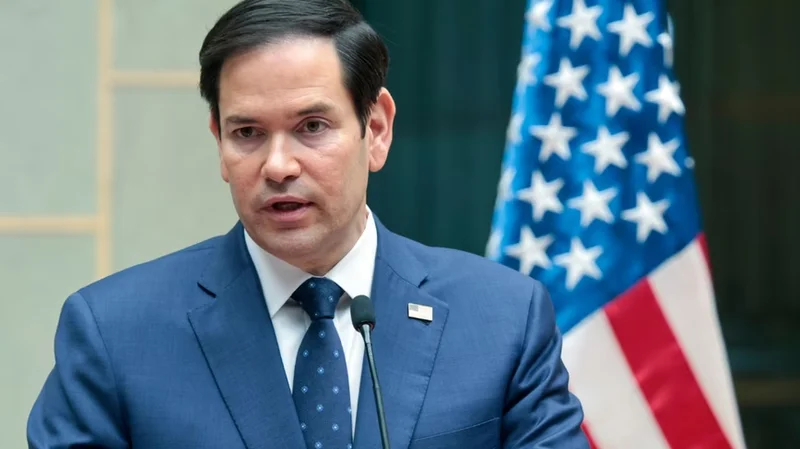
US Secretary of State Marco Rubio has told American diplomats to push back against a phrase that has spread through allied capitals since the summer: the tech “kill switch.”
In a cable dated July 16 and reviewed by Reuters, Rubio instructed envoys to counter the idea that Washington can remotely disable American technology abroad, a fear that hardened after the government briefly blocked foreign access to Anthropic’s top models in June and revived European talk of digital sovereignty.
“Pausing narrow uses or requiring a 30-day testing window prior to release of a highly potent new technology is not a ‘Kill Switch,’” the cable reads, according to Reuters’ account of the document.
“There is no government ‘magic button.’” It calls the narrative exaggerated and tells diplomats it fails to capture the nuances of US technology policy.
The 💜 of EU tech
The latest rumblings from the EU tech scene, a story from our wise ol' founder Boris, and some questionable AI art. It's free, every week, in your inbox. Sign up now!
The anxiety has a specific origin. On June 12, the Trump administration barred non-US residents from Anthropic’s most advanced models, Mythos and Fable, on national security grounds, then reversed course within the same month.
The whiplash left officials across Europe and Asia wondering how much of their AI stack sat behind a switch they did not control, and it sent technology executives in several capitals scrambling to promote home-grown alternatives.
That block followed a June 2 executive order requiring AI developers to submit new models for 30 days of cybersecurity testing before release.
For governments running public services on top of American models, the sequence looked less like routine safety review and more like leverage. Brussels held talks with Washington over restoring access, and the shutdown became a live case study in dependence.
Canadian Prime Minister Mark Carney went as far as comparing it to the 2008 financial crisis, warning of a systemic AI “model risk” that no single government could contain.
European lawmakers said as much in public. Christophe Grudler and Aura Salla, both of the centre-right European People’s Party, warned that the United States held “a real ‘kill-switch’ over essential technologies” that could be “switched off overnight by a foreign government.”
Edward Fishman of the Council on Foreign Relations told Reuters that allies increasingly fear their reliance on American artificial intelligence leaves them exposed to economic coercion.
EU finance ministers had already pressed for guaranteed access to Anthropic’s systems, and Austria floated the idea of hosting the company on European soil.
Not everyone accepted the framing. The International Association of Privacy Professionals argued the Anthropic episode was a governance problem rather than a kill switch, a security challenge dressed up as a sovereignty crisis. Rubio’s cable leans on that reading and pushes it further.
The document does more than quibble over vocabulary. It instructs diplomats to discourage “so-called ‘digital sovereignty’” initiatives that would wall off American products, and to promote US AI as the superior option wherever foreign governments weigh home-grown alternatives.
The message, in effect, is that dependence is not a risk to be managed but a market to be defended.
The phrase itself did not appear from nowhere. For more than a year, US lawmakers have floated the Chip Security Act, which would mandate location tracking, and in some drafts a remote kill switch, on exported Nvidia processors to keep them out of China.
A separate Remote Access Security Act sought to extend export controls into the cloud, closing the loophole that let restricted chips be rented offshore.
Nvidia has repeatedly denied that its chips carry backdoors or kill switches and urged Congress against location-verification mandates. Washington’s own chip curbs have tightened around Chinese firms in parallel.
Whether a testing window and a temporary export block amount to a switch is partly a question of language and partly one of trust.
Marco Rubio is betting his diplomats can win the argument over the word. The harder problem, and the one the cable does not resolve, is that allies now know the mechanism exists, whatever anyone agrees to call it.