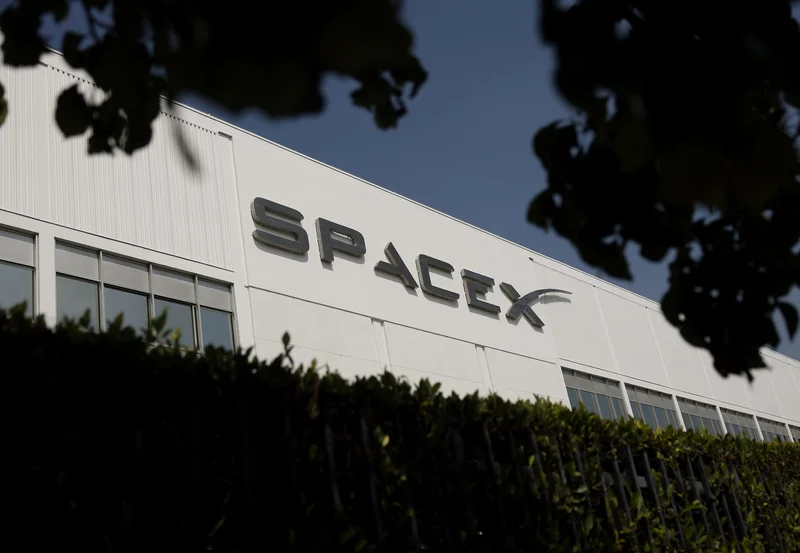
Space Exploration Technologies posted its first quarterly report since going public, leaving analysts cautiously optimistic on the stock even as spending concerns sent shares lower. The Elon Musk-led rocket company posted a loss of 9 cents per share for the second quarter, beating the 26 cents per share loss expected by LSEG. Its revenue came in at $7.81 billion for the same period versus the Street's consensus estimate of $6.93 billion. However, the stock tumbled more than 12% as the company's spending on artificial intelligence soared to more than $23 billion in the first six months of the year from $3.3 billion in the year-earlier period . Capital expenditures in the connectivity and space businesses also increased. SPCX 5D mountain SPCX 5-day chart Yet, many analysts on the Street believe the stock can mount a comeback. SpaceX forecast it will notch more than $100 billion in annual recurring revenue across all its business verticals, led by cloud services, by the end of this year. That promise to convert its large investments into outsized returns has left investors mostly optimistic about the company's future prospects, despite a few uncertainties, according to Bank of America. "SPCX beat expectations across topline and profitability metrics, and we see the company's reporting and communication as constructive," Bank of America analyst Ronald Epstein said Wednesday in a note to clients. "While the stock remains negatively impacted on elevated capex expectations and questions on how SPCX will monetize its capabilities through AI and Starlink Mobile, we are more positive in SPCX's positioning across its key markets following 2Q." The analyst has a buy rating on SpaceX. His $235 price target on shares suggests nearly 88% upside from Tuesday's close. Here's what others on the Street are saying about SpaceX. Morgan Stanley: Overweight, $300 "Our full-year 2027 revenue forecast of $102bn implies essentially no acceleration off the > $100bn in total-company 'ARR' expected by the company by YE26, largely due to our assumed fall in total Rev/Watt to $17/watt in 4Q27 from $31/watt in 4Q26 (normalizing pricing of compute as market becomes more saturated). If this conservative dynamic does not take place, and we were to run-rate $31/watt over our average 3.5 GW of compute, it would imply an incremental $42bn of AI revenues on our 2027 forecasts. Wells Fargo: Overweight, $215 Analyst Ken Gawrelski trimmed his target from $230. "Management confident that terrestrial compute capacity can reach 8+ GW in '27, pulling forward our '28 targets, with NVDA exclusive accelerator relationship. Visibility into secured power (turbines, not grid), confirmed land/building locations and an exclusive partnership with NVDA gives confidence in capacity roadmap through YE27. Assume some delays given ambitious target and forecast +5GW in '27, still an accel vs +1.5GW in '26. Estimate '28 capacity additions moderate to +2.5GW, prior +4.1GW." Deutsche Bank: Buy, $235 "Looking ahead, the near-term growth trajectory is much more robust than we anticipated, driven mainly by AI and we raise our forecasts, seeing a faster path to $100bn in annual revenue. At the same time, the capex appears to be gearing up for a big ramp in 2027 with ambitions to bring on at least another +3 GW of compute capacity. Overall, we remain steadfast in our long-term bull thesis on SpaceX, but acknowledge the stock has clearly been under downward pressure lately." Goldman Sachs: Buy, $220 "Over the short term, we expect that the shares will likely remain volatile as elements of additional liquidity (driven by the first lockup traunch expiration) could result in more widely distributed price discovery for the shares in the coming days. In addition, there remains several long-term narratives/debates (Starship launch cadence; Starlink broadband & mobile scaling; orbital compute; etc.) that, while we generally frame more positively/constructively, are unlikely to be resolved in the coming months/quarters." Citi: Buy, $200 "We've described the next 2-3 years as particularly catalyst-rich and management offered new insight into pre-existing catalysts as well as introduced some new ones. Ultimately, management's bullishness culminated in pulling forward the company's ~$1 trillion revenue target for 2031 to 2030 and 'potentially as soon as 2029.' If achieved, this result would be substantially above VA consensus of $232B revenue in 2029 and $372B in 2030." JPMorgan: Overweight: $240 Analyst Doug Anmuth raised his price target from $225. "SPCX is leveraging engineering capabilities from rockets and satellites to scale data centers more rapidly than the industry. In terms of monetization, beyond the Anthropic, Google, and Reflection AI deals, SPCX contracted another single customer to an additional $6.7B of cloud services revenue over 6 months, starting in October. We don't know who the customer is, but the universe of possibilities at $1B+/month is small—Meta, OpenAI, Microsoft, Softbank, Nvidia, someone else? SPCX also believes that the protracted supply/demand imbalance of compute could lead it to monetize Vera Rubins at $30-$50/watt. Again, that's well ahead of the $11-$16/watt range we had previously been modeling for the next few years." UBS: Buy, $210 "We believe the company is hitting on all cylinders - making significant progress on Starship (cautiously optimistic on having solved the heat shield, will attempt Starship catch next launch), expecting inflection in Starlink revenue growth w ~1,000 V3's (i.e. less than 20 launches, suggesting some time next year) and narrowing the gap with Grok while standing up another 3-7GW of compute next year (for 5-10GW+ total vs prior UBSe 4GW by YE27). The company pulled its expectations for $1T in annual revenue forward a year to 2030 given its confidence in underlying trends and expects to exit the year with total company ARR of $100B following recently signed cloud deals and the inclusion of Cursor."
SpaceX is falling after posting first earnings report since IPO. What the biggest Wall Street firms are saying