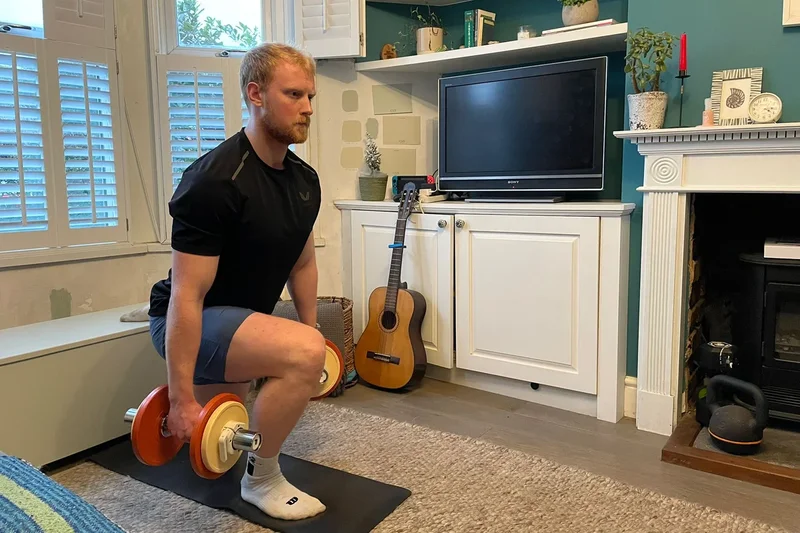
In my living room there is a well-stocked home gym with dumbbells, barbells, weight plates and more. On the face of it, this might sound like a questionable interior design decision, but visitors rarely notice.
Why? Because it is all concealed within a soft grey wooden window seat: the Fittle Box.
This compact chest is split into sections that neatly store everything needed for a comprehensive home workout. It comes with up to 55kg of weight plates as well as a barbell, four dumbbells, collars for keeping the weight plates in place, and an exercise mat too. When you’re done with your workout, you can stash them away and enjoy some telly in a room not dominated by fitness kit.
I’ve owned the Fittle Box for roughly two years now, and it remains the first thing I show first-time visitors to my house. It also passed my discerning girlfriend’s style standards, and it’s used more regularly than even I could have predicted.
The drawback is that prices start at £1,250. This is not an impulse purchase.
As a fitness journalist who’s ever-wary of fitness fads, and wants you to be able to stay in shape as cost-effectively as possible, I can’t recommend this lightly. But I do think there are people who could benefit from investing.
Read more: The three ‘essential’ kettlebell exercises for fitness and longevity, according to a strength coach
Read more: Best resistance bands, tested
- ContentsTwo barbells, four dumbbells, eight collars, one exercise mat, weight plates
- Total weight included55kg
- Why we love it- Contains everything you need for a comprehensive home workout
- Stylish
- Box doubles up as a bench
-
Wide selection of resistance
-
Take note- Expensive
- Unwieldy when full
What is the Fittle Box?
The Fittle Box is an all-in-one home gym containing an exercise mat, four adjustable dumbbells, one adjustable barbell, eight Olympic quick-lock collars and 35kg or 55kg of weight plates (depending on whether you pick the “base” option or more expensive “plus” package).
This is all neatly presented in a stylish and subtle box, which marks a nice change from the usual home workout aesthetic of clunky exercise machines and dumbbells cluttering up the spare room.
Thoughts from two years of testing the Fittle Box
My favourite thing about the Fittle Box is that, unlike so many viral fitness products before it, the brand doesn’t try to reinvent the wheel with a revolutionary new way of exercising. Instead, it champions tried and tested exercise methods (lifting weights), and does so beautifully.
The box looks fantastic, earning the approval of my art director partner, who labelled it “beautiful to look at both inside and out”. As a result, it now sits pride of place in the living room – not that you’d ever know there was a whole gym hiding in there.
Every time I revealed it to friends and family members, they were shocked to find an array of bars and plates inside, before quickly asking where they could buy one. One notoriously hard to impress relative even whacked the box on their optimistic Christmas list.
The Fittle Box streamlines your training too; it cuts out commute times to and from the gym, and it’s incredibly quick to set up. I loved how everything has its place, so I don’t have to rummage through a heap of rusty bars and weight plates to find what I need – an all too common occurrence in my former home gym (read: shed).
The quick-lock collars are far more efficient than the spinlock equivalents you find in most adjustable dumbbell sets. The box also doubles as a weight bench for moves like step-ups, split squats and single-arm dumbbell rows, broadening my exercise horizons, although I found it a bit too wide for chest presses. And if you’re short on exercise ideas, the Fittle website has a decent bank of follow-along “support”, “sweat” and “strength” classes.
I preferred the Fittle Box to other all-in-one workout benches I’ve tried, including the market-leading Technogym bench. High praise, considering Technogym’s excellent credentials.
The (more expensive) TechnoGym bench has three resistance bands, some knuckle weights and five sets of dumbbells which max out at 10kg. It’s presented smartly, but seasoned lifters will find these provisions too light to challenge them during heavy compound moves like squats and deadlifts.
The Fittle Box’s adjustable free weights allow you to choose from a much wider selection of resistances, catering to all fitness levels and allowing users to apply the progressive overload principle (the key to successful strength training) by incrementally increasing the weight they’re lifting over time, in line with their growing strength levels.
My final observations are how well the Fittle Box has aged. It looks almost identical to the day it arrived, and it has saved me on countless occasions over the last 24 months when I’ve wanted to train but haven’t had time to get to a gym.
Should you buy the Fittle Box?
Is the Fittle Box a serious bit of gym kit or just another novelty item? That’s the key question here.
I’ve tested a lot of new fitness tech, and there are myriad products I’ve used a handful of times before resigning them to the bottom drawer of my desk. My main concern going into this test was that the Fittle Box would suffer a similar fate, living out its days as an overqualified bench.
However, I quickly realised there was nothing to worry about, and was surprised to find just how much I used it. Despite being a regular gym-goer, it was incredibly helpful for squeezing some movement into busy days, doing some prehab work in front of the telly or catching up on some bits I’d missed from my weekly training plan. I also loved that there was plenty of weight to play with, so most exercisers will be able to create a dumbbell heavy enough for a brutal set of Bulgarian split squats.
My partner reaped the benefits too, finding the Fittle Box had everything she needed for an all-encompassing at-home exercise routine. There were only two notes we came up with. Firstly, while handy for adding cushioning to the top of the bench for chest presses, the exercise mat was too narrow to be much use for floor work, yoga and Pilates. And secondly, even with wheels on one side, the box was pretty tricky to manoeuvre, particularly when it had all the weights inside.
But these two minor gripes don’t change the fact that I think this is a fantastic product, delivering style and substance in equally impressive doses.
Finally, we arrive at the elephant in the room: the price. Fittle validates this by saying that, compared to a UK average £55 monthly gym membership, the box pays for itself in two years. If you have two people using it, that price is halved.
But £1,250 is still an awful lot of money, especially in a time when many of us aren’t flush with cash. For this reason, if you know you can get plenty of value from a £20 per month chain gym membership, it could be worth sticking with it. But if the Fittle Box allows you to train consistently when otherwise you would not exercise at all, it may be a savvy investment for your future health and fitness.
Read more: I trained like Anne Hathaway for a month, and the results surprised me