(ATTN: CHANGES dateline; ADDS U.S. readout in paras 14-18)
By Oh Seok-min
MANILA/WASHINGTON, July 22 (Yonhap) -- The top diplomats of South Korea, the United States and Japan on Wednesday reaffirmed close coordination on North Korea policy, underscoring their commitment to deterrence against Pyongyang and the denuclearization of the Korean Peninsula, Seoul's foreign ministry said.
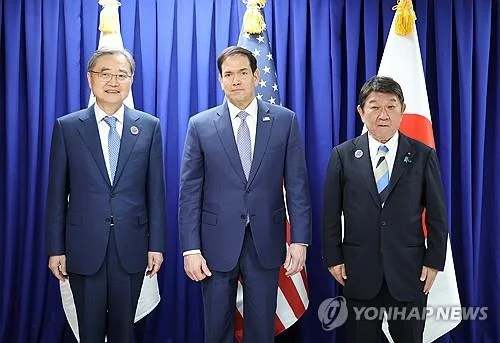
Foreign Minister Cho Hyun, U.S. Secretary of State Marco Rubio and Japanese Foreign Minister Toshimitsu Motegi agreed to strengthen cooperation during their trilateral talks held on the sidelines of Association of Southeast Asian Nations (ASEAN)-related ministerial meetings in Manila, according to the Ministry of Foreign Affairs.
The three diplomats are in the Philippine capital to attend the ASEAN Regional Forum (ARF), the East Asia Summit (EAS) foreign ministers' meeting and other related gatherings.
"The three ministers shared their assessments of recent developments on the Korean Peninsula and reaffirmed their commitment to maintaining a robust deterrence posture against North Korea while upholding the goal of the denuclearization of the Korean Peninsula," the ministry said in a statement.
"The ministers also agreed to maintain close coordination on North Korea policy and continue communication and cooperation aimed at preserving peace and stability on the Korean Peninsula through dialogue and diplomacy," it added.
South Korean Foreign Minister Cho Hyun (L), U.S. Secretary of State Marco Rubio (C) and Japanese Foreign Minister Toshimitsu Motegi pose for a photo ahead of their talks in Manila on July 22, 2026. (Yonhap)
The trilateral meeting took place two weeks after the three ministers held talks on the sidelines of the North Atlantic Treaty Organization (NATO) summit on July 7, which the ministry said highlights the importance the three countries place on trilateral cooperation and coordination.
Seoul has maintained that growing exchanges between North Korea and Russia, as well as between Pyongyang and Beijing, should contribute to peace and stability on the Korean Peninsula and help bring the North back to the dialogue table.
North Korea appears to have skipped the ARF for the second consecutive year, Seoul officials said, as it continues to focus on bilateral diplomacy with Russia and China while shunning multilateral diplomatic engagements. The ARF ministerial kicked off Tuesday and is set to end Thursday.
The three ministers also discussed key risks and areas for policy coordination in economic security cooperation and agreed to deepen practical cooperation in areas such as nuclear energy, critical minerals and emerging technologies.
Touching on the latest developments in Northeast Asia and the Middle East, the three agreed on the need to further strengthen communication and policy coordination amid growing geopolitical uncertainties, the ministry said.
"They exchanged views on regional security issues, including attempts to unilaterally change the status quo, and reaffirmed their commitment to upholding international law, including the principles reflected in the U.N. Convention on the Law of the Sea, as well as strengthening maritime security in the Indo-Pacific region, including Southeast Asia," the ministry said, without elaborating further.
Agenda items also included expanding cooperation in advanced technology protection, supply chain diversification and resilience, responses to economic coercion, transnational crime and disaster relief.
"The ministers agreed to maintain the momentum of trilateral cooperation through regular consultations at various levels and continue meeting frequently, including on the sidelines of multilateral gatherings," the ministry said.
In a separate readout, U.S. State Department spokesperson Tommy Pigott said the top diplomats reaffirmed the importance of maintaining a "unified" approach toward North Korea, underscoring their commitment to the "complete" denuclearization of the North and continued coordination to counter North Korean cyber threats.
In addition, they emphasized the importance of maintaining peace and stability across the Taiwan Strait, and "noted with concern" China's lack of sufficient notification of its recent intercontinental ballistic missile launch into the Pacific, according to the spokesperson.
The chief diplomats also committed to intensifying joint efforts targeting transnational criminal organizations, including networks operating scam centers, and to expanding trilateral discussions on Arctic issues in recognition of the region's growing strategic importance, he said.
"They also reaffirmed commitments to defense cooperation, maritime security, and upholding freedom of navigation, and pledged continued trilateral consultations at all levels," he added.
Moreover, the three sides discussed next steps to implement the trilateral Memorandum of Cooperation (MOC) on Small Modular Reactor Deployments in Other Countries, and to start deployment in the Indo-Pacific to advance energy diversification and technology cooperation, according to Pigott.
The three countries signed the MOC earlier this month when the top diplomats met trilaterally on the sidelines of the North Atlantic Treaty Organization (NATO) summit in Ankara, Turkey.
During the previous three-way meeting, the three diplomats reaffirmed their commitment to the denuclearization of the Korean Peninsula and vowed to continue efforts to pursue dialogue with Pyongyang.
graceoh@yna.co.kr
(END)