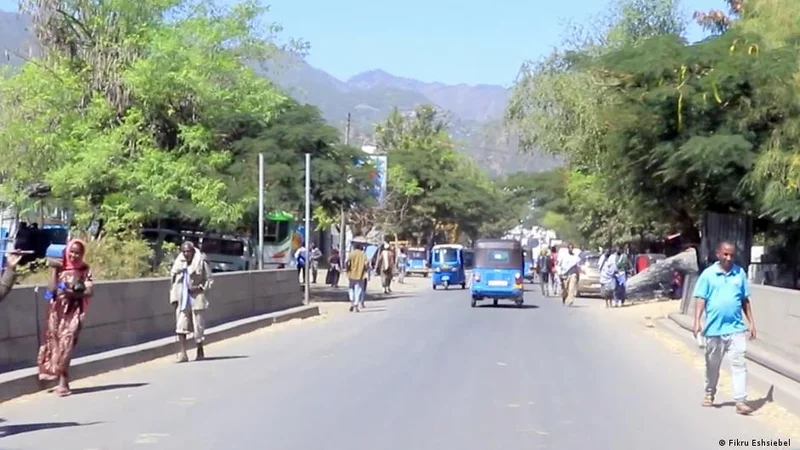
Residents of Alamata, a city that straddles Ethiopia's Tigray and Amhara regions. say a growing military presence have them fearing renewed fighting.
The city is one of the most contested areas since the Tigray War. Tigray People's Liberation Front (TPLF) forces took control of it at the start of this year, after Ethiopian federal troops withdrew.
One Alamata resident who requested anonymity for safety reasons said: "The TPLF forces have deployed many troops on the Raya front and have been instructed to be ready for war."
"In most areas of the city, you can only see soldiers," another Alamata resident, Ato Gebru TsefaEzigi, told DW. "It seems like a military city."
Alamata is the central hub of the Raya valley, which straddles the Tigray and Amhara regions and alongside. It includes the districts of Raya Azebo in the Tigray region and Raya Kobo in the Amhara region.
Did Ethiopia forces strike in Western Tigray?
In a statement on August 2, the regional government in Tigray said its forces had repelled an "open military offensive against the Tigray Security Forces in the vicinity of Shererina, Western Tigray" by Ethiopian federal forces.
It also stated that the federal forces were supported by forces belonging to Sudan's paramilitary Rapid Support Forces (RSF). DW could not independently verify the claims.
The Ethiopian federal government has not responded to the Tigray government's statement. However, Ethiopian media reported that Abraham Belay, the federal Minister of Irrigation and Lowland Areas acknowledged that clashes had taken place in western Tigray and blamed the TPLF for intitiating them.
A highly contested area
Alamata lies about 15 kilometers (9 miles) north of Kobo in the Amhara region and sits along a strategic highway linking Tigray with central Ethiopia.
Ethiopian federal forces entered the city in November 2020, at the start of the Tigray War. Forces loyal to the TPLF and deployed TPLF army units have been in control since federal forces withdrew on January 15.
However, the area's status remains unresolved under the African Union-brokered Pretoria Peace Agreement signed in November 2022. Political divisions within the TPLF have also fueled concerns about the durability of the peace process.
An estimated 600,000 people died in the 2020-2022 war. Millions were displaced and essential services collapsed across Tigray and much of northern Ethiopia. The federal government and the TPLF accused each other of having initiated the conflict.
Calls for access and restraint
Although the Pretoria agreement largely ended large-scale fighting, several key provisions remain unimplemented, including the status of disputed areas and the restoration of civilian administration in some of them.
The African Union has repeatedly urged all parties to fully implement the Pretoria agreement and resolve disputes through dialogue. Human rights group Amnesty International has also called for restraint and renewed its calls for independent access to the conflict-affected areas.
"We are also calling for access for human rights observers, investigators, and journalists to Tigray and to all regions impacted by the conflict in Ethiopia," said Suad Nur, Amnesty's Horn of Africa campaigner. "Because we know what happens when perpetrators commit crimes or conduct hostilities where there is no scrutiny or oversight ... We know what happens when hostilities unfold without scrutiny or oversight."
Regional implications
Renewed instability in northern Ethiopia could have consequences beyond the country's borders. International humanitarian agencies are currently overstretched in countries like Sudan and Somalia.
Analysts warn that renewed fighting in and around Tigray could trigger the displacement of even more people, disrupt trade routes and complicate peace efforts in the region.
For Alamata residents and those in Ethiopian communities still recovering from one of Africa's deadliest conflicts, the latest military movements have revived painful memories of conflict.
Negash Mohammed, Tamirat Dinsa and Mantegaftot Sileshi contributed to this article.
Edtied by: Benita van Eyssen