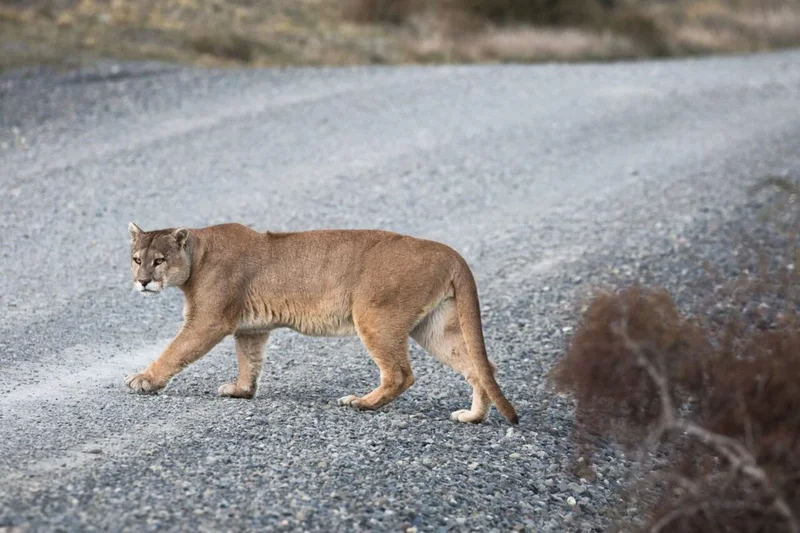
Pumas could be the crossing guard that humans never knew we wanted. Research out today shows how these hefty cats might be helping reduce car accidents involving deer.
Biologists studied puma and deer populations living in the Pacific Northwest. They found that areas that had a greater puma presence tended to have fewer deer-vehicle collisions. The findings highlight some of the less obvious perks that can come from humans co-existing with large predators, the researchers say.
“Carnivores may well be providing a similar road safety service elsewhere around the globe where populations have persisted and this valuable ecosystem service has just gone unnoticed to date,” lead author Justin Suraci, a wildlife ecologist and senior scientist with Conservation Science Partners, told Gizmodo.
The perks of pumas
Pumas are large carnivores, but they’re not actually closely related to the various species of felines we typically call big cats, such as lions, tigers, and leopards, which all belong to the genus Panthera. Pumas are their own separate genus (Puma), with only one species still living today: Puma concolor, better known as the cougar. Cougars are widely found throughout the Americas, with two subspecies, the North American and South American cougar. That said, they are also nicknamed mountain lions, adding to the confusion.
Suraci and his team were interested in understanding and quantifying the net value that communities living near pumas experience. And while people have often focused on the known risks, such as farmers losing livestock to the cats, we’re much less certain about their potential benefits, he says.
Some research has suggested that reintroducing large predators like pumas (and wolves) to an area can reduce deer-related car accidents. This study, however, looked at well-established populations of pumas and deer living in the Olympic Peninsula of Washington. The team analyzed information from a large database of camera trap footage as well as data on car accidents involving wildlife in the region. And they found a consistent pattern.
“On the Olympic Peninsula of Washington, deer alter their use of both space and time where pumas are present, overlapping less with roads and reducing activity at night, when some of the most dangerous collisions occur,” Suraci said.
The researchers estimated that high puma activity, relative to low, deceased the likelihood of a deer-related car accident by 67%. And over a five-year span, high puma activity could reduce the total number of these accidents by up to 76%.
Their findings, published Thursday in Current Biology, also provide some insight into how exactly pumas are causing less car accidents.
“Much of the past work speculating how carnivores might reduce deer-vehicle collisions was based on the assumption that carnivores need to kill enough deer, to reduce vehicle collisions with deer. This doesnât really make sense because pumas have little impact on the abundance of healthy deer populations,” study co-author Mark Elbroch, director of the Puma Program at Panthera, a nonprofit focusing on preserving wild cat populations, told Gizmodo. “Importantly, our work reveals itâs not by killing, itâs by scaring prey that they make their biggest contribution to reductions in deer-vehicle collisions.”
In many ways, Elbroch added, pumas could be seen as the furry version of wildlife bridges, which have received lots of political and public support lately for helping reduce hazardous interactions between humans and wildlife.
More to learn
The researchers say more work should be done to calculate the overall value, including both risks and benefits, of living near large predators like pumas. Next, they plan to work on quantifying the exact dollar savings that pumas in the Olympic Peninsula could be providing to the area.
While further research is indeed worthwhile, the authors hope their current work can illustrate why people should probably be more grateful to pumas and other large predators that we share our environments with.
“I think the most important take-away here is that coexisting with large predators is likely providing benefits to human communities right now, even if those benefits have not been clearly demonstrated to date, and this isnât necessarily limited to road safety,” Suraci said.