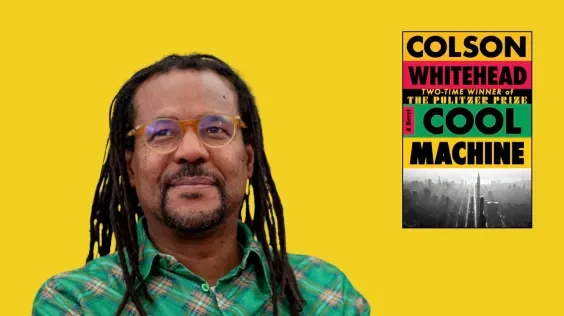
"The city was question and answer in one," Colson Whitehead writes early on inCool Machine, the final novel of his Harlem Trilogy. "Cause and effect and everything else, too." You can forgive the lifelong New Yorker for being a little romantic about his hometown, which is both the setting and central metaphor across the tales of Harlem furniture salesman-cum-not-so-reluctant-crook Ray Carney, whose misadventures come to a conclusion with Machine. Carney's capers, inspired by heist movies, are presented as discrete novellas, with each book—Harlem Shuffle and Crook Manifesto are the first two—consisting of three parts. Collectively, they span both a whole array of thieving and schemes as well as nearly three decades of New York history.
These vivid, pulpy, compulsively readable novels allow the two-time Pulitzer-winner to have a lot of fun, while providing readers with an informed perspective on the city through the 1960s, ’70s and ’80s, plus a healthy dose of structural critique (New York, of course, is built on thievery and deception just like most places). It goes down easy thanks to Whitehead's superlative ability to weave deep research with rich narrative: Carney, his partner Pepper, and all their other motley associates are so vibrant and winning that it's easy to understand why the author wanted to stick with them through three books.
For those who only know Whitehead through The Underground Railroad and The Nickel Boys—gutting, inventive, and understandably acclaimed works on slavery and juvenile incarceration, respectively—a juicy genre series might seem out of character. But he's reiterated over and over that horror and other genre fiction is his comfort zone; readers familiar with his other work know Whitehead is a remarkable humorist. If I may here plug John Henry Days, which a quarter-century later stands as a remarkably prescient media satire among many other things, right down to the indictment of "content" ... Whitehead, for the uninitiated, got his start at the Village Voice. He's even on Bluesky, reposting memes in keeping with his persona as your friendly, self-deprecating Gen X literary genius next door. Cool Machine is a portrait of his New York, spotlighting the downtown arts and music scenes of the ’80s through the bewildered, middle-aged eyes of Carney and Pepper (for comedic effect, of course).
I spoke with Whitehead ahead of the release of Cool Machine about New York, embracing change, and home furnishings. Our conversation has been lightly edited.
What are your earliest memories and associations with Harlem, as a native of both the neighborhood and the city?
Well, it was the 1970s. The city had not been cleaned up yet, and it was a particularly hard time because the city was bankrupt and crime was out of control. That graffiti-covered, dingy New York that I think people know from movies was definitely my formative New York.
I sort of mentioned it in The Colossus of New York, in my first essay about when you become a New Yorker, but I always remember my brother and me in the front car of the 1 train, looking out the window in the dark tunnel, and then the tunnel emerging to the elevated tracks at the 125th Street station. Coming out of the darkness, and then into the light. Then when I was doing research for The Nickel Boys, I was trying to figure out where to place a restaurant that Elwood goes with his wife. I hit Amsterdam and 140th, and I got this weird sense. I hadn't been there in 40 years, and suddenly I was across the street from this playground where I would always play when I was very little. It was weird that I'd forgotten it, and to suddenly have the sense memory of finally seeing it again was … not remarkable, but I remember it vividly.
One of your most quoted lines comes from The Colossus of New York: "You are a New Yorker when what was there is more real and solid than what is here now." I know that feeling, and I personally am quite nostalgic for many versions of New York that I never even got to experience. But that book and the Harlem trilogy both take a pretty optimistic view of the endless churn, to use your word, and rejuvenation and reinvention of the city. How do you keep faith in that rather than sort of getting lost in what was?
The first thing is that that description you quoted is about New York, but I think it's about any place that we love. If you have a hometown, you experience the same thing of superimposing your past over what's there now.
I have a lot of faith in New York's powers of rejuvenation. It's been laid low over centuries—yellow fever, economic crises, fires, 9/11, the pandemic—and you know, we bounce back. People come back. So I have faith in the churn and the power of reinvention because it keeps going on. I mention this a bunch, but Harlem's getting gentrified. Young white folks are coming, and some of them are the great-grandkids of the first German and Irish and Jewish immigrants who were there 150 years ago. I think that's just crazy and funny. It's a dance that will continue beyond our lifetimes, barring any nuclear war or something.
Do you have a favorite bygone New York place?
I did put some of them in the book. Veselka is very popular. But I always liked the Kiev, so I put the Kiev in there—that's where Pepper has lunch with LJ. The Blue Marlin, which was a bar by Columbia, is where Carney meets Uncle Rich's henchmen. Paying tribute to that was great. I used to live on the Lower East Side, down a block from Katz's, and that's where I put Dee Void's apartment. We're entering my teenage and twenty-something New York, so I put some signposts in there for me.
Do you have a favorite book about New York besides your own?
I don't think so. I mean, I think of Melville as a New York writer, even though he's talking about whales. Walt Whitman, of course. Manhattan Transfer by [John] Dos Passos made a big impression on me in college, and I've sort of been thinking about it a lot lately as I work on something new. But not really. I'm not like … rah rah in that kind of way. But cool movies like The Taking of Pelham One Two Three and Escape from New York—that one's in the book a bunch.
In Harlem Shuffle, you established this structure: three connected novellas, each gradually zooming out on a different tier of "crookedness." How did you wind up continuing that structure (or not) through Crook Manifesto and Cool Machine?
You're definitely zooming out from section to section: street level criminals and robbers in the first section of Harlem Shuffle, and then by the final section we have this panorama of real estate titans who are committing corruption on a much bigger scale. You're forced to think, how bad is Carney? How bad are those guys in the first section when these other people are robbing a city blind? In the second book, fire becomes a recurring motif. The fires in the distance get closer and closer in the first two sections of it, and then in the third one, we deal with the sort of large-scale corruption again: development money, insurance plays, and how it plays out on the street.
In Cool Machine, we do get some of the structural corruption, but it's also an epilogue in a way. I'm wrapping things up. I'm dealing with the fallout from Freddie's death in the first book, and saying goodbye to Carney and Pepper and the supporting cast. While we are dealing with a more structural malfeasance in the third section of Cool Machine, it is also a return to various themes and ideas from the early part of the series so that we can say goodbye.
Since you brought up Pepper: It feels like he, maybe even more than Carney, became the lovable antihero of the series. Did you see that coming? Are there any other analogous characters that you had in mind when you sketched him out?
The models for the series are films for me—the heist as a film genre. But in trying to figure out what kind of crime story I wanted to tell, I came across Richard Stark, the pseudonym of Donald Westlake. His hero, Parker, is a very low-affect, accomplished criminal who would be incredibly rich, except he's surrounded by idiots and morons who always undermine the job. So I wanted someone who was borderline sociopathic and violent to be in contrast to Carney, with a different attitude on crime and on family. He's isolated in the first one, and then eventually becomes part of Carney's family.
He was really fun to write in the first one, and he's a great foil for a lot of Carney's characteristics. I wanted to have more of him, so I gave myself permission to give him his own section in Crook Manifesto. He became a good foil for the discussion of pop culture and blaxploitation in that book, and he's also a good foil for talking about culture in Cool Machine because he has no idea who Basquiat is, or Julian Schnabel, or Liquid Liquid.
You say he's sociopathic, but then … how can you not like him at the same time?
Sure, of course—beneath his crusty sociopathic exterior, there's a fine person.
I was listening to an interview you did with Alexis Madrigal where he asked if you had exorcised anything in the course of writing Harlem Shuffle. You said you couldn't answer because you hadn't finished the trilogy yet. Now that you have, how has writing it changed your perspective, or helped you move through something?
I did love New York, but I love New York more now after writing about it for seven years in this certain kind of way. Obviously I've written about it a lot, but I think coming through the pandemic … I was writing Crook Manifesto holed up and couldn't go outside. I sort of knew that it was a bad patch, but we'd pull out of it. I thought that being in my little room scribbling, I was contributing to that somehow. In the same way that the 1970s were really terrible, but whether it's Philip Glass in Soho doing his crazy avant-garde stuff, or [DJ] Kool Herc in the Bronx pioneering hip-hop, or the Ramones, or the Talking Heads, artists were bringing the city back in their own weird little lofts and corners of the city.
I guess I didn't exorcise something. I appreciate the city more, and I really feel better about living here and being part of the mess. I feel more part of the community in a way I didn't feel like when I started. Like me going on about Harlem and the descendants of immigrants coming back just really sort of warms my heart.
The titles Harlem Shuffle and Cool Machine are both from song lyrics, and pop culture in general is woven throughout all three books. How did music, in particular, serve as a throughline and a background for these stories?
I play music while I'm working. I guess people are surprised that I play songs with lyrics, but it's just like a 4,000-song playlist of stuff I like so it will go from Archie Shepp to The Clash to Daft Punk and Underworld. I wasn't listening to jazz because I was writing about ’59 or funk because I was writing about 1973, those were mixed into a master list.
But I really got into the Osees, and they put out, like, two records a year. So now I have this seven-hour Osees playlist that, after playing it for all these years, is just like a Pavlovian signal that I should start working. I guess the idea is that it just keeps me company. It's music I love. Whenever I finish a book, I put on Purple Rain and Daydream Nation during the last three hours of composition. It's important to me, so I'm glad when I can put some stuff in the books—as I did in Cool Machine—to salute those people.
What was the last concert you went to?
I was in Berlin and I saw an orchestra called the Knights. They're based in New York, but I was googling Philip Glass concerts, and they were playing one of his compositions. So I went and saw them, and they did a cover of "Rhapsody in Blue," which I had never gotten into previously. Now I'm in this crazy "Rhapsody in Blue" thing.
Do you feel like you could pull off a heist now because you've done so much research on them?
I mean, I feel like I have since there's so many in the books. You have to plan the entrances and exits, how these contrivances work, when people get information, double crosses—you are planning a heist. If you asked me if I'd ever done a heist, I would say yes.
What's your coffee table like? [This is not a spoiler.]
It has a cool, weird mosaic—just very distinct.
So it's pretty ornate, kind of like the one you describe in the book.
So the phrase, "It's harder to find a good coffee table than it is to fall in love" [the epigraph of the first section of Cool Machine]—I used to say that a lot. I thought it was true, and then my wife was like, "Stop saying that. It's really insulting to me." So I just gave it to Carney instead.
Do you feel like you found a good coffee table?
The search goes on, but this one will do for now.