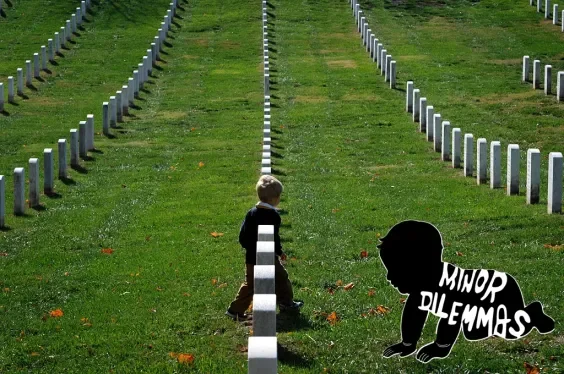
Welcome back to Minor Dilemmas, where a member of Defector's Parents Council will answer your questions on surviving family life. Have a question? Email us at minordilemmas@defector.com.
This week, Dave answers a question about talking to your child about death.
David:
Hi Defector Dad collective. My almost-three-year-old daughter just had one of her two main daycare teachers pass away suddenly, and my wife and I are at a loss as to how best to explain this to her. She's currently deep in her "why" phase, as well, so any explanation we give will probably be followed up with lots of further questions. Any advice for how to approach this?
First off, David, sorry to hear about your daughter’s loss. If she’s baffled by death, she’s got lots of company. Hell, I’m still in my “why” phase, and I’m waaaay older than three. Death will never make sense. Bewilderment of the bereaved is why religion exists, ain’t it? Provides explanations for the unexplainable. I’ve heard lots of folks get through life’s worst moments by relying on faith and assurances that the dead are “in a better place now.” I’m absolutely not here to say that won’t work for others. Just hasn’t for me.
The wisest, most comforting thing I’ve heard about death is: “Everything dies, baby, that’s a fact.” The rest remains a mystery. But, being that this is an advice column and you’re owed something, I will spew what I've learned from a lifetime of dealing with some deaths, and not dealing with others. Spoiler alert: I say deal with ‘em.
I didn’t always follow that counsel. My earliest encounter with death came with Gerbie, a gerbil I got from a kid at school who didn’t want him anymore. He was my first pet. I was probably six years old. I fed him and changed his bedding and watched Gerbie run on the gerbil wheel and rubbed his belly with one finger through the cage. Gerbie meant more to me than anything or anybody that came before him (if he was indeed a him). But not for long.
Shortly after he came into my life, Gerbie stopped eating and was barely moving. My mom, bless her, took Gerbie to the veterinarian. I don’t remember the diagnosis, but I could tell from the body language of the vet and my mom that Gerbie wasn’t given anything close to a clean bill of health. We went home with some drops and I was worried enough that I slept next to Gerbie's cage that night. I woke up to find the cage door open and Gerbie gone. I thought he’d escaped, which meant he’d had a miraculous recovery. I left my bedroom and told my parents that Gerbie got out and we need to find him! They looked at each other and told me: Nah. Turns out he’d died overnight, and they’d already buried him in the backyard. I assume that my parents, who were very kind, figured I was too little to deal with something so big. I can’t be sure because we didn’t have any real talk about Gerbie’s life or death. We didn’t deal with it.
This became a pattern when I was little. My paternal grandmother died within a couple years of Gerbie. My brother and sister and I weren’t brought to the funeral. I don’t remember ever having talks about her death. The only memory I have of that time is being packed in with lots of young cousins in the living room at grandma's house in Astoria watching TV game shows as her service was underway at a nearby church. My remaining two living grandparents died shortly thereafter. I didn't go to their funerals either. The grownups probably thought I was too young to deal with something so big.
Then again, these were all Catholic funerals, which I’d later regard as the most pointless events known to mankind. The ceremonies focused exclusively on the afterlife and were so devoid of humanity that there might as well be a cruller in the box beneath the pulpit instead of a person who lived a life worth hearing about and was loved and made people laugh. So maybe my folks left me with babysitters out of kindness. (I grew up culturally Catholic and retain some anger toward the church, which is rekindled at every funeral mass. But I have family and friends for whom it clicked and know mileage may vary.)
Over time, I’ve come to believe that keeping kids away from funerals, even lousy ones, is a mistake. There’s a fine chance that seeing lots of people come together to share real pain from a death can get kids thinking about how precious and short life is. What lessons are more important? And a good memorial service, where a life is recalled in detail by those who knew and loved the departed, can be downright revelatory. I grew to particularly appreciate that beautifully brutal crowd-participation ritual found at the end of some funerals where everybody takes a turn throwing dirt into the grave. Nobody comes out of the womb knowing how to deal with loss; you learn how to deal with it by losing people you love. And nothing forces you to deal with it quite like waiting in line to dump dirt on a dead body in a box in a hole.
I’ve also come to believe that there can be a price paid for not dealing with loss. For me, this came into play when I got to high school and my dad got terminally ill. I didn’t deal with it well, or at all. Over his last several months of life, I just stopped coming home except to sleep. A few hours after he died in his bedroom in our house, I went to my school’s basketball game. I loved and was in awe of my dad, but I don’t remember crying at his funeral. I don’t remember his funeral at all. Through the years I came to have serious guilt about my failure to be there for my dad as he was dying, for running out on my mom and siblings before and after he died. I’m sad that the only memory I have of the day he died is seeing my buddy Ash dunk on future All-American Carlos Yates at that game. I’m sure avoidance isn’t a novel way for an adolescent to handle family tragedy. But I still have lots of regrets from that sad chapter, and regrets are ass.
I obviously can’t know whether or not I would have handled my father’s dying days and death better if only I’d been asked to help bury Gerbie in the backyard, or thrown dirt on grandma instead of watching game shows. But, maybe? In any case, I’m convinced remorse over how I acted as a kid informed how I dealt with my mother’s demise years later. I met it head on. I spent much of her last year in doctors offices and hospitals, trying to get her well, and I don’t know that I’ve had a more profound year. When she died, I embraced the grief like never before. I couldn’t have cried more if crying was my job. (Some brilliant friends at a former workplace made a short movie about my dealing with my mom’s death.)
After becoming a parent of two boys, I thought about my experiences as a kid and resolved to never avoid dealing with death or make dying weird for them. They were four and eight years old when my mom’s health went south. Since I was their daycare provider, the kids accompanied me on many of those visits to doctors offices and hospitals, and saw her life slipping away from up close. She eventually went into hospice care in her own home, the house I grew up in.
That’s when my goal of not shielding them from her demise was put to a big test. As fate would have it, my kids were in the house the day she died. When I came out of her bedroom and told them the awful news, my eldest son, Eddie, immediately asked if he could go in to see her. I was not ready for that question, and had only a split second to make a decision. I defaulted to my resolution to not make death weird. Despite convulsing with grief as we walked to her room, I tried telling him how good she was to me and how lucky I was to have a mother who cared more about me than herself and that I wished I was more like her–the heaviest, most from-the-heart sentences I’d ever tried to utter. But through all that crying my words were coming out in a ridiculous, Mike Tyson–esque squeal that my son had never heard from me before. So when I finished my heartfelt tribute and turned from my poor mother lying in bed to look at Eddie, he was smiling wide and pointing at my contorted face. “Are you doing that to make me laugh?” he asked, giggling.
I hugged him, and was suddenly laughing as hard as I had been crying. My kids were sitting up front at her memorial service when I told the story of us over her now lifeless body. And when the opportunity arises, I still thank Eddie for giving me something to smile about on the worst day of my life.
I can’t know exactly what impact that episode or having them involved in my mother’s final days will have on my kids over the long term. But I have since witnessed Eddie behave gracefully when death hit close. Coach G, a beloved assistant basketball coach on his high school team, died from a fall in a pickup game. Like everybody who heard about the tragedy, the death left Eddie in the "why" phase. Who dies like that? I had no answers for him. But right away he acknowledged something big and horrible had happened, and wanted to talk about his coach. He told me of his love of basketball, how nice a guy he was, and how much time Coach G put in, all as a volunteer, just to help him and other kids get better. Eddie reached out on his own to members of the coach’s family, none of whom he knew, to say the same heartfelt things. We went to the funeral, and he heard straight from the family how much his words and being there for them meant. I wish I would have been that useful when I was his age.
Oh, right, you came here for some help! My advice would be: Talk to your kid about dead pets and how much joy they brought to you. Take her to funerals of anybody who meant anything to you or her. Hell, even Catholic funerals. Encourage her to talk about departed loved ones and not keep feelings inside. Cry a lot. Tell her life is precious, life is short. She can’t hear that enough.