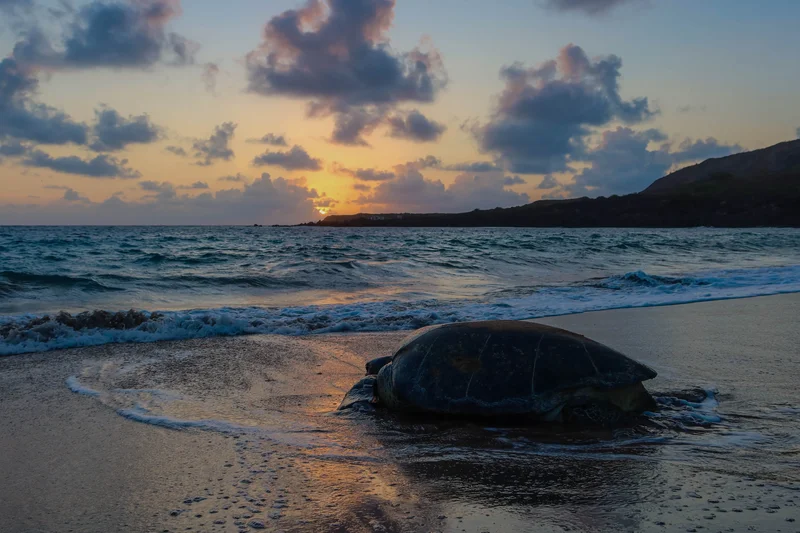
Night is falling in Long Beach, the beach that borders Georgetown, the capital of Ascensión Island. On the shore, something moves. A dark, enormous mass emerges from the waves with a slowness that seems deliberate. It’s a female green sea turtle (Chelonia mydas), which can grow to measure over four feet and weigh more than 330 pounds. She just crossed 1,400 miles of open ocean, from the coasts of Brazil. It took her six weeks. She ate nothing on the trip. She’s returning to the same beach where she was born. And now she has a job to do.
She advances across the sand, leaving a pair of tracks reminiscent of those of the caterpillar wheels of an excavator machine. She cries, her tears cleaning her eyes of sand, though for centuries sailors have believed her kind cry from fear or sadness. First, she makes the hole for her body, turning slowly; then, the bed for her eggs. She does this with her back legs, without looking, blindly, with millimetric precision. She lays around 150 soft white eggs, covers them, camouflages them, and returns to the sea. In two or three weeks, she will be back to lay more.
What the turtle does not know is that she is the protagonist of one of the greatest maritime conservation success stories in recent history. In October 2025, the International Union for Conservation of Nature removed the green sea turtle from its “endangered” list, reclassifying it as being of “least concern,” jumping over two intermediate categories. It was an unprecedented occurrence for the classification system that monitors endangered species around the world, and reflects the rise in the animal’s global population of more than 28% since the 1970s. “These animals have been doing this since the time of the dinosaurs; it’s a privilege to care for them,” says Laura Shearer, head of the AIG Natural Coastal Reserve, the initials standing for the government of Ascensión Island. The island is a British overseas territory of volcanic origin located in the Atlantic Ocean, approximately halfway between Africa and South America. It has been of great strategic and military importance for the British for centuries. But today, the turtle (which forms part of the island’s official crest) is starring in a strange tale of hope in dark times for biodiversity.
The massacre
The history of the green sea turtle in Ascensión is the history of the resistance of a species submitted to nearly industrial pressure for four centuries. When Portuguese sailors spotted the island for the first time in 1501, they found something extraordinary on its beaches: thousands of turtles that came ashore to nest without fear, given that they had no terrestrial predators. What followed was the systematic exploitation of them as a resource. The ships that crossed the Atlantic quickly learned the flip technique: when females lay eggs, they enter into an oxytocin-induced trance state that leaves them unaware of their environment. And so, sailors could flip them onto their shells. In this position, which she is unable to escape on her own, they could keep her alive in a ship’s storage area for weeks, feeding her only with buckets of sea water. Fresh and long-lasting meat in the middle of the ocean, at the cost of an incredible animal’s suffering.
John Ovinton, an observer who visited the island in 1691, described the scene with a mix of amazement and pity. Upon discovering themselves on their backs, the turtles “began to lament their situation with deep sighs and pitiful moans, leaking abundant water from their eyes.” This was actually their typical way of breathing and cleaning out the sand. But the image says something about the way that humans of the era saw the animals they exploited. The anecdote appears in the journalist Duff Hart-Davis’s precious book Ascension: The Story of a South Atlantic Island.
In fact in 1829, on the southern end of Long Beach, a circular pool 65 feet in diameter was built, with openings so that the sea water could enter and leave. There up to 300 turtles would be stored at a time, waiting to be consumed or boarded onto a ship. Since the females don’t eat during their time on the island — they arrive with fat reserves from Brazil — keeping them was easy. That same year a record was reached: 1,500 captured in a single season.
The Ascensión turtles did not just feed the British sailors who inhabited the island. They were also shipped live to England to be turned into soup, the period’s most prized dish. The John Lusty firm, which was based in London’s East End and whose address read “Turtling, London,” was the official supplier to the Admiralty lords, who were entitled to a certain number of liters of soup with each shipment.
An end to this practice came not through ecological consciousness, but the exhaustion of resources. The 1,500 turtles captured in 1829 shrank to mere hundreds in just 40 years. In 1944, the green sea turtle became an endangered species on the island.
The recovery of a species with the biology of the green sea turtle requires patience measured in decades. They take between 25 and 30 years to reach sexual maturity. Its survival rate to adulthood is between one and 10 of every 10,000 young. The rest are devoured by birds or fish. Those that do become adults disappear for years in the open ocean — the so-called “lost years” — during which science has yet to determine what they do, or where they go.
Observing hatchlings emerge from the sand is an experience that is hard to forget. You never know when they will be born. They break free by the dozens, practically at the same time. Those who are in the bottom part of the nest begin to move, shaking those above, and in a few minutes, the entire group erupts to the surface. This synchronicity does not take place by chance. The more turtles emerge at once, the greater chance there is that some of them will reach the sea. Upon emerging, they turn to the ocean, completely unguided. The light that comes from the sea is slightly more blue and green than on land, and that difference seems to be enough for them. This is why it’s so important to reduce light pollution on these beaches; if not, they could mistakenly head towards cities or highways.
The majority hatch at night, when predators are scarce and the heat won’t kill them. They weigh approximately 80 grams. Their soft shell fits in the palm of one’s hand, but even if they may be devoured by birds or crabs on their path, it’s important not to touch them. If you pick up a baby and bring it to the water, it will later get lost. That trek of those feet of sand imprint upon them a magnetic map of the beach, the same one they will bring back with them decades later to nest in this very place. Without their trip, no return is possible.
Population control
The systematic control of the Ascensión beaches began in 1977. During that first period, an average of 3,752 nests were recorded. Today, there are more than 25,000 per year, six times that of 50 years ago.
The IUCN specifically referenced Ascensión Island, along with Brazil, Mexico and Hawaii, in its justification of the turtle’s reclassification in October 2025. For Laura Shearer, the numbers are eloquent, but also invite caution. “We have one of the longest-running turtle monitoring databases in the world,” she says. “The importance of that long-term monitoring cannot be underestimated. It reveals subtle patterns that can only be seen through decades of observation.”
Mysteries remain as to how this recovery has worked. Science has yet to satisfactorily explain how the turtles find the island — a landmass measuring barely seven miles across in the middle of the Atlantic — after traveling 1,400 miles from Brazil. Biologist Archie Carr, the world’s top authority on the species, has guessed that perhaps, they follow a chemical footprint that the southern equatorial current carries from the island to the Brazilian coastline. But this has yet to be proven.
A fragile victory
The conservation’s success comes with an important asterisk. “If the protective measures disappear, the species will once again become endangered,” warns Shearer. The Ascensión green sea turtle is only safe while on the island. Females spend six months there during the nesting season. The males, who arrive before — from December to February — and leave without touching land, spend even less time. Mating takes place in the water before the females emerge to nest, and features a surprising biological particularity: the eggs the female is about to lay are already fertilized from the previous season, and the sperm she receives now — from several different males — will be stored for the next. The female can store it for months.
Present threats are very real. Climate change is altering the sand temperature that determines the sex of offspring. If its over 86 degrees Farenheit, offspring become female; any less, and they’ll be male. Today, more than 96% of newborns on Ascensión are females. The AIG has carried out experiments that involve casting shade on nests that have been able to raise the proportion of males to 12%. Shearer estimates that in 10 years, it will be necessary to apply such tactics on a large scale.
Invasive plants — Mexican hawthorn, tree tobacco and Mexican poppy — are encroaching on nesting beaches, covering the sandy habitat and trapping newborns in their root systems, as well as harboring rodents that prey on hatchlings. Every year, the conservation team removes hundreds of trees from coastal reserves. And then there’s bycatch: fishing nets lost or abandoned in international waters — more than a million tons a year — and that trap turtles, who drown if they can’t free themselves. “We can only conserve these animals while they’re in our care. But their life cycle means they spend only part of their existence in our waters,” says Shearer.
Meanwhile on Long Beach, the female turtle finishes camouflaging her nest. She drags her body back to the sea, and rides out on a wave. In two weeks, she’ll return. And in some 60 days, if the sand isn’t too hot, if the rats don’t find the nest, if the waves don’t wash them away, and if the birds and sharks don’t wait for them at the water, one or two of her 150 offspring will make it to the sea. One in every 10,000 will arrive to adulthood, and return decades later to this same beach, guided by a magnetic map we still don’t completely understand. 400 years of persecution nearly finished them off; 80 years of protection has brought them back. The question now is whether the world that surrounds them (its beaches, its seas, its climates, its humans) will give them enough time to fully recover.