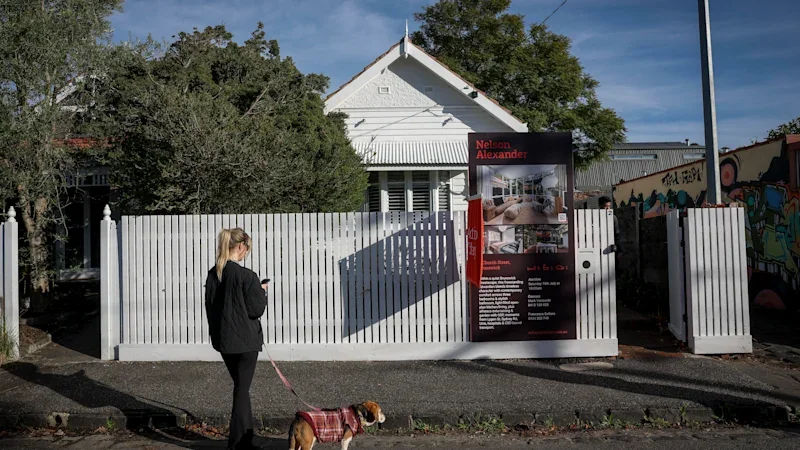
Fewer than 1 per cent of home owners are in negative equity across Australia, and first home buyers with low deposits are often buying in areas less affected by the property market downturn.
With house prices falling more than 3 per cent in both Melbourne and Sydney in the June quarter, according to Domain data, prominent agents and commentators have raised concerns about the loan-to-value ratio (LVR) of recent first home buyers and the threat of going into negative equity.
Negative equity is when someone’s property is worth less than the amount owing on their loan, which can make it harder to refinance with a different lender who may hesitate to take on the risk.
The actual share of properties in negative equity remains historically low, at below 1 per cent, Reserve Bank data from May shows.
PRD chief economist Dr Diaswati Mardiasmo said this meant 99 per cent of borrowers could cover their loan, even if they had to sell “in distress”.
“I don’t think it’s a big risk,” Westpac senior economist Matthew Hassan agreed.
Even for many of those who are in negative equity, the impact is largely theoretical.
“If your price goes backwards, and you’re in negative equity, and you’re not planning to sell your house, it’s no problem,” Terry Rawnsley, KPMG’s director of planning and infrastructure economics, said.
He noted that unlike a commercial loan, where a borrower might be required to refinance or sell if a property falls into negative equity, there was no such requirement for home owners.
“As long as the punters keep paying the loan off, then the banks are completely fine with it,” he said.
So who is at risk, and when should borrowers be concerned?
First home buyers
Almost 96,000 first home buyers took advantage of the 5% Deposit Scheme in the 2025-26 financial year.
“The majority... are borrowing 95 per cent of the property value,” Loan Market Rowville director Kris Faife said, noting this meant a fall of more than 5 per cent in the value of their home could lead to a recent buyer going into negative equity.
Rawnsley, Mardiasmo and Hassan agreed first home buyers who had taken out low deposit loans were most at risk.
But all three economists pointed out that most first home buyers were buying in areas that hadn’t experienced significant falls, and in some cases had gained value – the median house price in Melton, the lowest in Melbourne, grew 15.8 per cent in the year to the end of June, according to Domain.
“It’s predominantly the top-tier parts of the Sydney and Melbourne markets that have seen more aggressive price corrections, not parts of the market that you’d typically expect first home buyers to be active,” Hassan said.
Mardiasmo said negative equity was likely to be a short-lived problem, with repayments and growth over a five or 10-year holding period solving it over time.
“First home buyers, they’re not flipping [their home] in 18 or 24 months, which an investor or a professional renovator might be doing,” Rawnsley said.
Urgent sale
A marriage breakdown, job loss, injury, disability or death could lead to a circumstance where selling a home becomes necessary.
These situations are when negative equity can have a real impact on owners, as they’re not in the position to ride out a short-term fall and wait for the ideal time to sell – potentially selling and still owing money afterwards.
“A lot of the time, the bank will be able to work something out with you,” Mardiasmo said, noting a forced sale was a “last resort” that left both the buyer and the bank in a difficult situation.
She said banks would often try to reduce repayments or find a way to assist the owner to hold until a sale is more likely to pay off the loan.
“The advice for anyone who gets into financial troubles is the first call should be to your bank,” Rawnsley agreed. “The bank wants you to keep paying that mortgage, and they want to try and help you through any short-term difficulties.”
Refinancing and ‘mortgage prison’
Home owners who are in negative equity are unlikely to be able to refinance their loan with another lender, Faife said.
“It presents too much of a risk [to the bank],” he said. “It’s what we call a ‘mortgage prison’.”
He said banks knew customers in negative equity were unlikely to be able to negotiate a better rate or move to another lender.
Mardiasmo wasn’t so sure.
“It is a very bleak term… ‘prison’,” she said. “For most people, when you sign on to a mortgage… you’re signing on for 25 or 30 years.”
Borrowers are likely to move lenders, and in most cases sell their home before paying it off, but each mortgage contract factored in the full maturity of a loan, she said.
“[Banks are] not going to start penalising home owners at the very first sight of negative equity,” she said.
Rawnsley said it was “in Australians’ DNA” to do whatever it took to keep their home.
“Whether it’s taking on a second job or living a very dull and boring existence of baked beans on toast,” he said.
Risks for banks
Hassan said the Global Financial Crisis, when swathes of US borrowers defaulted, haunted discussions about negative equity in Australia.
“[Investors] would just send the keys to the bank,” he said, noting this wasn’t possible in Australia, as borrowers remained on the hook for the debt even if they lost the asset.
He didn’t think there was a systemic risk for Australian banks if rates of negative equity ticked up, pointing to Perth as an example.
“Prior to this latest boom, Perth had 15 years – through to 2021 – of sustained weak or negative price growth,” he said. “It didn’t precipitate a massive round of defaults.”
In the five years since, Perth’s median house price had almost doubled.
“Negative equity’s not the end of the world for housing markets in Australia,” he said.
More: