Sign in. It’s quick, free and it’s up to you.
An account is an optional way to support the work we do. Find out more.
*(Seo alt ónár bhfoireann Gaeltachta. Is féidir an bunleagan as Gaeilge a léamh anseo)
*
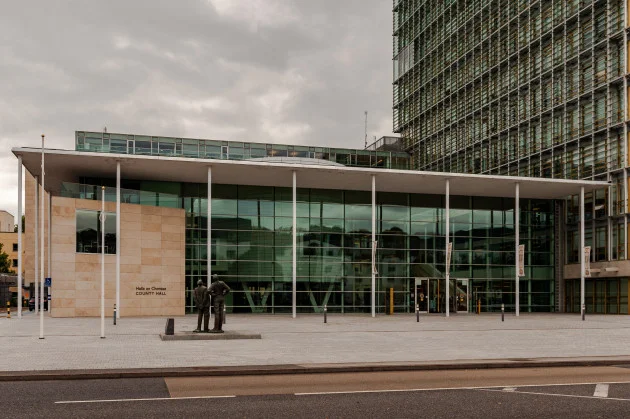
CORK COUNTY COUNCILLORS have voted overwhelmingly in favour of variations to the local authority’s development plan, including a language condition that would set aside 66% of housing developments for daily Irish speakers, at a special meeting on Friday.
The language condition approved by councillors on Friday will apply to all proposed new housing developments of two houses and more to go ahead in Cork Gaeltacht areas. The language condition was among a number of variations which got the green light at the special meeting of the Council.
Another proposal given approval included a variation to rezone additional land in the county to allow for the building of up to 10,000 extra homes. All of the proposed variations were passed without opposition and just a small number of abstentions.
However, the language condition is unlikely to last long as it conflicts with a National Planning Statement (NPS) on Gaeltacht housing issued in June, which will mean a significant reduction in housing being set aside for daily Irish speakers.
As there are Gaeltacht areas in counties Kerry, Galway, Mayo, Donegal, Meath and Waterford, the local authorities in each of these counties will all have to ensure their development plans are brought into line with the NPS.
Under the NPS, the number of houses to be set aside for daily Irish speakers will be equivalent to the percentage of people who said in the Census that they speak Irish every day, plus 10%.
In response to a query from The Journal, the Department of Housing, Heritage and Local Government issued a statement indicating that this additional 10% was being set aside for daily Irish speakers “not only to maintain daily use of Irish but to increase it”.
The same response states, however, that the National Planning Statement on Gaeltacht housing will come into effect during the autumn.
In the Cork Gaeltacht, there are two language planning areas, Muskerry and Cape Clear. The housing allocation of 66% will, in due course, be reduced from the 66% that councillors voted for on Friday to 33% and 35% respectively.
Previously there had been no langauge condition in Cork and Mayo while such clauses had been introduced by councils in Kerry, Galway and Waterford and were re in the process of being introduced in Meath and Donegal.
The Journal asked the Department what linguistic or scientific basis there was for the decision to set the language plan provision at a percentage equal to the number of daily Irish speakers plus 10%, but no direct answer was given to that question.
“The new Statement will, when finalised, provide more clarity and consistency on the development of new housing in Gaeltacht areas, by setting out standardised criteria for assessing local rural housing need and introducing standardised language competency assessments to prioritise Irish speakers,” the Department spokesperson said.
“With regard to the specific language criteria set out in Section 5.2, Proposals for Multi-Unit Housing in Gaeltacht Areas, the draft NPS proposes a single national approach by which the percentage of units required to demonstrate language competency for multi-unit proposals will be based on the number of daily speakers in the Gaeltacht Language Planning Area in which the development is to be situated.”
The response from the Department of Housing stated that this approach had been developed in partnership with the Department of Rural and Community Development and the Gaeltacht, and furthermore that the development of this approach had the support of an interdepartmental group on which there were representatives from both Departments along with Údarás na Gaeltachta and the eight local authorities with a Gaeltacht area.
The statutory authority for national planning statements such as this is contained in the Planning Act enacted in 2024 which came into effect in October of last year, the statement says.
“Following publication of the final NPS, local authorities will be required under Section 61 of the Act to submit a report to the Office of the Planning Regulator (OPR) within two months setting out its view as to whether its development plan is materially consistent with the National Planning Policies and Measures and, where necessary, take steps to address any material inconsistencies.”
Under the legislation, the local authorities have six weeks to resolve any inconsistency and it falls to the chief executive to draft a resolution for a vote by the councillors to amend the plan again so that it would be consistent with the National Planning Statement.
In the event that the Council votes against the amending resolution, the Planning Regulator can make a recommendation to the Minister, and it is the Minister who will have the final say on whether to direct or not direct the Council regarding bringing the development plan into line with the National Planning Statement.
The Department of Housing also clarified whether there would be a public consultation on the National Planning Statement on Gaeltacht housing.
The Department spokesperson’s response said that there would be a public consultation process on strategic environmental assessments and other appropriate assessments before the finalised version of the NPS would be adopted.
While there is a provision in the NPS for a language impact statement from the developer regarding the potential impact a housing development could have on language transmission in the area, there is no requirement for a language impact assessment that would have the same legal standing as an environmental impact assessment. It is therefore unclear whether a public consultation process on the NPS would be required on that basis.
“The final NPS will have immediate effect for the purposes of decision-making on planning applications by local authorities and An Coimisiún Pleanála, under the provisions of Part 4 of the Act of 2024, which relate to development consents and are due to commence in Autumn 2026.”
The Journal’s Gaeltacht initiative is supported by the Local Democracy Reporting Scheme.
This article was originally written in the reporter’s native Irish and has been translated to English here. AI was used as part of the translation process before final edits.
To embed this post, copy the code below on your site