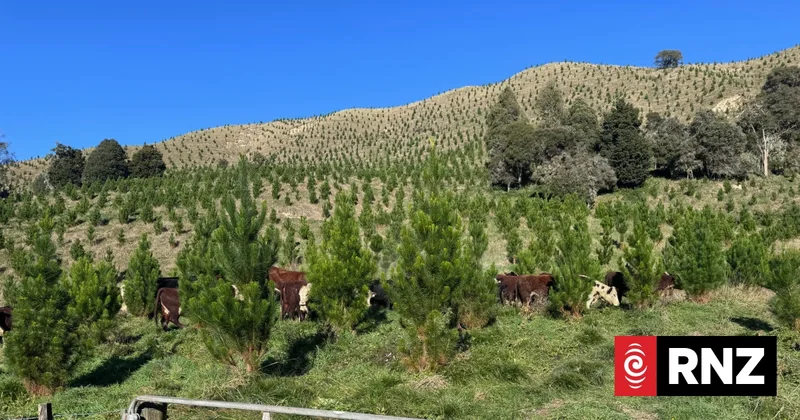
Farmers Sam Hain and Matt Long are busy poisoning pine trees on their new block of land near Gisborne.
They are pushing back against pines by transforming a forest planted on an original sheep and beef farm four years ago, and returning it to livestock farming.
The farm's woolshed, farmhouse, gates and fences have all long gone, they ruled out sheep, but cattle are part of the transformation.
Sam Hain admits he's in uncharted territory. The lack of fences had not put him off off the immense task of getting the land back to a productive beef farming operation.
It's a radical move. An agricultural consultant RNZ spoke to said he had not heard of any other cases of forestry conversions returning to farmland.
Carbon conversions have been widely criticised by farming groups like Federated Farmers for increasing forestry slash and wildfire risks, while also taking away local jobs.
After years of watching forestry taking over in his district, Hain said he was pleased "they've managed to buy one back".
"It's the heartland of farming country but it's sadly getting taken over by pine trees and some of which are just for carbon," Hain said.
He was working in partnership with his wife Gemma and fellow farmers Matt and Kate Long.
The 400 hectare property was entirely covered in young trees, with around 650 cattle now grazing the land to control the younger pines.
"It's certainly not going to be easy," said Hain, who will use virtual fencing collars on the cattle, which helps get around the absence of the farm's old fences.
Heavy machinery will help destroy younger pines on accessible land, while older trees are poisoned, leaving them to rot.
"There's 75 hectares of relatively flat land where I can mow the trees with the tractor - we'll be absolutely flat out farming beef cattle on those."
"Unfortunately we can't have sheep, because with a complete lack of infrastructure it's just too expensive to get them going.
"It's got no house, the woolshed has been bulldozed for the new state highway, and when they planted the pine trees they took all the gates out."
Beef and Lamb NZ data showed New Zealand's red meat sector generated $17.5 billion (4 percent) in GDP last year, and supported a total of 120,580 jobs, or 5 percent of total employment in New Zealand.
The farming group says forestry conversions make it harder for rural communities to retain people and skills, in turn reducing local spending, school rolls, rural services, and reducing agricultural production.
According to a consultancy, Orme and Associates, 330,000ha of whole sheep and beef farms have been confirmed as sold for forestry over the past decade - that's roughly six times the size of urban Auckland.
Recent statistics from the Overseas Investment Office (OIO) show last year foreign investors purchased more than 106,000ha of land.
Meanwhile, furniture giant Ikea's parent company Ingka Investments owned 43,000ha of forests in New Zealand. In June the OIO reported it had added the 350ha Taringatura Forest in Southland to its portfolio.
A consultant said if an existing forest burned, livestock farming could be an option to restore blackened hillsides to pasture. But he cautioned more mature forests come with significant carbon liability costs, making them expensive to take on.