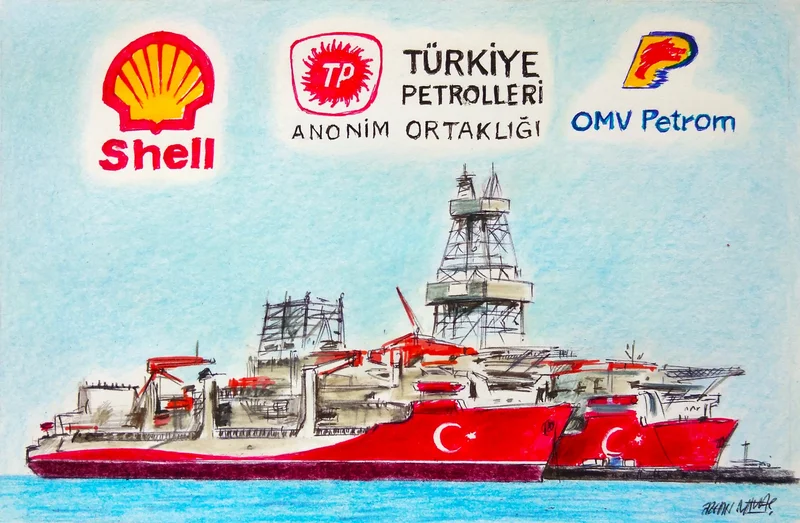
On July 31, the government of Bulgaria approved the transfer of 33% of the rights and obligations in the Khan Tervel offshore exploration license to Turkish Petroleum’s overseas subsidiary, TPOC. The decision’s finalized partnership structure presents Shell as operator holding 42%, while TPAO has 33% and OMV Petrom has 25%. Covering nearly 4,000 square kilometers in Bulgaria’s exclusive economic zone, the block lies relatively close to Türkiye’s giant Sakarya Gas Field. The partners will first begin with collecting and assessing 3D seismic data, and then an exploration well may follow if the results are promising.
The agreement does not, of course, guarantee a commercial discovery. Offshore exploration is both a costly and inherently uncertain process. Yet, its strategic value begins well before the first cubic meter of gas is produced. Costs and geological risks will be shared, new data will be collected, and three companies with different strengths will work on the same project. Türkiye will also carry the experience gained in its own waters into the maritime jurisdiction of a neighboring EU country.
Only a few years ago, discussions on Türkiye’s energy security focused almost entirely on import bills, pipelines and long-term contracts. These issues remain important, but they no longer tell the whole story. The National Energy and Mining Policy announced in 2017 placed domestic exploration and production at the center of reducing external dependence. The Sakarya gas discovery and rising oil production in Gabar showed what this policy could deliver. Sakarya, in particular, gave TPAO experience across the offshore value chain, from seismic surveys and deep-sea drilling to field development and production. Now, Türkiye is therefore moving beyond managing import dependence. It is gradually building the capacity to own, develop and produce resources at home and abroad.
The next step was to take this experience beyond Türkiye’s borders. Somalia is the clearest example of this internalization. The offshore agreement signed in 2024 marked TPAO’s first entry into Africa. Following seismic studies, the Çağrı Bey drillship began work at the Curad-1 well in April 2026, launching Türkiye’s first deep-sea drilling mission abroad.
The agreement with Hungary’s MOL in April 2025 had already opened another door, enabling TPAO to conduct upstream activities at the Buzsak and Tamasi fields and establishing its first such presence in Europe. And the recent agreement with BP in Iraq added another dimension. TPAO acquired a 15% interest in BP Energy Company of Kirkuk Limited and became a partner in the redevelopment of the Baba and Avanah domes together with the Bai Hassan, Jambur and Khabbaz fields. The project’s initial phase is estimated to contain more than 3 billion barrels of oil equivalent. Türkiye is therefore no longer involved in Iraqi oil only through the pipeline to Ceyhan. It now has a direct stake in production. These projects differ in geography and scale, but they follow the same logic. TPAO is moving from cooperation documents to equity participation, drilling and production. This is the real meaning of its internationalization.
The Bulgarian partnership was formally created through Shell’s transfer of part of its license rights, while Sofia provided the regulatory approval. Yet that approval still reflects confidence in TPAO, which brings three advantages: proximity, knowledge of the same geological basin, and offshore experience proven at Sakarya. More importantly, its location can also reduce logistical burdens and make coordination easier.
The consortium itself is well balanced. Shell contributes global deep-water expertise while OMV Petrom brings decades of experience in the western Black Sea, including the Neptun Deep project. And finally, TPAO adds operational knowledge from the southern part of the basin. Thus, it’s clear that the partners’ capabilities are complementary.
For Bulgaria, which was fully dependent on Russian gas until 2022, the search for domestic resources is part of a broader effort to diversify its gas supply. Although exploration will not answer its immediate energy needs, a commercial discovery could eventually provide a new source of gas, investment and public revenue. For Türkiye, the Khan Tervel project expands access to resources beyond national borders and strengthens TPAO’s position as an international partner. For the wider region, Southeastern Europe in particular, any future production could contribute to supply security and make better use of the growing interconnections between Türkiye and European markets.
Khan Tervel should therefore be viewed as more than another exploration block. It connects Türkiye’s domestic success in Sakarya with its wider energy diplomacy. From Somalia to Hungary and now Bulgaria, the direction is increasingly clear: Türkiye is evolving from a country known mainly as an energy corridor and import market into a country that also explores, produces and shares upstream risk. Bulgaria’s recent approval is a meaningful recognition of that change.