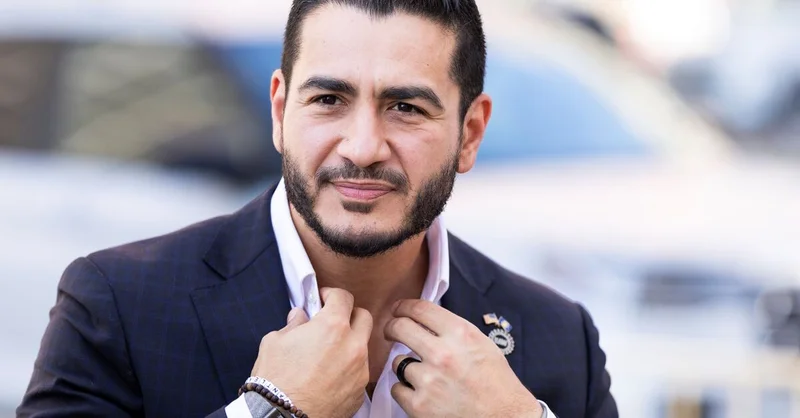
AIPAC to oppose El-Sayed after major Michigan primary victory
The America Israel Public Affairs Committee said it will work to oppose Abdul El-Sayed’s “radical anti-Israel agenda” as his opponent seeks to paint him as extreme.
A prominent pro-Israel group said Wednesday that it will oppose Abdul El-Sayed’s Senate campaign in November after the pro-Palestinian progressive narrowly won Michigan’s Democratic primary.
What happened: The American Israel Public Affairs Committee (AIPAC) issued a statement congratulating what it described as 30 pro-Israel candidates who won their primary elections Tuesday night. They included incumbent Democratic Rep. Wesley Bell of Missouri, who again defeated former Rep. Cori Bush, a critic of Israel and former member of the progressive group known as the "Squad."
Responding to El-Sayed’s victory, AIPAC said, “Our members remain determined to ensure that voters reject Dr. El-Sayed and his radical anti-Israel agenda in November.
“Through AIPAC, millions of American citizens will keep working to help elect pro-Israel leaders and to help defeat anti-Israel detractors between now and November, and in many cycles ahead,” the committee said, adding that it was “encouraged” by Tuesday’s overall results.
El-Sayed, a physician and public health professional whose parents are from Egypt, defeated Rep. Haley Stevens in the Democratic primary for the seat being vacated by retiring Sen. Gary Peters. El-Sayed won 48.5% of the vote to Stevens’ 47.5%.
Although some polls last month showed El-Sayed defeating Stevens by a comfortable margin, he ultimately won by around 14,000 votes.
Stevens was backed by AIPAC, and the organization and its affiliated groups spent around $30 million supporting her campaign, according to The Associated Press.
El-Sayed comes from Michigan’s large Arab American community and would become the first Muslim American elected to the US Senate if he defeats former Republican Rep. Mike Rogers in November’s general election.
Why it matters: Criticism of Israel was a prominent part of El-Sayed’s campaign, alongside his opposition to the Iran war and his focus on domestic issues, such as affordability.
He has described Israel as an apartheid state and alleged that the Israeli military campaign against Hamas in Gaza constituted genocide. According to his campaign website, El-Sayed opposes US military aid to Israel, Saudi Arabia, the United Arab Emirates and Egypt, while supporting aid to Ukraine.
Some human rights organizations, including Israel’s B’Tselem, have said that Israel’s occupation of the West Bank amounts to apartheid. South Africa brought a genocide case against Israel at the International Court of Justice in late 2023 over the Gaza war, though the Hague-based court has yet to issue a final ruling. Israel rejects both allegations.
In an April interview with CNN, El-Sayed called both Israel and Hamas “evil.”
He also targeted AIPAC during the primary, saying during a debate in July, “For too long, our foreign policy has been handed to us by the likes of the state of Israel and AIPAC.”
AIPAC could seek to capitalize on concerns among some Jewish voters in Michigan about comments El-Sayed made during the campaign.
Rabbi Jen Lader of Temple Israel criticized El-Sayed in April over his response to an attack on the suburban Detroit synagogue the previous month. In an op-ed published by The Free Press, she accused him of “suggesting that violence against a synagogue in suburban Detroit could be understood through the lens of Israeli action.”
The synagogue was targeted in a vehicle-ramming attack in March that the FBI described as a “Hezbollah-inspired” act. The assailant, who was the only fatality after shooting himself, had reportedly lost family members in an Israeli strike in Lebanon.
El-Sayed told reporters in April that "nothing justifies the heinous attack," adding that "hurt people do hurt people, and the circumstances happening 6,000 miles away can affect the lives that we live here."
Rogers intensified his campaign against El-Sayed on Wednesday, calling his opponent an “extremist” and highlighting his association with controversial streamer Hasan Piker.
“I spent years hunting terrorists and bringing Osama bin Laden to justice,” Rogers, a former FBI agent, said in a statement. “Never in a million years did I think that I would be running against someone who believes America deserved 9/11.”
Piker, who strongly supported El-Sayed during the primary, said in 2019 that the US “deserved” the Sept. 11 attacks, though he later apologized for the comments.
El-Sayed declined to condemn Piker’s comments during an April interview with Politico, saying, “I’m not here to disavow people’s views. This whole gotcha game, platform policing, cancel culture — I thought we were over it.”
Several prominent Michigan Democrats have endorsed El-Sayed following his victory, including Sen. Elissa Slotkin. Slotkin criticized him during the campaign over his association with Piker but endorsed him shortly after the primary result was announced Wednesday.
El-Sayed is among several __pro-Palestinian____ __progressive candidates who have won significant Democratic congressional primaries this cycle. Melat Kiros won her primary in Colorado in June, while three candidates backed by New York City Mayor Zohran Mamdani won their races that same month.
Know more: Polling indicates that negative views of Israel have risen sharply among Democrats. An April survey by the Pew Research Center found that 80% of Democrats and Democratic-leaning voters held an unfavorable view of Israel, compared with 53% in 2022, before the Gaza war.
AIPAC remains influential in US politics and played a significant role in helping Ed Gallrein defeat Rep. Thomas Massie in the Republican primary for Kentucky’s 4th Congressional District in May. Massie is a libertarian who opposes US support for Israel, along with several other Trump administration foreign policy priorities.