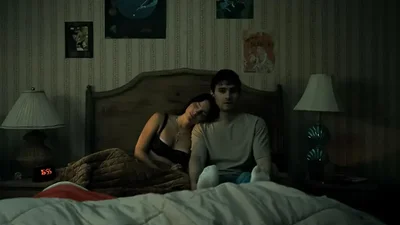
Another way the film reflects a problem in relationships today is how we mistakenly think we know someone just from being easily accessible or connected to them.
As the film progresses, it becomes clearer that Bear is more than willing to accept a version of Nikki that isn't really her at all, so long as she continues loving him. In doing so, he never has to grapple with who she really is or whether the feelings he's projected onto her are ever returned.
Bear has known of Nikki for years. They work together, joke during shifts and share several mutual friends. He scrolls through her social media, tries to notice little details about her life and speaks about her as though he understands her.
But seeing someone's Instagram Stories or spending hours with them at work doesn't mean we know how they think, what their anxieties are or what they’re really like in a relationship. It certainly doesn't immediately tell us how they feel about us.
Bear refuses to confront that. Instead, he clings to the post-wish version of Nikki he's already imagined.
When his friends point out that Nikki has been lying and is behaving "strange", "weird", and unlike herself, Bear brushes them off. Even as her behaviour becomes increasingly possessive and violent, he remains convinced that this is still the woman he's wanted all along. Ironically, despite Bear spending years wanting Nikki, the moment she stops acting like herself, he barely notices.
Real Nikki is complicated. She might reject him. She might only ever see him as a friend. She might turn out to be different from the person he's imagined after years of pining for her from afar.
The possessed post-wish Nikki demands none of that. She exists solely to validate Bear's fantasy. She never disagrees with him, never leaves him and never exercises the very agency that makes her a person rather than a mere object of affection.
It's an unsettling exaggeration of how relationships in the modern world can sometimes unfold.
With the internet and social media at our fingertips, we can learn someone's interests before we meet them. We follow their daily routines online, and we can piece together a version of who they are from photos, videos and passing conversations. Sometimes, we fall for that carefully assembled picture instead of the person standing in front of us.
Real intimacy doesn't work like that. It asks us to keep discovering another person, to accept that they'll surprise – and even disappoint – us. It requires us to recognise that they'll always remain more complex than the story we've written about them in our heads or our screens.