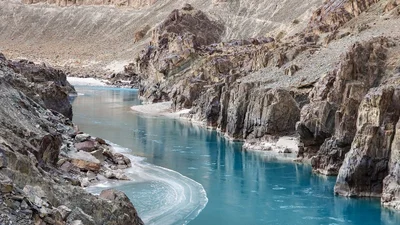
India is stepping up work on multiple projects in the Indus basin, countering Pakistan's vehement and consistent victimhood narrative to berate New Delhi over the decision to suspend the water treaty, officials told India Today. Besides, India is open, at least in theory, to the option of exiting the treaty if required, citing raison d’etat (reason of state) wherein a nation's foreign policy is purely influenced by its interests and stability.
According to a senior government official, projects at various stages of implementation in Jammu and Kashmir are expected to add around 5,300 MW of capacity, against the Indus basin's existing operational capacity of 3,300 MW. India has accelerated several projects since suspending the Indus Waters Treaty (IWT) with Pakistan after the Pahalgam massacre last year, with Pakal Dul and Kiru likely to be completed this year. Additionally, Kwar and Ratle hydroelectric projects are expected to be operational next year. All these projects are based in the Kishtwar district of J\&K. India has also restarted work on the Tulbul Navigation Project in J\&K's Sopore, which Pakistan has opposed for decades and was stalled by Islamabad in 1987 citing the water treaty.
Emphasising the raison d'etat, a senior official said that India cannot be "compelled to stay in a treaty that is demonstrably not in New Delhi's interest". The official further said that any future renegotiation of the treaty would not restore the pact "in its present form" and needs to be renegotiated in a modified format subject to Islamabad credibly and irrevocably halting its support for terrorism against India. Officials told India Today that New Delhi sought renegotiation under Article XII(3) in 2023 and renewed that invitation both before and after the Pahalgam attack, but has received no substantive response from Islamabad.
Government sources told India Today that New Delhi has so far shared details of as many as 79 projects with Pakistan under the treaty's provisions and that Islamabad has historically objected to nearly all of them, irrespective of scale. Senior officials said the first objection came in 1962, barely two years after the treaty was signed, over a project of just 200 kilowatts. That dispute took nine years to resolve despite what officials said was a negligible impact on downstream flows.
Officials also pointed to what they described as a double standard on reservoir maintenance. The Salal Dam on River Chenab is now nearly 95 per cent silted, leaving barely 5 per cent usable storage and well below its designed power-generation capacity, they said. To recover some of this capacity, India uses flushing and de-silting techniques that have previously been endorsed by international experts. However, Pakistan routinely objects to these techniques in Indian project filings despite using identical methods on its own reservoirs.
Officials said data from the Indus Water Commission presents a picture sharply at odds with Pakistan's claims on the treaty. Pakistan receives an estimated 135–140 MAF of water annually but has the canal capacity to divert only about 104 MAF. This means roughly 35 MAF, more than India's entire treaty share of 33 MAF, flows unused into the sea every year, officials added. They said that long-term Pakistani government data puts this figure closer to 27 MAF on a 50-year average, though last year alone saw more than 30 MAF discharged into the sea during the kharif season. Citing Pakistan's National Water Policy 2018, officials told India Today that of the 104 MAF that Islamabad does divert, only about 58 MAF reaches their farm gates, with roughly 46 MAF lost to conveyance losses and seepage.
On storage, officials said Pakistan's reservoirs hold just 13.3 MAF, or about 10 per cent of its annual run-off, even as it draws over 50 MAF from groundwater to compensate. Sedimentation has further axed capacity, with Mangla having reportedly lost around 12 per cent of its storage to silting and Tarbela close to 38 per cent, they added. By contrast, India, which receives about 33 MAF under the treaty, stores 13.41 MAF thereby translating to roughly 45 per cent utilisation efficiency of its available share. The officials also flagged Pakistan's interprovincial water disputes, saying Punjab and Sindh are each allocated 37 per cent of shares, but the former draws more than half the total, a domestic distribution issue that is often characterised on international platforms as an India-caused shortage.
Officials told India Today that the 1960 preamble of the treaty was explicitly grounded in "goodwill and friendship" between the two neighbours, a basis that Pakistan has since eroded. They further said that, through decades of cross-border terrorism, Islamabad had not honoured the spirit of the pact.
When it comes to dispute resolution, the treaty provides a graded mechanism beginning with commissioner-level talks, followed by secretary-level engagement, then referral to a Neutral Expert, and only, as a last resort, a Court of Arbitration. India had been participating in the Neutral Expert process, officials said, but suspended that after the treaty was put in abeyance because site visits and related procedural steps could no longer be carried out.
However, Pakistan bypassed this sequence by approaching the World Bank directly for a Court of Arbitration, which India considers illegally constituted and thus, does not recognise. Officials said the World Bank's decision to allow both the Neutral Expert and the Court of Arbitration to proceed simultaneously on the same questions was a serious "institutional misjudgment", and that New Delhi does not consider itself bound by any awards from either track. They also noted that, unlike the treaty with Pakistan, India has no comparable treaty mechanism with China on the Brahmaputra, though an expert-level arrangement on data sharing exists.
- Ends
Published On:
Jul 21, 2026 08:11 IST