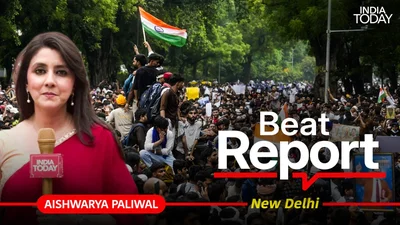
The day began with one certainty: it wouldn't be routine. The opening day of Parliament session is rarely uneventful. This time, it carried even more weight.
On Day 1 of Parliament, the silence inside felt louder than the slogans outside. For weeks, the Opposition had been raising a host of issues. Outside Parliament, the Cockroach Janta Party (CJP) had called for a massive 'Chalo Sansad' march. Having covered several protests in the national capital over the years, I knew the streets wouldn't remain quiet. If the battle outside was about numbers, the battle inside would be about strategy.
I reached Parliament early. What I didn't know then was that over the next few hours, I would witness two parallel stories unfolding -- one on Delhi's streets and another inside the country's most powerful corridors.
A CITY UNDER BARRICADES
The closer I got to Parliament, the clearer it became that this wasn't going to be an ordinary session.
Central Delhi had turned into a fortress. Barricades stretched across roads. Police personnel stood at almost every turn. Around Le Meridien and Railway Bhavan, security was impossible to miss.
By 9.45 am, I entered the Parliament complex and made my way to Makar Dwar.
Exactly as the clock struck 10, MPs began arriving. One after another, they stepped out of their cars, not talking about legislation or politics, but about the traffic. Almost everyone had a story about the massive jams they had endured before reaching Parliament.
Sometimes, the mood of the day reveals itself long before the House assembles.
TWO NARRATIVES, ONE PARLIAMENT
The divide inside Parliament was as visible as the barricades outside. Opposition MPs largely viewed the CJP protest sympathetically. NDA leaders, however, argued that the demonstrations were inconveniencing ordinary citizens.
The contrast wasn't subtle, it was striking.
Congress leaders chose their words carefully whenever they were asked about the protest. The Samajwadi Party, however, looked ready. I noticed party president Akhilesh Yadav walking alongside Ayodhya MP Awadhesh Prasad. The two were deep in conversation, clearly discussing the day's strategy.
Then came another moment that caught my attention.
As reports of swelling crowds outside Parliament began trickling in, I saw Dimple Yadav speaking with Akhilesh Yadav and other Samajwadi Party leaders. Minutes later, the women MPs moved away together.
At around 11.20 am, Dimple Yadav led a march inside the Parliament premises, holding placards alongside other women MPs from her party.
While several Opposition parties appeared to be weighing their options, the Samajwadi Party had already made its move.
Sometimes, politics isn't announced from a podium, it begins with who starts walking first.
Behind closed doors, the government was moving just as fast.
At around 11:30 am, I went back inside Parliament. The atmosphere had changed. Meetings were happening simultaneously. Corridors buzzed with hurried conversations. Officials walked briskly between offices.
The corridor outside Home Minister Amit Shah's chamber had become one of the busiest spots in Parliament.
Union Minister JP Nadda met Amit Shah before leaving Parliament around 11.40 am for his residence, where he held the first round of talks with CJP representatives. Soon after, Union Education Minister Dharmendra Pradhan entered Amit Shah's room.
The government was clearly working on its response even as events continued to unfold outside.
THE FIRST NEGOTIATION
The first meeting between JP Nadda and CJP representatives had begun earlier, around 11.50 am.
When I learnt that Nadda had left Parliament, I made a series of calls. People familiar with the discussions told me that Nadda first asked the representatives what exactly their demands were. They presented a list.
He then asked why those demands had not been submitted in writing and requested a written memorandum.
It wasn't a breakthrough. But it was the beginning of a conversation.
Then, suddenly, everything changed.
Around 12.30 pm, while I was speaking with BJP leaders about the government's next move, something unusual caught my eye. CISF personnel began running across different parts of the Parliament complex. Not walking. Running.
Within minutes, security became noticeably tighter.
By 12.40 pm, the Parliament gate near Vijay Chowk -- the entrance frequently used by MPs -- was shut.
Security personnel took positions. Weapons were visible. There was unmistakable urgency.
For a few tense minutes, I could feel anxiety ripple through the complex. The atmosphere suggested that security agencies were responding to rapidly evolving inputs from outside. Walkie-talkies crackled continuously. MPs were glued to their phones, trying to understand what was happening beyond Parliament's walls.
At the same time, the Rajya Sabha had been adjourned, and several MPs remained seated inside their vehicles while security assessments continued.
NORMALCY RETURNED, BUT ONLY ON THE SURFACE
By 1.10 pm, the gates reopened. The Prime Minister's cavalcade moved out. Around 1.20 pm, MPs began leaving in their vehicles. Traffic inside Parliament resumed.
But inside the corridors, the day was far from over.
As soon as I finished tracking the security movement, I rushed back. Almost immediately, I saw Dharmendra Pradhan once again heading towards Amit Shah's room.
The meetings hadn't stopped. Neither had the negotiations.
PRIYANKA GANDHI'S MESSAGE
At 2 pm, I returned to Makar Dwar. Priyanka Gandhi emerged with several Congress MPs. We reporters instinctively rushed towards her.
Asked about the protests, she criticised the government's handling of the situation.
"We are all asking for a discussion. There are problems and major issues with the education policy. Yet, you are unwilling to discuss it; instead, you are using tear gas on the students and beating them up. For what? They are our children," she said.
Outside, protests continued. Inside, political positions were becoming sharper.
FOUR HOURS OF STRATEGY
Inside Parliament, Amit Shah and Dharmendra Pradhan remained in discussions for nearly four hours. Around 3 pm, I also saw Union Minister Piyush Goyal entering Amit Shah's chamber.
Every movement seemed to indicate that the government was exploring options and attempting to find common ground.
Then, at around 4 pm, another phone call brought fresh information. Following the earlier discussions, CJP representatives had now submitted a written memorandum of their demands to JP Nadda.
By 4.30 pm, the meeting between Amit Shah and Dharmendra Pradhan concluded.
The day, however, ended without any assurance from the government on the CJP's three demands. Nadda urged the protesters to call off the agitation and cooperate with the administration in restoring normalcy.
Throughout the day, the government kept a close watch on developments. Officials monitored the protest continuously, and instructions were issued to the police and paramilitary forces to avoid using force -- or to use only the minimum force necessary if the situation demanded.
THE DAY THAT TOLD TWO STORIES
As I walked out of Parliament in the evening, I realised the day's biggest story wasn't just about a protest. It was about two Indias operating side by side.
Outside, slogans tried to force the gates open. Inside, conversations tried to keep the system together.
One side marched with placards. The other negotiated behind closed doors.
And somewhere between the barricades outside and the corridors inside, India's democracy played out another long, tense, and unforgettable day.
- Ends
Published On:
Jul 21, 2026 08:22 IST