There was a time when we called the monsoon month of Sawan by its name. In traditional lore, with its arrival, swings would appear in orchards. The air would be filled with the melodies of the kajri folk form and Raag Malhar. The Earth changed its attire as nature draped herself in a green veil.
Sawan meant relief and hope.
For farmers, Sawan is still Sawan. Even today, they call it by that name. Few other lives are bound to rain and drought as intimately as theirs. They await Sawan with particular longing. They know that the rhythm of cultivation changes with it.
Farmers know what the month means for paddy, maize, jowar, chana, black gram, cotton and other crops. Many of their festivals, too, fall in this month. There is Teej. There is Nag Panchami. The agricultural calendar and the Hindu ritual calendar have long lived together.
But we no longer inhabit that older sense of time. We now live within an official Hindutva calendar. It is no longer Sawan that begins but the auspicious month of Shravan. Every mention of Shravan must now be preceded by adjectives such as “holy, sacred or auspicious”.
Sawan has been stolen from ordinary people. Perhaps it would be more accurate to say that Sawan has been abducted. Its abductor is the Bharatiya Janata Party.
Over the past decade or so, Sawan has been subjected to a process of thorough Hindutvaisation. Governments led by the Bharatiya Janata Party welcome the sacred month of Shravan with full-page newspaper advertisements. It is as though Indians no longer learn of its arrival from the changing colour of the sky or the scent of wet earth, but from government announcements.
Nor is one advertisement considered sufficient. Governments repeatedly remind people that Shravan has arrived and is very much there. More than that, they also tell Hindus what their principal duty during the month is.
There was a time when Krishna exhorted Arjuna: “Rise, Partha. Lift your Gandiva.” Now, governments issue a different command. Shravan has begun. Rise, O Hindus. Raise your kanwar to your shoulders.
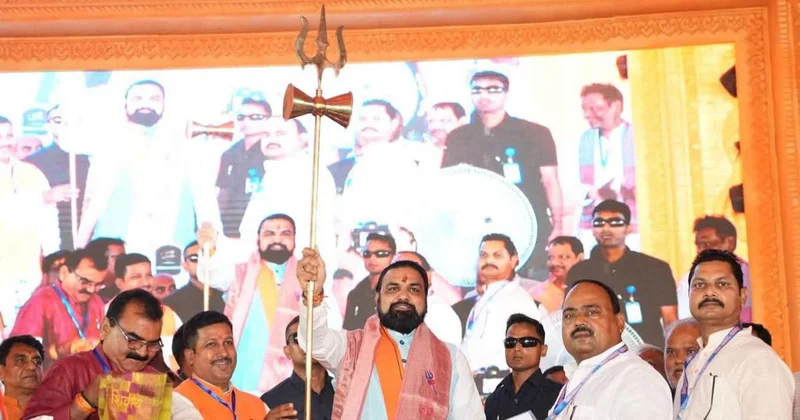
Take Bihar. On July 28, the Hindi newspapers in the state carried a full-page advertisement issued jointly by the Bihar government and its Department of Tourism announcing the inauguration of the Shravani Mela or Shravan fair.
Government advertisements in Bihar these days invariably come bathed in saffron and this one was no exception. At the top of the advertisement, next to the words “Shravani Mela” were a saffron triangular flag, a damru drum and a trident. At the centre was an image of Shiva himself, holding a trident in his hand.
The chief guest at the inauguration was Bihar’s chief minister, Samrat Choudhary. Among the distinguished guests were the two deputy chief ministers belonging to the Janata Dal (United), Vijay Kumar Choudhary and Bijendra Prasad Yadav. Several ministers of the Bihar government and many legislators were also listed as participants.
Earlier, on July 15, the Bihar government had released another advertisement. This one announced an “attractive prize scheme” to promote the Shravani Mela. The Tourism Department invited participants to "take the spiritual, cultural and tourism experiences of Shravani Mela 2026 to the world through your camera and creativity and win attractive prizes”. The first prize was at Rs 3 lakh, the second Rs 2 lakh and the third Rs 1 lakh. There were two fourth prizes of Rs 50,000 each and five consolation prizes of Rs 25,000.
Curious about the changing language of official celebration, we looked for last year's advertisement about the event. It was considerably smaller. There was no announcement of an inaugural ceremony. It merely informed devotees about the facilities that would be available between July 11 and August 9.
At the top appeared the line: “For the comfort of devotees, the Kanwar Yatra has now been made easier.” Below was the phrase “Shravani Mela”, accompanied only by a trident and a damru. Nothing more.
During the Kanwar Yatra, devotees walk hundreds of kilometres to collect water from the Ganga near Haridwar. They fill it into two pots balanced on a stick and carry this kanwar back to their home states to offer the water at temples. The Kanwar Yatra began on July 30 and will end on August 11.
The Bihar advertisement went on to list the facilities that Bihar Tourism had arranged to make the pilgrimage easier – night shelters, tent cities, medical camps, cafeterias, safe drinking water, fans, coolers, tourist assistance centres, kanwar stands, CCTV surveillance, toilets and a 24-hour helpline. On one side was an image of Chief Minister Nitish Kumar. On the other stood a few Kanwar pilgrims.
The difference between last year’s official welcome to Sawan and this year’s is not difficult to explain. Last year, too, Bihar was governed by the Bharatiya Janata Party-led National Democratic Alliance coalition. But the chief minister was Nitish Kumar. This year, the chief minister is from the BJP. Last year, in the government advertisement, Shiva did not carry a trident.
This year, the trident has been placed firmly in his hand.
Once upon a time, the Shiva of Sawan was the bearer of the damru. He was Bhole Baba. He no longer seems permitted to remain so. Both Shiva and his devotees are being absorbed into the machinery of the state.
Traditional kanwariyas call themselves “bam”. Chanting “Bol Bam” and carrying water, they journey towards Baidyanath Dham. Some run the entire distance. Some roll upon the ground. Some walk slowly, resting every few miles.
Today, they have been transformed into religious tourists. The government waits upon them. The BJP hopes to make worldly gains from the spiritual labour that these pilgrims undertake.
Even so, Bihar still places Hindus at the centre of its narrative.
In Uttar Pradesh, however, the government's attention seems fixed less upon Hindus than upon Muslims. Meat shops are being shut down. Hotels along the pilgrimage routes receive warnings to only serve vegetarian food. The very people who describe a single hour of collective Friday prayers on a public road as being an unacceptable obstruction to traffic now close highways and roads altogether for ordinary citizens. The roads are reserved exclusively for kanwariyas
Sawan has been stolen. Shankar, the lord of the three worlds, has been nationalised. In the larger project of transforming Hinduism into Hindutva, the appropriation of Sawan is only one stage.
Apoorvanand teaches Hindi in Delhi University.
Sami Ahmad is a journalist and a translator.
We welcome your comments at letters@scroll.in.