Hiroshima A-bomb girl inspiring Filipino children to fold peace cranes
The story of Sadako Sasaki, a Japanese girl who died of leukemia 10 years after being exposed to radiation from the 1945 atomic bombing of Hiroshima, has inspired children in the Philippines to fold origami peace cranes in a campaign to end war.
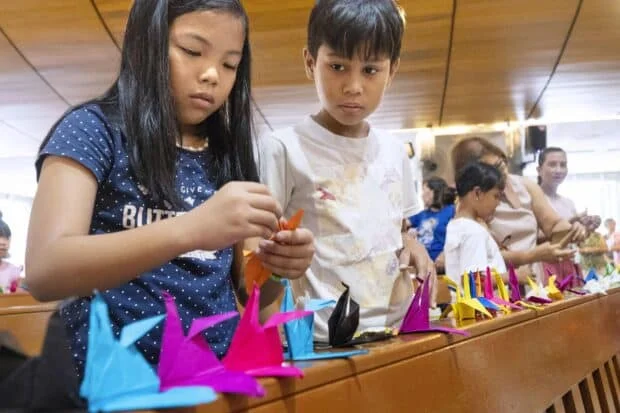
In events organized by Catholic priest Robert Reyes, the children gathered on two occasions, in late April and mid-May, in a church in Quezon City, north of the capital Manila, and folded over 1,000 colorful cranes. Reyes said they aim to promote peace “through something as simple as folding origami.”
The paper crane became a symbol of hope and peace after World War II, and that symbolism has taken on renewed significance over the years, particularly as conflicts such as the recent fighting involving Israel, the United States and Iran continue around the world.
Article continues after this advertisement
Sasaki was 2 years old when she was among the thousands exposed to radiation after the U.S. dropped the atomic bomb on the western Japanese city of Hiroshima on Aug. 6, 1945.
Believing a Japanese legend that folding 1,000 paper cranes would see her wish to recover granted, Sasaki made origami cranes until she died in 1955.
Reyes, 71, learned about Sasaki’s story when he visited Hiroshima Peace Memorial Park and Hiroshima Peace Memorial Museum in 2024. He was so moved by Sasaki’s story that he talked about the paper cranes in one of his Mass homilies in the Philippines.
A boy happened to be listening to Reyes’ homily and was inspired to make paper cranes, thinking it would grant him a wish. Grateful to the priest, the boy then gave Reyes several of his paper cranes as a gift in March.
Article continues after this advertisement
Reyes said it gave him the idea to organize origami activities for the children in his parish. He said it also felt timely to launch a peace campaign after U.S. and Israeli attacks on Iran began in February.
Article continues after this advertisement
“The war in Iran is creating repercussions worldwide. And we’re feeling it strongly (even) here in the Philippines,” Reyes said.
On April 21, a short program was held where the children offered a prayer for peace as they started making the paper cranes from the church pews. A video that depicted Sasaki’s life was also shown onscreen.
Leah Dacume, 16, who joined about 50 others, said she found Sasaki’s story “inspiring.” Another participant, Anica dela Torre, 10, said folding a crane made her feel like “helping stop the war.”
During the May 16 session, about 200 children participated and they were joined by Archbishop Charles Brown, the Vatican’s representative to Manila, who spoke to the children and promised to send some of their works to Pope Leo XIV in Rome.
Brown told reporters that he found Sasaki’s story “beautiful” after hearing it for the first time from Reyes.
In his speech to the children, he said, “When war happens, many bad things happen to people, especially children. We want war to stop and peace to reign, continue and spread throughout the world.”
In the early years of his priesthood, Reyes had run marathons across his country to draw attention to causes including environmental conservation, clean governance, justice and peace.
With many parts of the world still in turmoil or at war, Reyes said the peace cranes are a “creative” way to get the message of peace across, and he believes that if more children become involved, they could be a “powerful” voice to influence government leaders and policymakers.
“Hiroshima and Nagasaki should be remembered now, especially now,” Reyes said, adding that he hopes to continue the peace crane campaign by tapping other parishes and children’s organizations in the Philippines. /dl