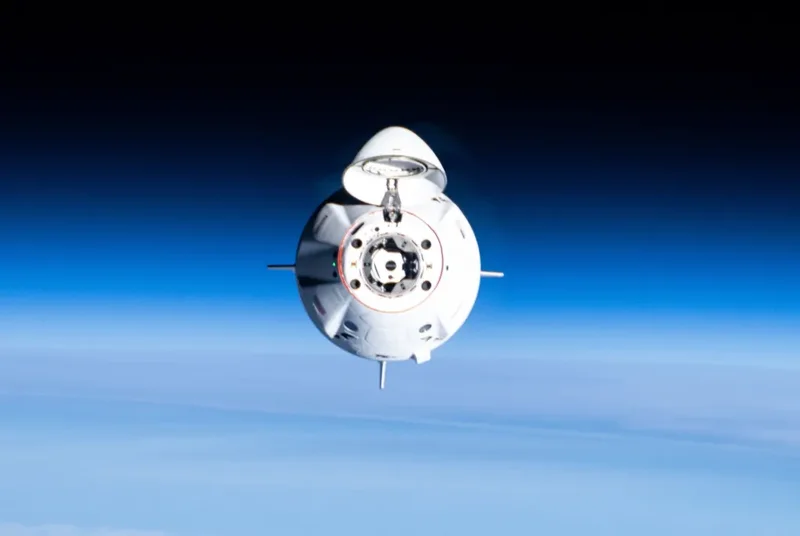
WASHINGTON — NASA and Roscosmos have agreed to continue exchanging seats between Soyuz and Crew Dragon spacecraft, but that agreement does not yet extend to Starliner.
Russian media reported in July, after a meeting between NASA Administrator Jared Isaacman and Roscosmos Director General Dmitry Bakanov, that the two had agreed “in principle” to extend an agreement between the agencies to barter seats between the two spacecraft on International Space Station missions. That allows NASA astronauts to fly on Soyuz while Roscosmos cosmonauts fly on Crew Dragon and thus ensures both NASA and Roscosmos personnel can remain on the station if either vehicle is out of service for an extended period.
NASA officials did not immediately confirm that report or provide a readout of Isaacman’s meeting with Bakanov. It was the first face-to-face meeting between the two and also marked the first visit by a NASA administrator to Russia or the Baikonur Cosmodrome in Kazakhstan since 2018.
During an Aug. 3 briefing about the upcoming Crew-13 mission to the ISS, whose crew again includes a Russian cosmonaut, NASA officials confirmed that they have extended the seat barter agreement but provided few details about the extension.
Dana Weigel, manager of NASA’s low Earth orbit program, said the agencies work about 18 months ahead on missions. “We work on a shorter horizon with all our agreements, so we are covered for a number of missions with the exchanges,” she said.
She said she did not know the specific missions included in the agreement, and officials said at the briefing they would later provide that information. As of the end of the day Aug. 5, the agency had not provided those specifics.
Weigel, though, said the agreement does not, for now, include Boeing’s Starliner, which NASA has yet to certify for long-duration crewed ISS missions.
“We have not finished the work on Starliner. What they’re waiting to see is the rest of our flight and certification data,” she said. “They’d like to see that data before we go into it.”
NASA has been working with Boeing to address propulsion system issues seen on the vehicle’s last flight, the Crew Flight Test mission two years ago. Both NASA and Boeing officials said in recent briefings they were working to fly Starliner again on a cargo-only mission, perhaps before the end of this year.
The focus of the work has been on thrusters in Starliner’s service module that overheated while on approach to the station on the previous flight, said Richard Jones, deputy director of NASA’s commercial crew program, at the briefing. That includes installing structures called thermal shunts to direct heat away from the thrusters as well as insulation on the thrusters themselves.
“These changes have proven themselves in the White Sands ground testing,” he said, referring to the New Mexico facility used for Starliner thruster tests. “They have looked at those improvements and have definitely shown that the thermal improvements have taken shape in a planned form.”
“Boeing has done a great job making thermal modifications to the spacecraft,” Weigel said, adding that the testing of those modifications was still being closed out.
At the Crew-13 briefing, as at some previous briefings, NASA did not include the Starliner-1 cargo mission among the visiting vehicles headed to the ISS in the coming months. Weigel, though, said the agency has not ruled out flying it before the end of the year. That depends on both completing the work on Starliner’s thrusters and finding a spot in the schedule.
“We’re going to make sure that we’ve laid in all the right technical work and that we use that to drive the schedule,” she said. “But in terms of a space station flight plan and windows where I’ve got an open docking port, I’ve still got capability to fly Starliner in this year.”